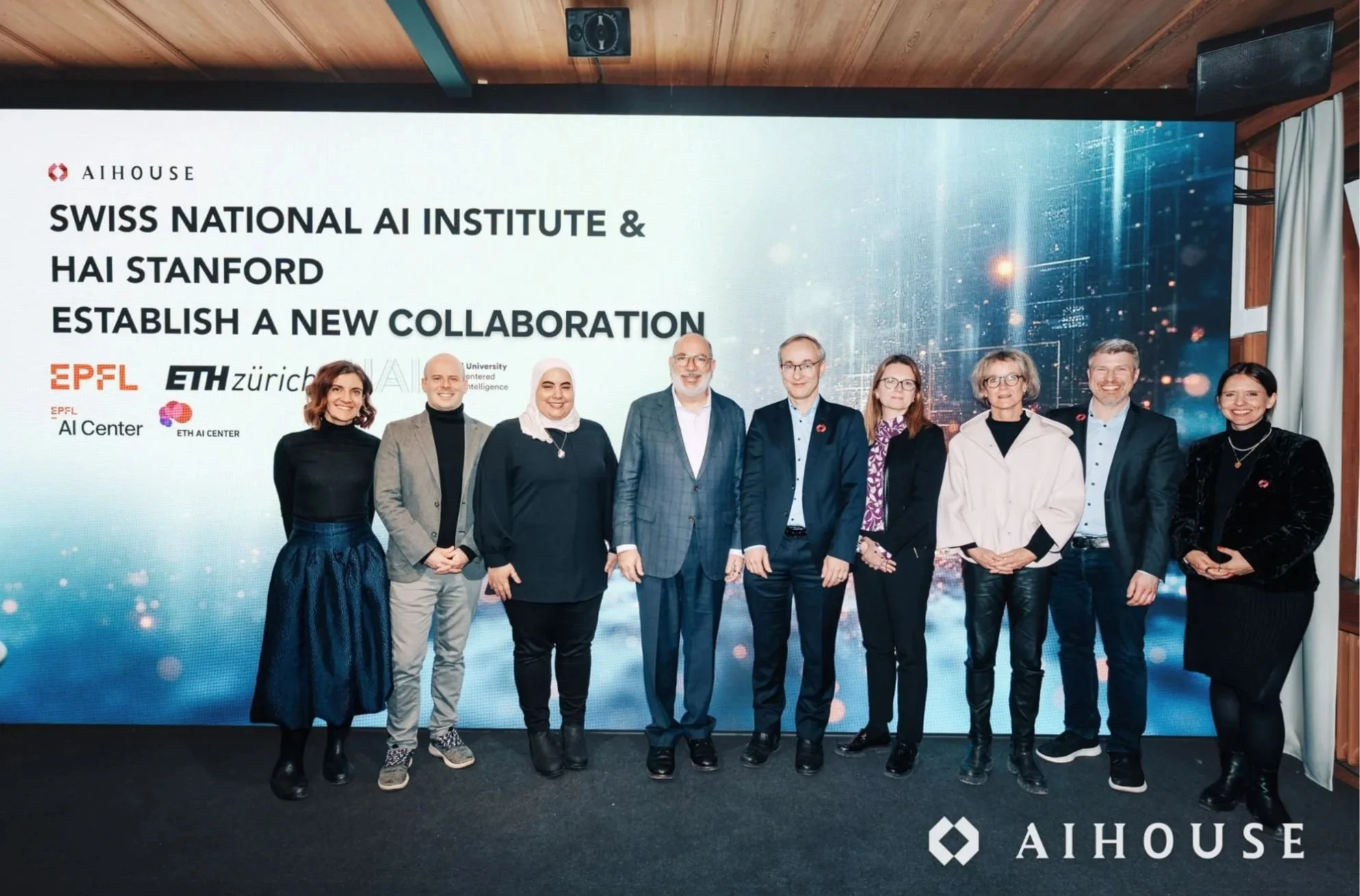
A Different Kind of University AI Announcement
Most university AI partnerships announced over the past year follow a familiar template: a single vendor, typically OpenAI, Google, or Microsoft, provides tools and infrastructure in exchange for institution-wide adoption and a marketing moment. The partnership formalized between ETH Zurich, EPFL, and Stanford HAI breaks that template. It is a research alliance between three academic institutions, with no commercial vendor as a signatory, built around open foundation models and shared research on human-AI collaboration rather than around deploying any single company's product across campus.
The agreement runs through the Swiss National AI Institute, jointly led by the ETH AI Center and the EPFL AI Center, and was announced during the World Economic Forum in Davos. The Davos setting matters less than the substance: this is three research institutions choosing to pool capability specifically so that no one of them, or any commercial lab, sets the agenda for how foundation models get built and evaluated. The timing also puts the announcement in direct conversation with the vendor-funded campus deals being signed at the same moment, offering a visible contrast for any reporter, or any CIO, paying attention to both.
The Explicit Goal Is Academic Independence
The language the signatories used to describe the partnership is unusually direct about its purpose. Annette Oxenius, Vice President for Research at ETH Zurich, said the agreement strengthens academia's ability to shape the future of foundation models, a phrasing that positions universities as a counterweight to commercial AI developers rather than as customers of them. James Landay, co-founder and co-director of Stanford HAI, described the alliance as uniting leading researchers across continents to advance human-centered AI, language that again centers the research mission over any product deployment.
Stéphanie Lacour, EPFL's Vice-President for Support to Strategic Initiatives, framed the ambition even more broadly, describing the work as laying the groundwork for a transatlantic research ecosystem that is open and inclusive. Menna El-Assady, an assistant professor at ETH Zurich and ETH AI Center faculty member, tied the mission to keeping human values and agency at the core of technical progress. Taken together, the quotes describe an alliance built to preserve academic standing in AI research, not to distribute a vendor's product faster.
What the Work Actually Looks Like
The partnership's planned activities are concrete even where its funding details are not yet public. The three institutions plan joint research projects, researcher exchanges between Switzerland and Stanford, open-source model development, and the creation of shared benchmarks for responsible AI evaluation and deployment. Open-source model development is the detail worth underlining: rather than building internal tools on top of a commercial foundation model API, the alliance is positioning itself to produce models the broader research and education community can inspect and build on directly.
Benchmarks are the other load-bearing piece. An institution's ability to evaluate whether an AI system is safe, fair, or effective for a given use depends on having benchmarks it trusts and did not simply inherit from the vendor selling the system. A shared, academically governed benchmark effort gives participating institutions, and potentially others who adopt the same standards, an evaluation framework that was not designed by the company whose product it is meant to evaluate. That independence is precisely what a university, or an enterprise procurement team, loses when the only available benchmark comes bundled with the tool being purchased.
Why Vendor-Funded Deals Still Dominate the Headlines
Vendor-funded campus rollouts remain more common than alliances like this one for a simple reason: they are faster to announce, easier to fund, and immediately visible to students and faculty through free tool access. A university accepting free ChatGPT Edu or Gemini for Education licenses gets adoption and a press moment in weeks. A multi-institution research alliance aimed at open models and independent benchmarks takes years to produce comparable deliverables, and its output is a research paper or an open model rather than a login screen students can use tomorrow.
That trade-off is exactly why this alliance is worth attention rather than skepticism about its pace. The vendor-funded path and the academic-independence path are not mutually exclusive, and most universities, La Trobe and SFBU among the recent examples, are pursuing vendor deals for near-term classroom access while a smaller set of research-heavy institutions pursue alliances like this one for longer-term independence. Both tracks are rational responses to the same underlying pressure, just on different time horizons.
The Governance Lesson for Any Institution Weighing Vendor Lock-In
For a CIO or university technology leader watching AI vendor dependence accumulate across departments, this alliance demonstrates that a credible non-vendor track exists, even if it is not a fit for every institution's size or research capacity. It is a reminder that evaluation benchmarks and foundation model access do not have to come from the same company whose product is being evaluated, a conflict of interest that rarely gets named directly in vendor-funded campus deals, and one worth raising explicitly the next time a vendor offers to supply both the tool and the metric used to judge it.
The roadmap implication for enterprise technology leaders outside higher education is more modest but still real. Even organizations with no ambition to build their own foundation models can apply the same separation of concerns: source evaluation criteria and benchmarks independently from the vendor whose tool is being evaluated, rather than accepting a vendor's own claims about safety and performance as the only available yardstick. The ETH, EPFL, and Stanford HAI alliance is a university-scale version of a discipline every AI buyer should be practicing at a smaller scale already.