What Snowflake actually shipped
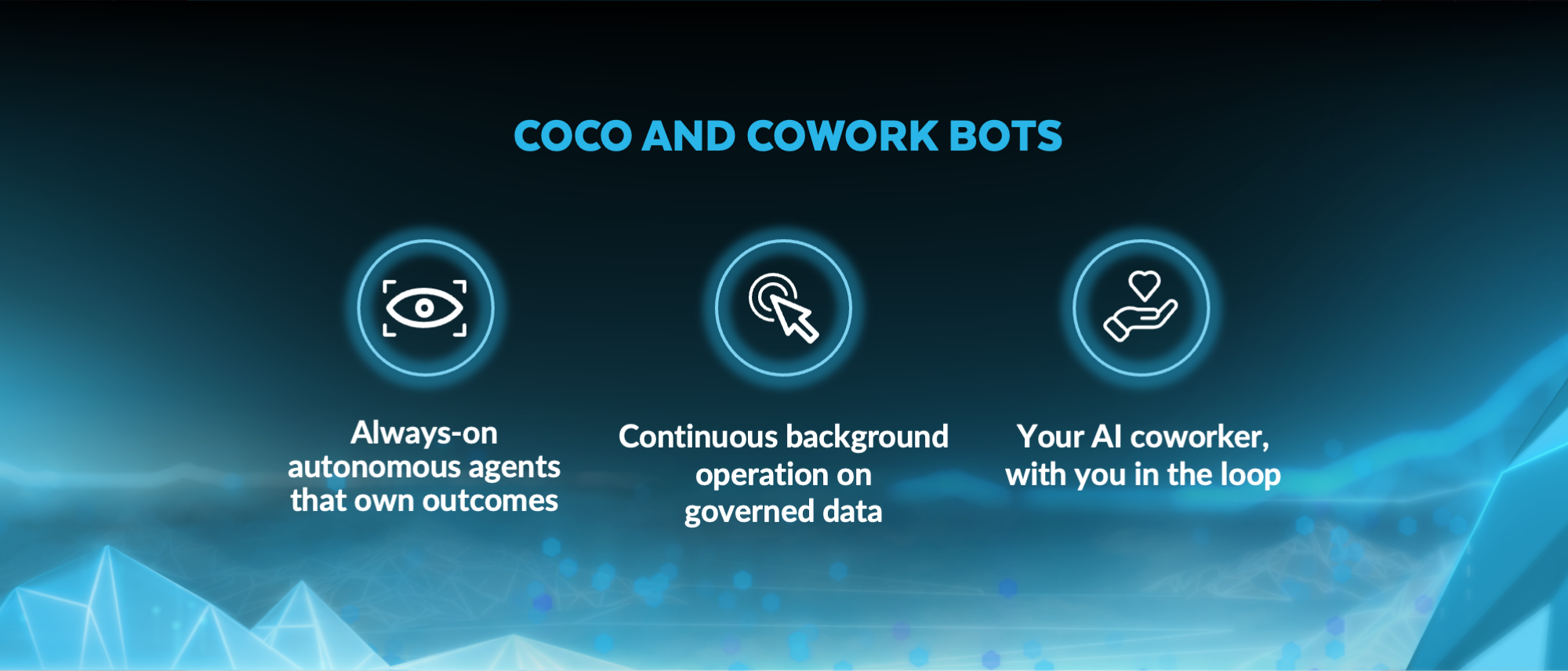
At its Expedition 2026 event, Snowflake introduced two named agents aimed at different users inside a data organization. CoCo is a coding agent built for data teams, handling the kind of data pipeline and query development work that previously required a human engineer to write and debug directly. CoWork is a personal agent aimed at knowledge workers more broadly, designed to handle data retrieval and analysis tasks without requiring the user to write queries themselves. Alongside both, Snowflake introduced Bots, background agents that act inside a user's existing tools under that user's own permissions and surface only when a decision requires explicit sign off.
Snowflake also launched Cortex Training, which lets enterprises fine tune open weight models inside their own governed environment rather than relying entirely on serverless third party fine tuning infrastructure, with Snowflake claiming up to 61 percent lower training cost than serverless alternatives. Taken together, this is a platform level bet that enterprises want AI capability embedded directly inside the data platform they already use for governance and access control, rather than layered on top through a separate AI vendor relationship.
The adoption numbers and what they actually show
Snowflake EVP Christian Kleinerman framed the pitch bluntly: the difference between agents that guess and agents that know comes down to data, and this is the agentic enterprise, built on Snowflake. The adoption figures backing that claim are notable in scale, CoWork used by more than 5,800 accounts and CoCo by more than 9,100 accounts on a quarterly average basis, across a base of more than 14,500 enterprise customers total. Those numbers suggest roughly a third to two thirds of Snowflake's enterprise base has at least tried one of these agents, which is a meaningfully higher adoption rate than most enterprise AI feature launches achieve in their first measured quarter.
The customer quotes Snowflake cited add useful texture to the adoption numbers. Docusign chief data officer Bala Sahejpal said the agents cut the company's data team's time to deliver value dramatically, while United Rentals chief technology and security officer Tony Leopold said what once took days can now be done in minutes. Both quotes point at the same underlying claim, meaningful time compression on existing data team workflows, which is the specific outcome any enterprise evaluating these agents should test directly against their own workload before taking the vendor's adoption figures as sufficient evidence of fit.
Why the Bots permission model is the detail that matters most
Bots acting inside existing tools under a user's own permissions, rather than operating with a separate elevated agent identity, is the governance design choice that should get more attention than the adoption numbers. This mirrors the same architectural pattern worth demanding from any enterprise agent platform: an agent that inherits the access boundaries of the human it is acting on behalf of cannot accidentally expose data that human was never authorized to see in the first place, which closes off an entire category of access control failure before it can occur.
The decision to have Bots surface only for sign off decisions, rather than running fully autonomously end to end, is equally deliberate. This keeps a human checkpoint at the specific moments where a decision carries consequences worth confirming, while automating the substantial volume of lower stakes work that does not require that checkpoint. For CIOs evaluating data platform agents broadly, this surface for sign off pattern is a reasonable minimum bar to hold any competing vendor to, regardless of whether you ultimately choose Snowflake's platform specifically.
What Cortex Training's cost claim means for your build versus buy math
The claimed 61 percent training cost reduction from running fine tuning inside Snowflake's own governed environment rather than through serverless third party infrastructure is a specific, checkable claim worth testing directly against your own fine tuning workloads before accepting it at face value. If that figure holds up under your own organization's usage patterns, it meaningfully changes the economics of a build versus buy decision for any enterprise currently paying for third party fine tuning infrastructure separately from its core data platform.
The governance angle matters here too, and may be worth more than the cost savings alone for regulated enterprises: fine tuning inside your existing governed data environment means the training data never has to leave the access control boundary you have already built and audited for your core data platform. That keeps a sensitive fine tuning dataset, which might include proprietary business data or customer information, from having to cross into a separate third party infrastructure boundary with its own distinct security posture that your team has to separately vet and monitor.
The adoption rate as a signal about agent fatigue
Most enterprise AI feature launches struggle to clear meaningful adoption within their first measured quarter, a pattern consistent with the broader survey data showing the majority of generative AI pilots never progress past proof of concept. Snowflake's reported adoption figures, assuming they hold up to scrutiny, suggest CoCo and CoWork are clearing that bar more successfully than the typical enterprise AI feature, which is worth investigating further if your organization is a Snowflake customer not yet using either agent.
A reasonable explanation for the stronger adoption is that these agents are embedded directly inside a platform data teams already use daily, rather than requiring adoption of an entirely new standalone tool. That distribution advantage, building AI capability into the tool people already have open rather than asking them to adopt a new one, is the same lesson visible in Salesforce's Agentforce Coworker rollout and across several other recent enterprise AI launches, and it is worth weighing heavily when evaluating where to place your own organization's next AI investment.
The decision this reader actually owns
If your organization already runs on Snowflake, pilot CoCo or CoWork against a specific, well bounded data team workflow this quarter, using the permission inheritance and sign off checkpoint design as your primary evaluation criteria rather than the adoption numbers alone, since your own workload fit matters more than how many other accounts have tried the feature. Ask specifically whether the agent's access reliably mirrors what the underlying human user is authorized to see, and confirm that in testing rather than taking it on faith from the announcement.
If your organization runs on a competing data platform, use Snowflake's specific design choices, permission inherited Bots, sign off checkpoints for consequential decisions, and governed in platform fine tuning, as the benchmark questions to bring to your own vendor. A competing platform that cannot describe a comparably specific governance architecture is asking you to accept more risk for whatever adoption convenience it offers, and that tradeoff deserves scrutiny before you commit.