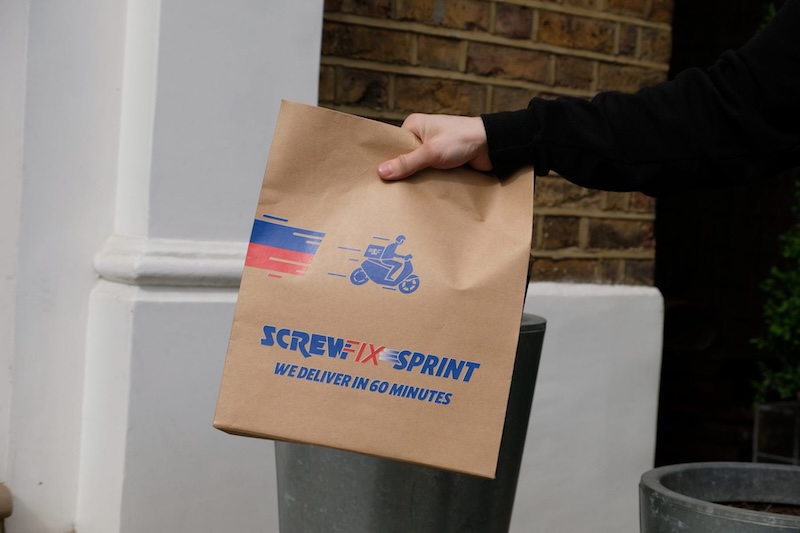
A delivery promise built for a customer who can't wait
Most retail delivery promises are built around convenience. Screwfix's Sprint service is built around a harder constraint: a tradesperson standing on a job site who is missing a part and cannot bill for the hours lost waiting on it. That is the customer Sprint is designed for, and it explains why the promise is pitched at 60 minutes rather than same-day or next-day, timeframes that would be unremarkable for general retail but would leave a trade customer stuck mid-job. Screwfix, owned by Kingfisher, has now taken that promise to 600 stores, with the count still rising as the rollout continues.
That store footprint translates into population coverage Screwfix can actually quote with confidence: more than 62 percent of the UK, a figure that matters more to a trade customer than store count alone, because it answers the only question that counts for them, whether Sprint reaches their job site, not whether it reaches a nearby town. Scaling a 60-minute promise to that share of the population without building a dedicated delivery fleet is the harder achievement here, and it rests on the courier partnership underneath the headline figure.
Why a courier partner, not a fleet
Screwfix built Sprint on Gophr, an on-demand courier network, rather than standing up its own delivery fleet across 600 locations. That is the build-versus-buy decision every retailer chasing fast delivery eventually faces, and the trade-offs run in predictable directions. A dedicated fleet gives full control over driver availability, branding and service quality, but it is capital-intensive and slow to scale, because every new store needs its own vehicles and drivers hired and trained before the promise can go live there. A courier partnership scales as fast as the partner's network does, which is how Screwfix reached 600 stores without that build-out.
The cost of that speed is dependency. Screwfix's 60-minute promise is only as reliable as Gophr's driver availability in each market, and any capacity constraint on the partner's side becomes a customer-facing failure on Screwfix's side regardless of whose infrastructure actually broke down. For a retail CTO weighing the same decision, the question is not simply which model is cheaper to launch. It is whether the retailer's brand promise can tolerate being only as strong as a partner's weakest local market, in exchange for the speed that partnership buys.
What the adoption numbers actually tell us
Max Britten, Screwfix's Managing Director for the UK and Ireland, says tens of thousands of customers have used Sprint so far this year, a figure he shared directly rather than through a formal release. That number confirms real usage beyond a marketing pilot, but it is also vague enough that it tells us little about frequency, repeat usage, or how it breaks down across the 600 stores now live. A retailer with a growing footprint publicizing a round, imprecise adoption figure is giving a directional signal, not an auditable metric, and should be read that way rather than treated as proof of product-market fit at scale.
What is more concrete is the marketing effort sitting behind the expansion: the Screwfix Convenience campaign, fronted by Mo Farah, launched earlier in 2026 specifically to drive use of Sprint alongside Click and Collect and check-in services. Pairing a celebrity-fronted campaign with an infrastructure expansion to 600 stores signals that Screwfix sees Sprint as a demand-generation lever worth marketing spend, not just a cost center quietly running in the background. That combination, visible marketing plus expanding physical coverage, is usually the clearer signal of internal confidence than an adoption number alone, and it is a pattern worth watching for when judging whether any retailer actually believes in a service it has just announced, rather than simply testing the water with a quiet, low-commitment pilot.
The store-as-fulfillment-hub thesis, applied to trade retail
Sprint depends on the store functioning as a fulfillment hub rather than purely a retail front end, each of the 600 locations effectively acting as a dispatch point a courier can collect from within the hour. That thesis is familiar from grocery and general merchandise, but trade retail adds a wrinkle: the products being delivered are often heavier, bulkier, or needed in combination with other items from a specific job, which raises the bar for what the courier network and the store's picking process both need to handle reliably within that window.
For a retail CTO running a comparable store estate, the transferable question is not whether to copy Sprint specifically, but whether the store network already has the density and inventory accuracy to support a courier-based rapid delivery promise before committing marketing spend to it. Screwfix reached 62 percent population coverage because its store density already supported it; retailers without that density starting from a thinner footprint should expect the courier partnership to expose gaps in store-level pick accuracy and stock visibility well before the 60-minute promise becomes the binding constraint.
Why trade retail is a natural first mover on rapid delivery economics
Tradespeople often bill clients by the hour, which turns a missing part into a direct, calculable cost rather than a mild inconvenience. That makes the Sprint customer more willing to tolerate a delivery fee, and more responsive to a marketing push built around speed, than a typical consumer comparing prices on a discretionary purchase with no time pressure attached. That demand profile is what makes trade retail a more forgiving environment to prove out rapid, courier-based delivery economics before a general retailer tries to extend the same promise to a customer base with far less urgency and far more price sensitivity per delivery.
Retailers in adjacent professional-trade categories, auto parts, industrial supplies, agricultural equipment, face a similar customer profile and should treat Screwfix's rollout as a transferable case study on courier partnership economics, population coverage targeting, and marketing-led adoption. It is a weaker guide for general retailers assessing whether 60-minute delivery works broadly across categories where customers feel less time pressure, since the willingness to pay and the tolerance for a newer, less-proven service both depend heavily on how expensive waiting actually is for the person placing the order.