A pricing tool gets a second job
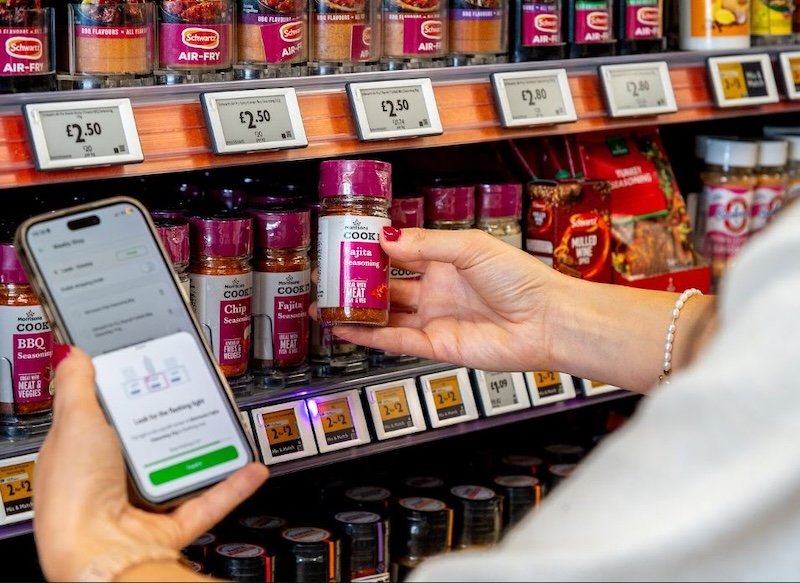
Electronic shelf labels exist, commercially, to let a retailer update prices across a store in seconds instead of sending staff down every aisle with a label gun. Morrisons and Vusion have now given that same hardware a second function: helping shoppers find products. The mechanism is simple. A customer opens the Product Finder tool on the homepage of Morrisons' More Card app, searches for an item, and selects "flash price label." The app shares the product's in-store location and asks the shopper to confirm they are in the right aisle, then the matching digital shelf label flashes magenta so they can spot it without scanning every shelf.
Morrisons and Vusion describe this as a UK supermarket first, and whether or not a competitor matches that claim precisely, the underlying move is the one worth noting. The feature requires no new in-store infrastructure beyond the electronic shelf labels Morrisons already installed for pricing. That is the more durable lesson for a retail CTO than the first-mover claim: hardware justified on one business case can carry a second, customer-facing use case once the software layer above it is built to support it.
Why this only works where the labels already are
The feature is being added to stores as they install digital shelf edge labels, and currently more than 270 Morrisons supermarkets have that infrastructure in place. That constraint matters more than it looks. Product Finder is not a software feature Morrisons can simply switch on chainwide; it is gated by a hardware rollout that has its own pace and its own capital cost, unrelated to the app feature riding on top of it. A shopper in a store without electronic shelf labels gets no benefit from this launch at all, no matter how the feature is marketed nationally.
That gating is a useful reminder for any CTO stacking new digital capability on existing store hardware: the software roadmap is only as fast as the hardware footprint beneath it, and announcements built on top of a partial estate should be read as a preview of where coverage is heading, not where it already stands. Morrisons and Vusion gave no rollout timeline for extending electronic shelf labels, or this feature, beyond the current 270-plus stores, so the pace of expansion is not yet public, and shoppers in the remaining stores will see the feature marketed nationally well before they can actually use it locally.
The timing is the real strategy
Gordon Macpherson, Morrisons' Group Productivity Director, ties the launch directly to the calendar: Christmas, he says, is one of the busiest times of year for customers, and the feature helps them find products quickly, whether that is for Christmas dinner or a last-minute essential. Launching in mid-November, rather than waiting for a slower month to iron out issues, puts the feature into service exactly when store traffic, basket complexity and shopper impatience all spike together. That is a deliberate bet that the feature earns more value under peak pressure than it loses from being newer and less proven.
Roy Horgan, Vusion's UK and Ireland CEO, frames the partnership in similar terms, describing the platform as designed to help retailers "improve operational execution" while calling Morrisons "a fantastic partner in embracing innovation." Vendor language aside, the operational case holds up: a shopper who finds an item themselves in seconds is a shopper who did not need to pull a staff member off a till or a replenishment task to ask where something is, which is exactly the kind of small friction peak-season staffing plans struggle to absorb at scale.
What other grocery CTOs should take from this
No usage or sales figures accompanied the launch, so there is no external evidence yet of how often shoppers use Product Finder or whether it changes basket size, dwell time or staff interruption rates. That is a fair gap to flag rather than paper over: this is a launch announcement, not a results announcement, and retail CTOs should treat it as the former. What is verifiable is the architecture decision behind it, building a customer-facing feature on top of pricing infrastructure already paid for, rather than commissioning separate in-store wayfinding hardware.
That architecture choice is the transferable idea here, more than the specific feature. Any retailer that has already invested in electronic shelf labels, in-store Bluetooth beacons, or similar infrastructure for one stated purpose should be asking what second use case that same hardware could support before buying something new. Morrisons and Vusion's bet is that the answer, at least for shelf labels during a pressured shopping season, is customer navigation. Whether it moves the numbers Morrisons actually cares about will only be visible once post-Christmas trading data exists to check it against.
Shelf labels are becoming a platform, not a price tag
Morrisons' launch fits a wider pattern visible across UK grocery this quarter, where electronic shelf label networks are being treated less as a single-purpose pricing tool and more as general in-store display infrastructure capable of dynamic signage, promotions and now wayfinding. Marks and Spencer has separately begun deploying Vusion's Connected Store platform in new stores for similar reasons, building a Bluetooth-enabled base that supports product information and staff-facing features beyond pricing alone. Electronic shelf labels were also a stated focus area at the 2026 RTIH Innovation Awards, suggesting the category is moving in this direction across multiple vendors and retailers at once, not just at Morrisons.
The labor math behind this shift is straightforward and worth stating plainly. During peak trading, every minute a staff member spends walking a customer to a product is a minute not spent on a till, a replenishment task, or a stockroom count, all of which matter more as Christmas volume climbs. A navigation feature that reduces even a modest share of those interruptions returns labor hours to tasks that scale better under pressure, which is the practical argument for treating shelf-label infrastructure as an extensible platform investment rather than a one-off pricing tool with a single fixed purpose.