A regional grocer's AI bet
Schnucks, the 112 store chain operating across Missouri, Illinois, and Indiana, has launched a new AI powered shopping assistant built in partnership with VitalityIP, a digital nutrition and health data platform. The assistant draws on more than 6 billion lines of shopping, health, and nutrition data to build shopping lists, suggest meal ideas based on ingredients a customer already has, and offer personalized nutritional guidance tied to the retailer's weekly deals and recommended products. That data foundation is the notable part of the announcement, since it points to a partnership built around health and nutrition specifically rather than a general purpose AI vendor retrofit.
Ted Schnuck, the company's chief operating officer, described the tool as a personalized digital shopping assistant that understands the chain's aisles, sales, promotions, and customers' lifestyles at a level a plain search bar cannot match. For a regional grocer competing against national chains with far larger technology budgets, a differentiated data partnership is one of the few ways to offer something distinct rather than matching feature for feature against Kroger or Walmart's own AI investments.
Turning the weekly ad into a shopping surface
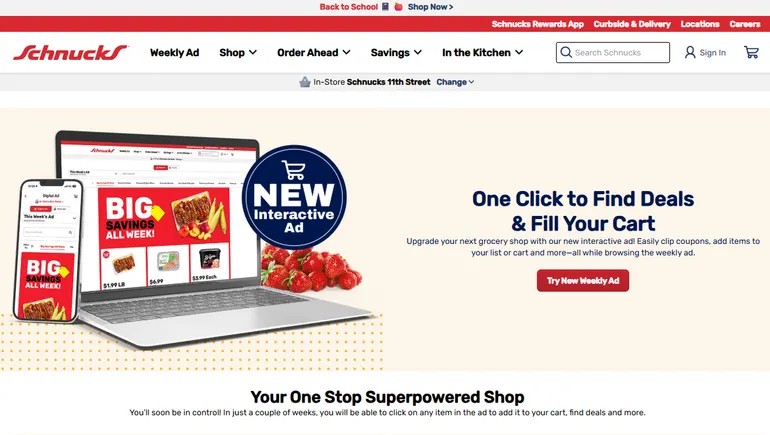
Alongside the assistant, Schnucks launched an interactive version of its weekly ad that lets shoppers clip digital coupons directly from the circular, add items straight to a shopping list or online cart, view product details, and check availability across in-store, delivery, and pickup. Shoppers can toggle between this interactive mode and a classic static layout, which keeps the format familiar for customers who prefer the traditional browsing experience while giving digitally engaged shoppers a faster path from ad to cart.
That toggle matters more than it might first appear. Weekly ads remain one of the highest engagement touchpoints in grocery retail, and turning that surface into a transactional interface, rather than just a digital replica of a paper flyer, converts a passive browsing habit into an active purchase funnel without forcing shoppers to abandon a format they already trust and use every week. It also gives Schnucks a much richer data trail on which promotions actually convert, since a clip and cart action inside the interactive ad is a far stronger purchase intent signal than a printed coupon a shopper may or may not redeem in store.
Why paper circulars are still in the plan
Notably, Schnucks is continuing to print both the current and the following week's paper ads at all 112 stores even as it rolls out these digital tools. That decision reflects a demographic reality most grocery chains face: a meaningful share of shoppers, particularly older customers, still plan purchases around a printed circular, and abandoning that format risks alienating a loyal segment of the customer base before the digital alternative has fully proven itself.
The dual track approach is a more disciplined rollout strategy than retailers that force a hard cutover to digital only formats. It lets Schnucks measure real adoption of the interactive ad against the paper version over time, rather than assuming digital engagement based on downloads or app installs, and it avoids the customer backlash that comes with removing a familiar tool before a comparable replacement has earned trust. Regional grocers in particular tend to have older, more loyalty driven customer bases than national chains, which raises the cost of a misjudged digital cutover and makes this kind of gradual transition a more defensible default.
The vendor choice worth noting
VitalityIP is not a household name in retail technology, and Schnucks' choice to build with a specialized nutrition and health data platform rather than a broader retail AI vendor is a meaningful signal. It suggests the retailer prioritized depth in one specific dimension, personalized nutrition guidance, over breadth across every possible AI use case a larger vendor might pitch. For a mid sized grocer with a defined customer base and limited technology budget, that kind of focused partnership can deliver a sharper differentiated experience than a generic platform deployed the same way at every competitor.
It is also a data point for how the AI vendor landscape in grocery is fragmenting. Rather than one or two dominant platforms serving every retailer's conversational AI needs, chains are increasingly picking partners suited to a specific strategic angle, whether that is health data, inventory computer vision, or loyalty personalization. That fragmentation creates more options for regional grocers but also more integration and vendor management work for the technology teams stitching those partnerships together.
What the data foundation actually buys
Any grocer evaluating a similar move should treat the data foundation as the real diligence question, ahead of the assistant's conversational polish. A 6 billion line dataset spanning shopping, health, and nutrition information is what actually differentiates guidance quality, and that scale is far harder for a competitor to replicate quickly than a chat interface layered on top of generic product data. Vendors pitching a conversational layer without a comparable data asset behind it are selling a thinner version of the same idea.
That distinction should shape how technology leaders score vendor proposals in this category. A polished demo interface is easy for most AI vendors to produce today, so it tells a buyer very little about long term differentiation. The harder, more useful question is what proprietary data the vendor brings to the partnership, and whether that data compounds over time as a retailer's own shoppers use the tool, the way Schnucks' 6 billion line dataset presumably does.
What CTOs at similarly sized retailers should watch
Schnucks' move offers a useful template for other regional and mid market grocers watching national chains pour money into AI without a comparable budget of their own. Rather than trying to match Walmart or Kroger's scale of investment directly, a focused partnership around one differentiated capability, in this case health and nutrition personalization, gives a smaller chain a specific reason for customers to prefer its digital experience over a larger competitor's more generic assistant.
The paper circular decision is equally instructive. Schnucks is not treating digital rollout as an all or nothing bet, and that patience gives the company real usage data to judge the interactive ad against before making any decision about scaling back print. Other regional retailers under pressure to show fast digital progress should note that a phased, dual track rollout can still produce a credible AI story without forcing an irreversible format change on a customer base that has not yet fully moved with it.