A Network, Not Another Conference
On June 30, 2026, RETHINK Retail introduced Media in Retail, or MiR, a network of established and emerging leaders shaping where retail and commerce media go next. The framing matters. Retail media already has a crowded calendar of summits, an arms race of measurement standards, and no shortage of vendors selling closed-loop attribution. What it has lacked is a durable, cross-company room where the people running these businesses can actually develop. MiR is positioned as that room, and the distinction from a one-off event is the entire point of the launch.
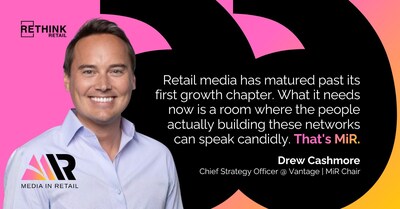
We read this as a deliberate counter to conference fatigue. Drew Cashmore, named chair of MiR and chief strategy officer at Vantage, put it directly: retail media does not need another conference, it needs a place to develop the next generation of talent. That is an unusually candid diagnosis from inside a category that has spent three years celebrating its own ad-revenue growth. The implicit claim is that the money has arrived faster than the management depth required to sustain it, and that the next phase of maturity will be won on people, not on yet another self-service buying interface.
Who Is in the Founding Cohort
The first cohort is the most revealing part of the announcement. It includes Mark Williamson, AVP of retail media at Costco, Stephenie Cattonar of The Home Depot's Orange Apron Media, Alyson Soderberg of Ulta's UB Media, Austin Leonard of DG Media Network at Dollar General, Lauren Bolles, COO of Tesco Media, Alice Anson of Sainsbury's Nectar360, and Trent Becker, who leads US retail media at Vusion. This is not a roster of agency consultants. These are operators who run the retail media networks that brands actually buy.
Two things stand out. First, the cohort is intentionally cross-retailer, putting direct competitors such as Costco, Ulta, and The Home Depot in the same peer group. That only works if participants treat craft and career development as non-rival goods, which is a meaningful cultural bet. Second, the inclusion of Tesco and Sainsbury's alongside US grocers and big-box players signals a transatlantic ambition. RETHINK has said MiR will eventually span the full commerce-media ecosystem of retailers, brands, agencies, and technology providers, but starting with retailer-side operators keeps the early credibility anchored where the inventory lives.
The Talent Thesis Behind the Move
Retail media has been the fastest-growing line item in many retailers' profit pictures, and the talent market has not kept pace. Operators are routinely poached, networks are stood up faster than leaders can be trained, and the institutional knowledge of how to run a profitable, brand-trusted media business sits in a thin layer of executives. MiR is, at its core, an attempt to thicken that layer. By framing the work as a craft to be taught rather than a category to be hyped, the network is implicitly arguing that the sector's biggest risk is no longer ad demand, but the supply of capable people to manage it.
Marie Chevrier Schwartz, CEO of RETHINK Retail, leaned into that convening role, saying the organization builds the rooms where the right people connect in ways that move their businesses forward. For CTOs and CIOs watching from the technology side, the signal is worth absorbing. The constraint on scaling a retail media network is increasingly organizational, not technical. The measurement stack, the clean rooms, and the self-service tools are commoditizing. The scarce input is leadership that can balance shopper trust, brand outcomes, and margin without breaking any of the three.
Timing Around NRF 2027
MiR will host its inaugural Media in Retail Summit in New York City in January 2027, deliberately scheduled just before NRF 2027: Retail's Big Show. The timing is strategic rather than incidental. NRF week already pulls every senior retail leader to Manhattan, so anchoring the summit there lowers the cost of attendance and borrows the gravity of the industry's largest gathering. Susan Newman, NRF's senior vice president of event strategy, said the inaugural summit will convene leaders to navigate the convergence of retail and media, which is a careful acknowledgment that these two disciplines are no longer separable.
We would caution that calendar adjacency to NRF is a double-edged sword. The same week that guarantees attendance also guarantees competition for attention against hundreds of vendor announcements and keynotes. MiR's value will hinge on whether the summit feels like a working peer session or merely a satellite event riding NRF's coattails. The network's stated emphasis on talent development, closed-room candor, and craft over spectacle suggests it understands that risk. The proof will be in whether the January gathering produces the kind of practitioner exchange that conferences, by design, rarely deliver.
What Executives Should Take From It
For business technology leaders, MiR is a useful barometer of where retail media sits in its maturity curve. When a category stops launching new tools and starts launching talent institutions, it is admitting that the easy infrastructure wins are behind it and the durable advantage now lies in execution. That should reframe how retailers budget. The next dollar of competitive edge in retail media may be better spent on developing and retaining the operators who run the network than on the next attribution vendor or measurement partnership.
It also tells brands something. If the retailers selling them media are now formalizing a shared craft and shared standards through a peer network, the buy side should expect more consistency and more sophistication, but also more disciplined pricing. A maturing operator class is harder to extract value from than a fragmented one still learning the trade. We will watch whether MiR stays a genuine development network or drifts toward a credentialing club. For now, the more interesting story is the admission embedded in the launch: retail media's bottleneck has moved from pixels to people.