Amazon Productizes Its Own Playbook
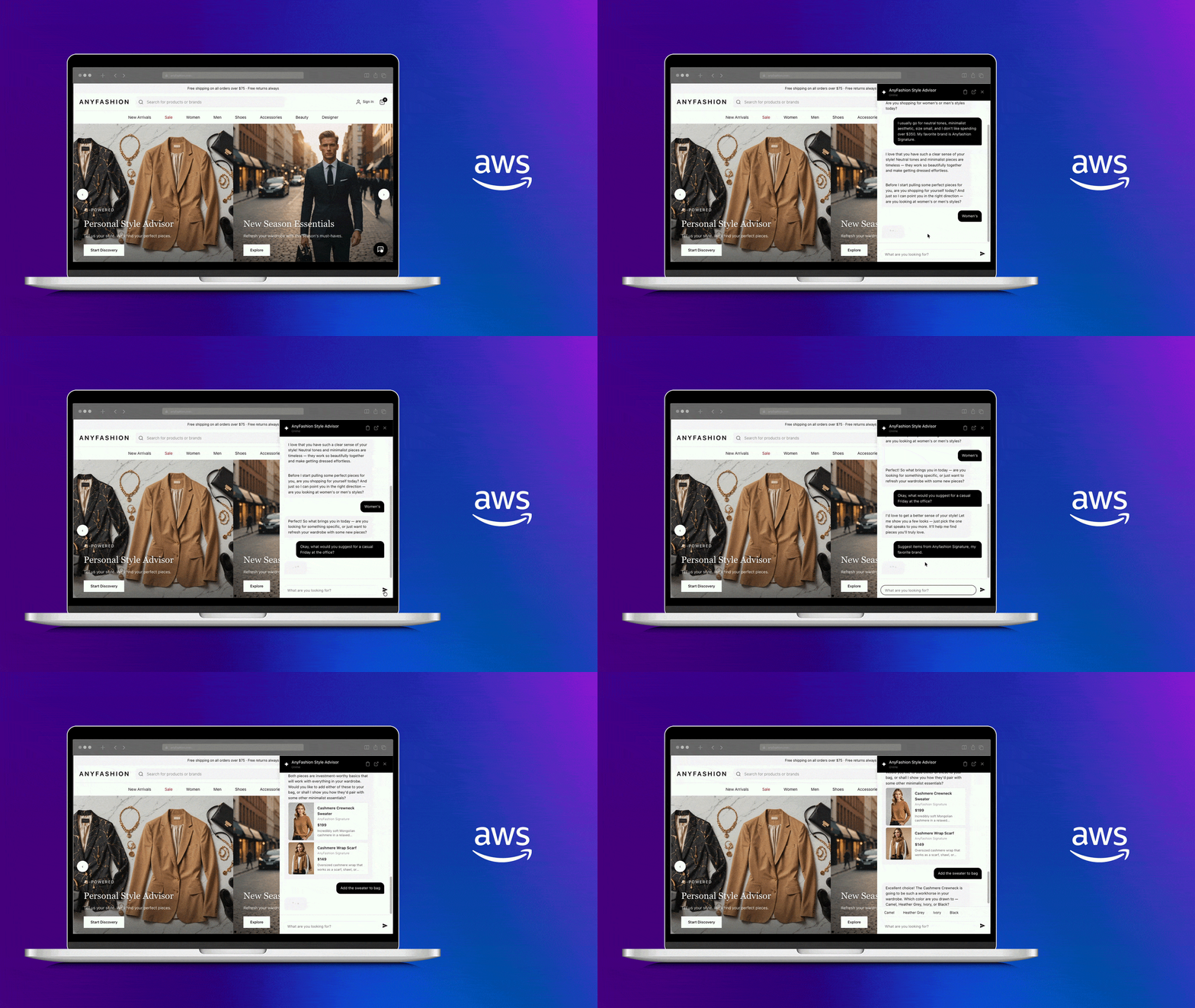
Amazon has decided that the smartest thing to do with its shopping AI is to sell it to everyone else. Through a new AWS solution, the Agentic Shopping Assistant, Amazon is offering retailers the same class of technology that powers its own Alexa for Shopping experience, formerly known as Rufus. The tool lets a retailer stand up a conversational shopping agent tailored to its own catalog, customer data, business rules, and brand voice, rather than pointing shoppers at a generic chatbot. In effect, Amazon is renting out the brain behind its storefront.
This is a classic AWS move, and a revealing one. Amazon has long turned its internal infrastructure into external products, from compute to logistics, and it is now doing the same with agentic commerce. The company is betting that even retailers who compete fiercely with Amazon.com will pay to run their shopping experiences on Amazon's cloud and Amazon's AI. It is coopetition at scale: your rival's shoppers become your cloud customers, and the technology that helped Amazon win becomes a revenue stream regardless of who ultimately makes the sale.
The 12 Billion Dollar Proof Point
The pitch rests on a genuinely eye-catching number. Amazon says the AI shopping assistant behind this product was used by more than 300 million customers last year and drove nearly 12 billion dollars in incremental sales. For a category still crowded with unproven AI experiments, that is a rare claim of large-scale, dollars-and-cents impact rather than engagement metrics or demo enthusiasm. It reframes the conversation from whether conversational commerce works to how much revenue a retailer is leaving on the table by not having it.
Amazon reinforces the case with a conversion statistic: shopping sessions that use the assistant convert at roughly 3.5 times the rate of traditional keyword search. Whether those figures translate cleanly to other retailers with different catalogs and customer bases is an open question, and executives should treat vendor numbers with appropriate skepticism. Still, the underlying logic is sound. A shopper who can describe what they want and get a curated answer is further down the funnel than one squinting at a grid of search results. The proof point is the most persuasive part of the entire offering.
Bedrock, AgentCore and the 60-Day Promise
The technical foundation is Amazon's own AI stack. The Agentic Shopping Assistant is built on Amazon Bedrock, AgentCore, and OpenSearch, and AWS provides architecture guidance, starter code, and expert support to help retailers launch a conversational experience in roughly 60 days. That timeline is the real product feature. The gap between wanting an AI shopping agent and shipping one that is reliable, on-brand, and connected to live inventory is where most retail AI ambitions quietly die.
By supplying the reference architecture and the connective tissue, AWS is trying to compress that gap from a speculative multi-quarter project into a defined engagement. For retail technology teams, that is meaningful, because building an agent from scratch means assembling model orchestration, retrieval, and safety controls that few merchandising organizations are staffed to handle. The trade-off is dependency. A 60-day launch on Bedrock and AgentCore is also a 60-day commitment to Amazon's platform primitives, which is precisely the lock-in that makes the offering so attractive to Amazon in the first place.
Kate Spade as the Reference Customer
Amazon is anchoring the launch with a recognizable early adopter. Kate Spade, through parent company Tapestry, is among the first brands to build on the new capability, having launched a Kate Spade AI Gift Concierge on Amazon Bedrock AgentCore that chats with shoppers about the occasion, the recipient, and their style before recommending products. It is a tidy illustration of how a fashion brand can use agentic commerce for a genuinely hard problem, gift discovery, where shoppers often do not know exactly what they want.
Tapestry's chief information and digital officer, Yang Lu, offered a quote that captures the division of labor well, saying that AWS brought the recipe, but together we built the customization our consumers needed. That framing is honest about what these platforms do and do not provide. The infrastructure and the patterns come from Amazon; the brand voice, the domain expertise, and the customer understanding still have to come from the retailer. The reference customer matters because it moves the offering from a slide into a shipped experience that other brands can evaluate against.
The Coopetition Bargain
The strategic tension in this deal is impossible to ignore. Retailers adopting the AWS Agentic Shopping Assistant are handing more of their commerce stack to a company that is also one of their most formidable competitors. Amazon captures cloud revenue, deepens its platform relationships, and gains yet another window into how retail actually works, all while its rivals build atop its rails. For Amazon, this is close to an ideal position. For the retailer, it is a bargain that trades strategic independence for speed and capability.
Whether that bargain is wise depends entirely on a retailer's alternatives and its appetite for dependency. A brand with no realistic path to building its own agentic capability may reasonably conclude that a fast, proven Amazon-powered experience beats having none at all. A larger retailer with the resources to build or to choose a more neutral partner should think harder about how much of its future it wants running on a competitor's platform. The offering is powerful precisely because it makes the convenient choice and the strategically risky choice the same choice.
What Retail CIOs Should Weigh
For retail technology leaders, this launch crystallizes a decision that agentic commerce is forcing on the whole industry: build, buy, or rent the intelligence that will increasingly mediate customer relationships. AWS is making the rent option extraordinarily easy, with a credible proof point, a mature stack, and a 60-day path to production. That convenience is real and should not be dismissed, especially for teams that would otherwise ship nothing.
The counterweight is to price in the long-term cost of dependency and data exposure alongside the short-term gain. We would encourage leaders to ask where the customer intent data flows, how portable the resulting experience is, and what leverage the retailer retains if terms or priorities shift. Amazon has built an offering that is genuinely useful and genuinely self-serving at the same time. Recognizing both truths at once, rather than being seduced by the demo or scared off by the competition, is the posture that will serve retail CIOs best as this market takes shape.