A New Layer of Defense for Enterprise AI Use
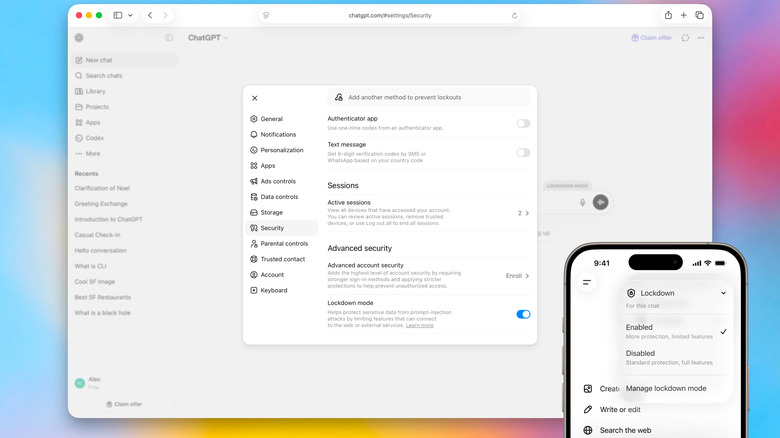
OpenAI has launched Lockdown Mode, a security feature designed to protect ChatGPT users from prompt injection attacks that hide malicious instructions in web content. The feature represents a significant step forward in enterprise AI security, responding to a growing class of threats that has become one of the most pressing concerns for organizations deploying large language models.
Prompt injection attacks work by embedding hidden instructions in web pages, documents, or other content that an AI model processes. These instructions can trick the model into performing actions the user did not intend, including exfiltrating sensitive data. As organizations increasingly connect AI systems to the internet and to internal data sources, the attack surface has expanded dramatically.
What Lockdown Mode Disables
When Lockdown Mode is activated, ChatGPT disables several of its most powerful features. Live web browsing is replaced by access to cached content only, meaning the model cannot fetch real-time information from the internet. Retrieval and display of images from the web is also blocked, though image generation within ChatGPT remains available. The deep research functionality and agent mode, both of which involve multi-step autonomous actions, are disabled entirely.
These trade-offs are intentional. Each of the disabled features represents a vector through which prompt injection attacks could operate. By removing them, OpenAI reduces the likelihood that an attacker can trick the model into taking actions that expose sensitive information. For organizations handling regulated data, national security information, or proprietary business intelligence, this trade-off may be well worth making.
Not a Silver Bullet
OpenAI has been transparent about the limitations of Lockdown Mode. The company acknowledges that even with the feature enabled, ChatGPT could still be vulnerable to prompt injections that appear in cached web content or uploaded files. These could still affect the behavior or accuracy of a response. Lockdown Mode reduces the likelihood that sensitive data gets shared, but it does not eliminate all attack vectors.
This honesty matters for enterprise security teams. No single control can fully protect against prompt injection, and Lockdown Mode should be seen as one layer in a broader defense-in-depth strategy. Organizations should continue to implement data classification policies, access controls, monitoring, and employee training around AI use.
Who Should Use It
OpenAI has positioned Lockdown Mode as a feature for specific use cases rather than a general-purpose improvement. "Lockdown Mode is not intended for everyone," the company stated. "It is designed for people and organizations that handle sensitive data and want stricter protection from data exfiltration risks related to prompt injection."
The rollout begins with self-serve ChatGPT Business accounts, with eligible personal accounts also receiving access. This phased approach allows OpenAI to gather feedback and refine the feature before broader deployment. For enterprises that have been hesitant to deploy AI assistants in sensitive environments, Lockdown Mode may provide the additional comfort needed to move forward.
The Growing Prompt Injection Threat
Prompt injection has emerged as one of the most significant security challenges in the AI era. Unlike traditional software vulnerabilities, which can be patched at the code level, prompt injection exploits the fundamental way that language models process context and instructions. As we noted in our coverage of the Google Gemini assistant prompt injection attacks, even the most sophisticated AI systems are susceptible to these techniques.
The security community has been racing to develop defenses, ranging from input sanitization to output monitoring to architectural changes like those represented by Lockdown Mode. OpenAI's approach of disabling high-risk features rather than trying to detect every possible injection represents a pragmatic recognition that perfect detection is not currently achievable.
Implications for Enterprise AI Strategy
For organizations building on OpenAI's platform, Lockdown Mode provides a new tool for managing risk. It allows companies to offer ChatGPT access in environments where the cost of data exposure is high, without requiring a complete ban on AI assistant usage. This is particularly valuable in regulated industries like financial services, healthcare, and government, where compliance requirements have often been a barrier to AI adoption.
We see Lockdown Mode as part of a broader trend in which AI providers are building enterprise-grade security controls into their products. As token costs come under scrutiny and as organizations demand more visibility into how their data flows through AI systems, we expect to see more features like this from every major AI platform.