A European AI campus gets its first paying customer
Dutch developer Volt announced on October 12 that AI cloud provider Nebius has signed a Letter of Intent to become the first offtaker at its planned AI Gigafactory in the Port of Rotterdam, roughly 35 miles from Amsterdam. The agreement is non-binding and the precise technical setup, including which compute equipment Nebius will deploy, is still being worked out, but it gives Volt's project something most greenfield European data center campuses lack this early: a named, committed customer willing to put its name on the announcement. Volt first revealed its Rotterdam ambitions in April 2026, and the project has moved from concept to a signed commercial commitment in roughly six months, fast by European data center standards.
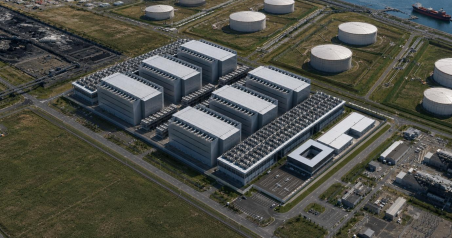
The campus itself has been resized since Volt's original pitch. Volt now describes a 600 megawatt campus spread across six buildings, down from the 800 megawatts it floated earlier in the year, with the first phase consisting of two 100 megawatt data centers. Total first-phase investment comes to roughly €7 billion, or about $7.8 billion, split between €2.5 billion ($2.8 billion) for construction and €4.5 billion ($5 billion) for compute hardware, a split that underscores how much of a modern AI campus's cost now sits in silicon rather than concrete and steel.
Why offshore wind, and why Rotterdam
The site's power strategy is the detail that separates this from a typical hyperscaler land grab. Volt plans to draw electricity from offshore wind farms coming ashore near the port, supplied through Dutch utility Eneco, rather than contracting new gas-fired generation the way several major US projects have done this year. That choice reflects both the Netherlands' existing offshore wind infrastructure in the North Sea and the tighter political and regulatory constraints European developers face around new fossil generation tied to data centers. Volt founder and CEO Han de Groot acknowledged the underlying tension directly, saying "the concerns about electricity are justified," a notably candid admission from a developer actively trying to secure grid connections for a 600 megawatt load.
Rotterdam's port location also matters for reasons beyond power. Port infrastructure typically comes with existing heavy-duty grid connections, fiber routes and permitting frameworks built for industrial-scale tenants, which shortens the timeline for exactly the kind of grid interconnection work that has stalled data center projects elsewhere in Europe. Volt is also positioning the site as part of the Dutch bid for one of the European Union's five planned 300 megawatt AI gigafactory designations, a program meant to anchor sovereign AI compute capacity inside the EU rather than leaving the region dependent on US hyperscaler regions for frontier AI workloads.
Nebius keeps building its European footprint deliberately
For Nebius, the Rotterdam deal is part of a broader pattern of methodically securing capacity across multiple geographies rather than concentrating in any single hyperscaler-style megacampus. Earlier in October the company signed a separate 50 megawatt lease with AIB Data Centers in the United States, meaning Nebius closed two meaningfully different capacity deals, one in the US, one in Europe, inside the same month. Nebius CEO Arkady Volozh framed the Rotterdam move in explicitly geopolitical terms, saying "we want Europe to be successful on the global stage," positioning the company as a European-aligned alternative to US hyperscalers for enterprises and governments that want AI infrastructure with a European sovereignty story attached.
That positioning has real commercial value right now. European enterprises and public sector buyers facing data sovereignty requirements or simply wary of dependence on US cloud providers have limited credible alternatives at scale, and Nebius has spent the past year building exactly that reputation through deals like this one. Becoming the named anchor tenant at a flagship Dutch AI campus, backed by offshore wind and explicitly targeting EU gigafactory status, gives Nebius a reference story that is difficult for AWS, Microsoft or Google to match on sovereignty grounds, even though all three have far larger European footprints by raw capacity.
What this means for enterprises weighing European AI capacity
Enterprises and public sector buyers evaluating where to place AI workloads in Europe now have a clearer data point on timeline and cost. A project moving from concept to a signed anchor tenant LOI in six months, with power sourced from offshore wind rather than new fossil generation, suggests that well-positioned European sites with existing grid infrastructure can move faster than the multi-year interconnection queues that have become the norm in the US. That said, the deal remains a non-binding Letter of Intent, and the gap between LOI and operational capacity at gigawatt-adjacent scale has tripped up other European projects, including the Google sites Finland recently halted construction on.
For CTOs building a European AI infrastructure strategy, Rotterdam is worth tracking as a test case for whether offshore wind can credibly underwrite large, latency-sensitive AI compute without the backup generation hedges hyperscalers have leaned on elsewhere. If Volt and Nebius can bring the first two 100 megawatt buildings online on a believable timeline, it strengthens the case for wind-backed European capacity as a genuine alternative to US regions, not just a sovereignty talking point. If the project slips the way several European megaprojects have this year, it will reinforce the view that renewable-only power strategies remain the harder path to gigawatt-scale AI infrastructure.
The bigger competitive picture
Rotterdam adds to a growing list of European AI infrastructure bets that are explicitly positioned against, rather than alongside, US hyperscaler dominance: Sesterce's planned €10 billion campus in Jämsä, Finland, Aragon's fast-tracked $70 billion pipeline in Spain, and now Volt's Rotterdam gigafactory candidate all share a common thread of trying to build sovereign-feeling AI capacity on European soil with European or European-aligned operators. Whether any of them can match the speed and scale of US buildouts remains an open question, but the commercial logic for enterprises is becoming clearer regardless: multiple credible European options are emerging for the first time in this cycle, rather than a straight choice between US hyperscaler regions or nothing.
For enterprise infrastructure teams, that shift changes the negotiating calculus with AWS, Microsoft Azure and Google Cloud's European regions, even if volumes at Nebius or Volt's scale never rival the big three. Credible alternatives, even modest ones, give European customers leverage in pricing and sovereignty commitments that did not exist eighteen months ago. Expect hyperscalers to respond with their own sovereignty-branded European offerings, and expect deals like Nebius's Rotterdam LOI to keep arriving roughly monthly as the AI gigafactory land rush plays out across the continent.