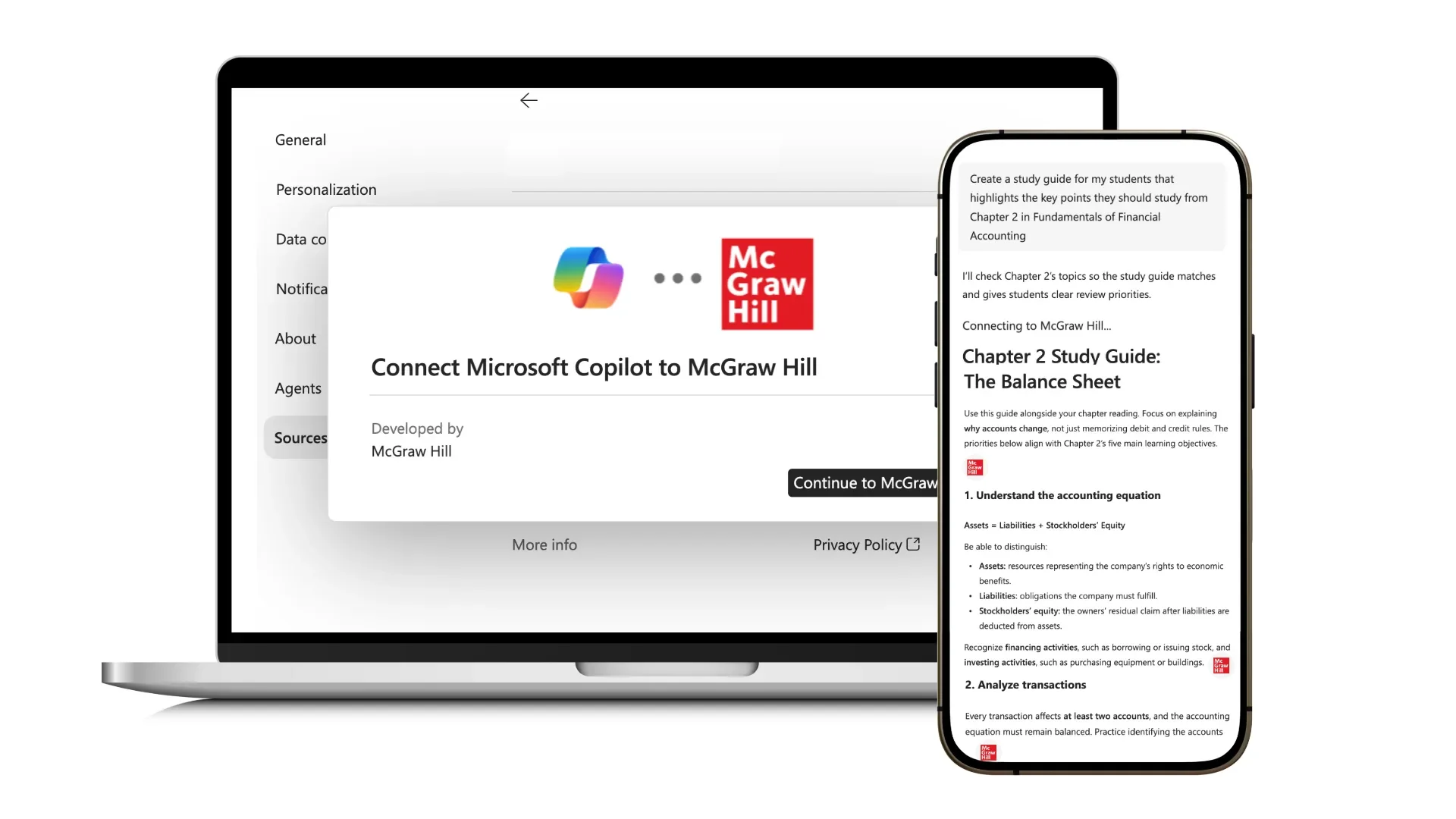
What McGraw Hill actually shipped
McGraw Hill announced it will bring its K-12, higher education, and professional learning content into Microsoft 365 Copilot through a new plugin, with a limited beta opening to eligible customers in early 2027. The plugin connects Copilot to McGraw Hill's content systems using the Model Context Protocol, the emerging standard for linking AI systems to external data and services. Practically, that means an educator or administrator working inside Copilot can pull a study guide, a translated handout, or a lesson plan generated directly from a licensed McGraw Hill textbook chapter, instead of asking a general-purpose model to approximate the content from scratch.
This sits alongside McGraw Hill's existing AI products, AI Reader, Sharpen, Learning Studio, Writing Assistant, and Teacher Assistant, which run inside the company's own learning environment. The Copilot plugin is a second distribution channel, not a replacement. Dave Cortese, McGraw Hill's Chief Digital Information Officer, described it as a way to "expand into new channels while maintaining control over how our content is used and valued." That line is the whole story: McGraw Hill wants the reach of sitting inside Microsoft's assistant without surrendering the licensing control that makes its content a business rather than a commodity.
Why MCP, not a flat API
A decade ago, this kind of deal would have been a flat API integration: Microsoft gets a data feed, McGraw Hill gets a royalty, and the terms get negotiated once a year. MCP changes the shape of that arrangement. It lets McGraw Hill expose specific, scoped tools and content on a per-query basis rather than handing over a bulk dataset, which means the content owner keeps a technical choke point on exactly what gets pulled, by whom, and under what license tier. That choke point is the product now, as much as the content itself.
For a buyer, this matters because MCP-based access changes how you evaluate a content or knowledge vendor. The question is no longer just "can we get an API key," it is "which AI assistants can this vendor's MCP server actually talk to, and does that list include the one we standardized on." McGraw Hill chose Microsoft first because McGraw Hill itself adopted Copilot as its enterprise AI productivity tool, which it says it will also use to build employee AI fluency internally. Vendors are increasingly picking integration partners based on their own internal stack, not yours.
The governance pitch is doing real work
Deirdre Quarnstrom, Microsoft's Vice President of Education Experiences, framed the plugin as giving institutions "a secure, governed way to adopt AI responsibly." That phrasing is not incidental. Every AI-in-learning deal announced this year has needed a governance line to clear procurement, and vendors now write that line into the press release rather than leaving it for the sales team to improvise. The practical governance claim here is narrow but real: content stays inside McGraw Hill's licensing control, access is scoped to customers who already hold both a McGraw Hill license and a Copilot seat, and nothing about the plugin implies the underlying model gets retrained on McGraw Hill's IP.
That is a lower bar than full data governance, and it is worth naming the gap. The announcement says nothing about data retention, logging, or what happens to a generated study guide once it leaves the plugin. For a CTO running procurement on a similar integration, "governed" in a vendor's press release is marketing shorthand for licensing control, not a substitute for your own data handling review. Read the governance claim as a starting point for your diligence checklist, not as a checklist you can skip.
What this means for vendor lock-in
Gating beta access to customers who hold both a McGraw Hill license and a Microsoft 365 Copilot seat is a packaging decision with teeth. It means an institution that standardized on Google Workspace or a different AI assistant gets no path to this content through AI tooling, regardless of how much it already pays McGraw Hill. Content vendors are starting to treat AI-platform compatibility as a premium tier rather than a universal feature, and that tier follows the vendor's own platform bet, not the buyer's.
This is the same dynamic enterprise software has run for twenty years with cloud providers, now playing out one layer up, at the content and curriculum level. If your organization's L&D stack depends on content from a vendor that has not yet picked an AI platform partner, assume that choice is coming and that it will not necessarily match yours. The time to ask a content vendor about its AI integration roadmap is during the renewal conversation, not after it ships a plugin for a competitor's assistant.
The pattern every L&D vendor will copy
McGraw Hill is a textbook publisher, but the mechanics here generalize cleanly to any vendor sitting on proprietary content your workforce touches: compliance libraries, technical documentation, internal wikis dressed up as a knowledge base product, certification content, even internal playbooks licensed from a consultancy. Any content owner facing the same pressure McGraw Hill faced, AI assistants want to answer questions using their material whether they are compensated or not, will reach for the same MCP-gated plugin model rather than an open API or, worse, no control at all.
Expect your current content and curriculum vendors to announce similar plugins over the next twelve months, each one scoped to a specific AI platform rather than offered everywhere. That is good news in that it keeps licensing terms intact and your vendor's business model solvent. It is a planning problem in that it means content access inside your AI assistant of choice becomes a procurement variable you now have to track vendor by vendor, rather than something your AI platform team can assume will just work.
What belongs on your roadmap
Put a single question on every content and curriculum vendor renewal from here forward: which AI assistants can your platform talk to today, and what is on your roadmap for the next twelve months. Treat the answer as a real input to your AI platform standardization decision, not a footnote. A vendor that has not committed to any AI integration path is a flag worth raising in the same conversation where you discuss price and contract length.
If you are standardizing your organization's AI assistant now, whether that is Copilot, a Claude-based deployment, or something built in-house, build a short list of the content and knowledge vendors your workforce actually relies on and ask each one directly whether an MCP-based integration with your chosen platform is planned. McGraw Hill's plugin is a small announcement on its own. The pattern it previews, content owners choosing which AI platform gets their IP and on what terms, is the thing worth planning around.