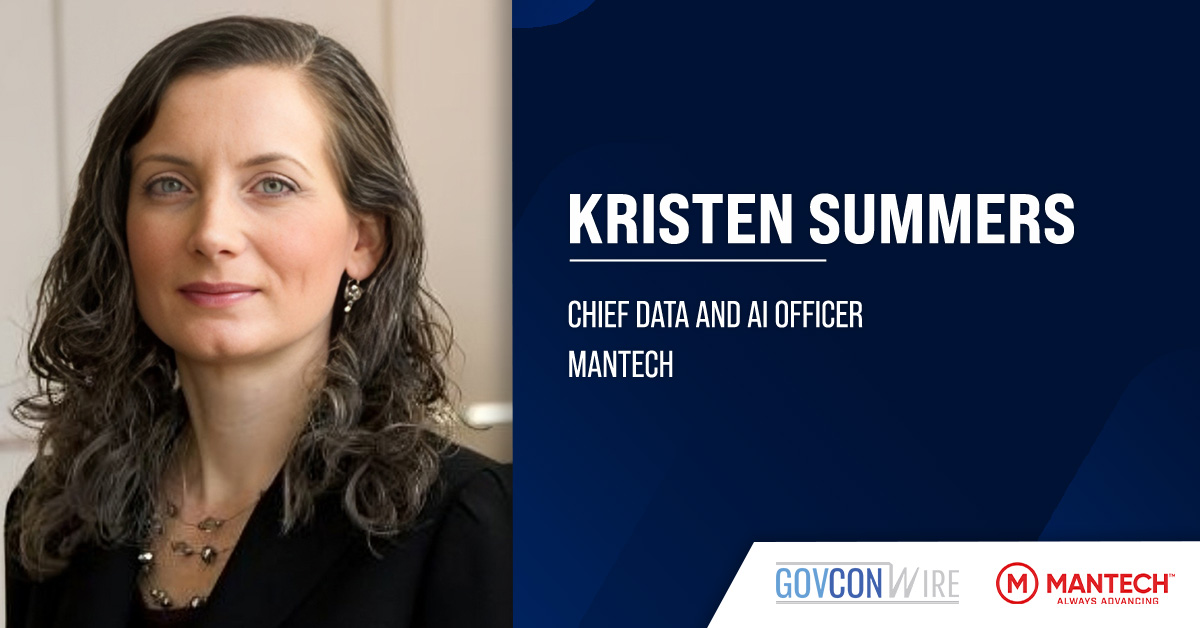
ManTech elevates a career AI technologist to the C-suite
ManTech promoted Kristen Summers to chief data and AI officer on July 14, moving a long-standing technologist into an executive seat focused entirely on data and artificial intelligence. Summers had been vice president and technical fellow for the company's data and AI practice, and she steps up as her predecessor, Brandy Durham, shifts into the chief technology officer role. For a government services contractor, splitting out a dedicated data and AI leadership role is a meaningful organizational choice. It says the discipline has grown large enough and central enough to warrant its own executive voice inside the technology and capabilities organization rather than living as a subordinate practice under a broader engineering remit.
We pay attention to these title changes because they reveal where budget and accountability are consolidating. A chief data and AI officer with a clear mandate can set standards for how models are built, evaluated, and governed across every program the company runs. Summers carries a doctorate in computer science from Cornell and more than twenty years working at the intersection of artificial intelligence and government technology, including hands-on work in multilingual natural language processing, optical character recognition, and event forecasting. That is a leader who has shipped the specific kinds of systems federal customers ask for, which lends the appointment more weight than a purely strategic hire would.
Why a chief data and AI officer title matters now
The chief data and AI officer role has spread quickly across the enterprise landscape, and the reasons are consistent. Organizations discovered that scattered analytics teams and inconsistent data governance made it nearly impossible to deploy AI responsibly at scale. Concentrating authority in one executive is how boards try to fix that. In a federal contracting context the stakes rise further, because government AI work carries requirements around security, auditability, and accountability that commercial buyers can sometimes defer. Summers will guide the company's data and AI strategy while leading a team building advanced technology offerings for both federal and commercial customers, a dual mandate that forces her to reconcile two very different risk appetites.
For technology leaders watching from adjacent industries, the structural lesson is portable. When a company names a single executive to own data and AI together, it is admitting that the two cannot be managed separately. Models are only as trustworthy as the data feeding them, and governance that stops at the analytics layer fails the moment a model reaches production. ManTech placing this role inside its technology and capabilities organization, rather than in a standalone innovation lab, suggests the company wants AI embedded in delivery rather than showcased in a demo environment. That is the more durable way to operationalize the technology, and it is the harder one to execute.
The federal AI mandate behind the move
The federal market gives this appointment its urgency. Government agencies are under sustained pressure to adopt artificial intelligence for mission work while satisfying strict oversight, and contractors that can supply governed, deployable AI stand to win. Summers spent more than seven years at IBM as a distinguished engineer and AI chief technology officer for its data and AI expert labs, and led technical delivery for North America government expert labs. She then served as an operating unit chief technology officer at Microsoft Federal. That path runs straight through the vendors and programs that define federal AI procurement, which positions her to translate agency requirements into buildable systems.
We would watch how ManTech packages this leadership change for its government customers. Agencies increasingly ask vendors to prove that a model works and that its outputs can be traced, secured, and defended under audit. An executive whose career includes more than fifteen years as a technical director at CACI understands that world intimately. The commercial half of her mandate is the wildcard. Federal rigor can be a selling point in the private sector, where AI governance is finally getting board attention, provided the company can deliver that discipline without the cost structure that government work usually carries.
What her background tells us about execution
Execution risk is where promotions like this succeed or fail. Summers is an internal elevation, which reduces the ramp-up cost and signals continuity of strategy, since she already ran the data and AI practice. Internal promotions also carry a hazard: the mandate expands but the organization around the leader may not change fast enough to match it. The move of Brandy Durham into the chief technology officer role suggests ManTech is reshuffling its senior technical bench in a coordinated way rather than filling a single gap. That coordination matters, because a data and AI chief needs the CTO's infrastructure and the delivery teams pulling in the same direction.
The honest measure of this appointment will be program outcomes, not org charts. Federal AI work is unforgiving, and the gap between a compelling capability briefing and a fielded system is where many contractors stumble. Summers has the technical credibility to close that gap, having built production systems across natural language and forecasting. What we cannot yet judge is whether she will get the funding and the engineering headcount to industrialize AI across a large services portfolio. Those resourcing decisions, made quietly over the next few quarters, will tell us far more than the announcement itself about how serious the company is.
The read for commercial CIOs
For commercial CIOs, the ManTech move is a useful mirror. The federal sector is often ahead on the governance questions that private enterprises are only now confronting, because agencies were forced to answer them first. A leader who can carry secure, auditable AI practices from government into commercial engagements is exactly the profile many boards say they want. If you are building an AI operating model, the structural choice here is worth copying: give data and AI to one accountable executive, and place that person close to delivery rather than off to the side in an innovation function.
The broader signal is that AI leadership is professionalizing. Companies are no longer content to appoint a figurehead and announce a strategy. They are elevating technologists with deep delivery records and doctorates in the field, people who have shipped systems under real constraints. That shift raises the bar for everyone. For enterprise buyers evaluating AI vendors, the credibility of the technical leadership is becoming a legitimate procurement criterion. ManTech naming a Cornell-trained AI practitioner to its C-suite is a small but telling example of where the market is heading, and it is a standard worth applying to your own hiring.