A Score for the Agentic Era
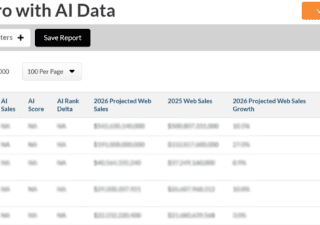
Digital Commerce 360, the research firm behind the closely watched Top 1000 ranking of North American online retailers, has added an agentic readiness layer built with ReFiBuy, an agentic commerce analytics company led by longtime ecommerce figure Scot Wingo. The new AI Commerce Rankings grade each of the Top 1000 on how well prepared their catalogs and storefronts are for shopping driven by AI agents, and the firms plan to refresh the scores quarterly. For retail technology leaders, the launch matters because it turns agentic readiness from a vague strategic worry into a benchmarked metric that peers, boards, and competitors can now see and track over time.
The timing follows a sharp shift in how shoppers reach retail sites. Adobe Analytics reported that traffic to United States retail sites from generative AI tools rose 693 percent year over year during the 2025 holiday season, and stayed elevated into 2026 with AI source traffic up 393 percent year over year in the first quarter. That growth curve is why a readiness score now carries weight. The Top 1000 has always been one of the most important scoreboards in ecommerce, said Scot Wingo, chief executive of ReFiBuy, adding that estimated online sales show who won the last era of ecommerce while the new rankings show who is positioned to win the next one.
What the Ranking Measures
The ranking combines four signals into a single readiness view. The first is bot friendliness, a measure of whether AI agents can actually access a retailer's catalog data rather than being blocked at the door by bot defenses. The second is AI source traffic share, the portion of a retailer's visits already arriving from AI tools. The third is the diversity of those AI sources, which captures whether a retailer shows up across many assistants or depends on one. The fourth is 90 day momentum, the recent trajectory of AI driven traffic. Together they describe whether a catalog is accessible, visible, gaining traction, and competitive inside AI shopping environments.
Each signal maps to a concrete engineering decision. Bot friendliness depends on how a retailer configures robots directives, edge security, and structured product data, the same controls that once existed to keep automated traffic out. Traffic share and source diversity depend on feed quality and on how well product content answers the questions an agent asks on a shopper's behalf. Momentum rewards teams that are actively tuning for AI discovery. The practical message for a CTO is that agentic readiness is largely a data and infrastructure problem the organization already knows how to work on, provided it stops treating AI crawlers as threats to be filtered.
Scale No Longer Wins
The most striking finding is that size and readiness have decoupled. The retailer ranked 814th by online sales in the Top 1000 came in first on AI readiness, and the early leaders across the rankings include Online Labels, Nixon, Fashionphile, Everlane, and Brooklinen, none of them giants of the online sales chart. That pattern should unsettle large incumbents that assumed their scale would carry them into agentic commerce. A smaller, focused retailer with clean product data and open access to agents can outrank a household name whose catalog is locked behind aggressive bot management and inconsistent feeds.
For technology leaders, the decoupling is an opportunity and a warning at once. It means a mid sized retailer can build a defensible position in AI shopping without matching a competitor's marketing budget, purely by getting the data plumbing right. It also means a large retailer's brand equity offers little protection if agents cannot read or trust its catalog. Brian Warmoth, editor in chief of Digital Commerce 360, credited ReFiBuy with bringing the methodology and data capabilities to help add an important new layer of agentic readiness to the Top 1000. The quarterly cadence means every retailer's position will move, and standing still will show up as decline.
What to Instrument Now
The rankings give retail technology teams a ready made checklist. First, confirm that AI agents can reach the catalog, which means auditing bot rules and edge defenses that may be silently blocking the very traffic the business now wants. Second, enrich product data with the attributes agents rely on, including answers to common questions, compatible accessories, and substitutes, so an assistant can represent a product accurately. Third, measure AI source traffic directly, because a metric no one tracks will not improve. Fourth, monitor diversity across assistants, since dependence on a single agent is a concentration risk as the AI shopping landscape keeps shifting.
None of this requires a platform replacement, which is the reassuring part of the story for teams weary of large migrations. The work sits in feeds, structured data, access policy, and analytics, all areas an existing commerce team can own. The harder shift is organizational, because it asks security and marketing to agree that verified AI agents belong on the allow list, and it asks leadership to fund discovery work whose payoff shows up in a third party score rather than an immediate conversion line. Retailers that make that shift early will compound their advantage every quarter the rankings refresh.
The Competitive Stakes
The rankings also change the competitive conversation inside retail. Until now, agentic readiness was easy to defer, because no external scorecard forced the issue and the traffic still felt small next to search and paid social. A public, quarterly benchmark removes that comfort, since a board can ask why a competitor three times smaller scores higher on the metric that governs the fastest growing traffic source. That pressure is healthy, because it moves AI discovery from an experimental side project into a tracked business objective with an owner, a baseline, and a trajectory that leadership will revisit every quarter.
There is a risk in optimizing for any single score, and retail leaders should hold the ranking in perspective. A high readiness grade means agents can find and represent a catalog well, and a strong grade alone does not guarantee conversion or margin once an agent completes a purchase. The smarter use is diagnostic: treat the four signals as a health check on infrastructure and data, fix the weak ones, and pair the external score with internal metrics on AI driven revenue and returns. Retailers that combine the benchmark with their own economics will avoid gaming a number while missing the profit it is supposed to represent.