An Award That Rewards Outcomes, Not Hype
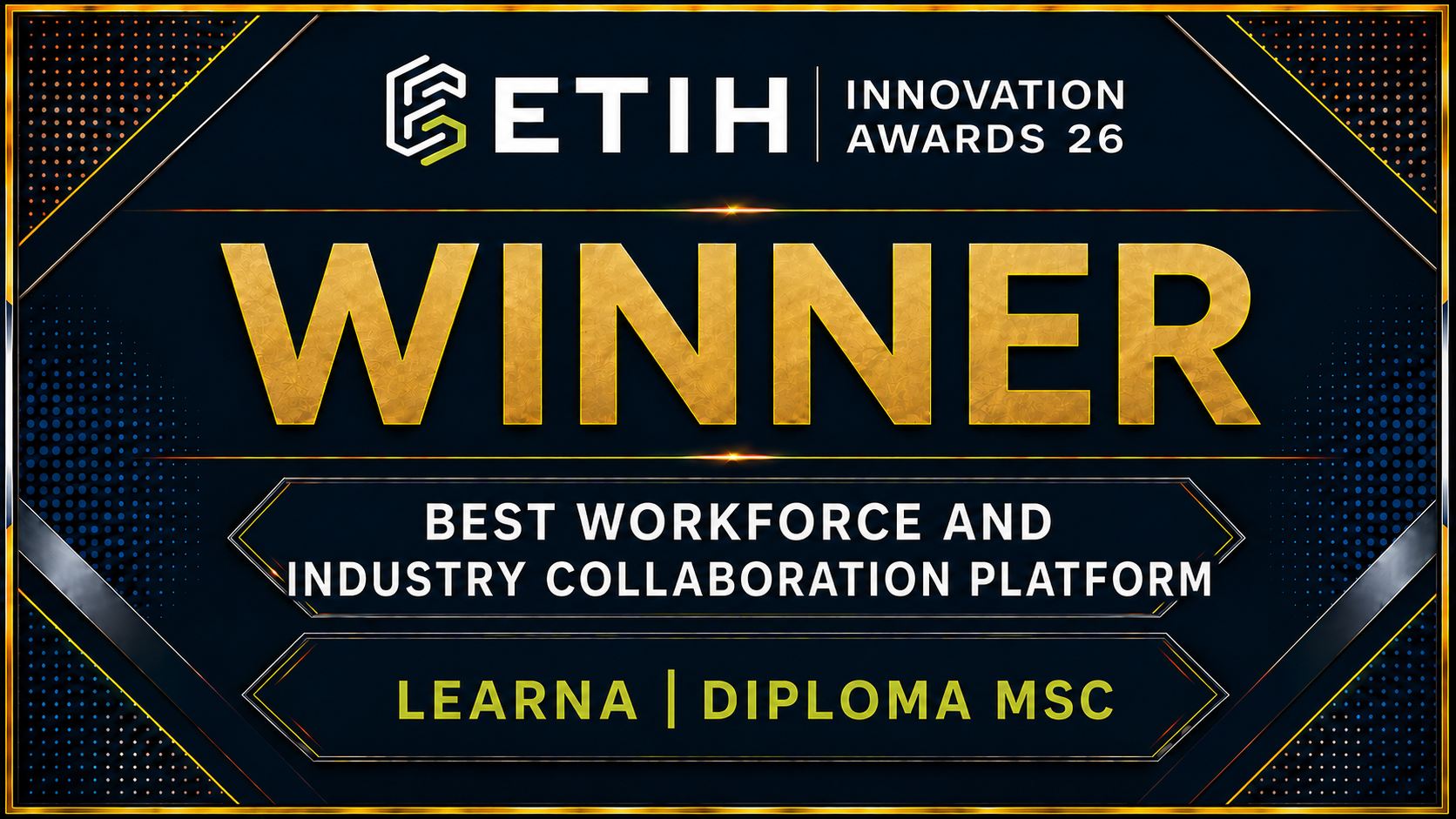
On June 24, Learna was named Best Workforce and Industry Collaboration Platform at the 2026 ETIH Innovation Awards. The company delivers accredited online postgraduate medical education to working healthcare professionals worldwide, in partnership with the University of South Wales and the University of Buckingham. What makes the win notable is not the trophy but the evidence behind it. In a sector awash with AI demos and pilot announcements, Learna stood out on the least glamorous metric in education: people actually finishing.
We pay attention to completion because it is where most online learning quietly fails. Massive open courses became famous for single-digit completion rates, and corporate training is frequently a compliance ritual rather than a capability builder. Learna reports a 79 percent online completion rate and 87 percent student satisfaction as of 2025, numbers that would be the envy of nearly any enterprise learning function. Those figures are the real story, and they explain why a postgraduate medical provider won a workforce award.
The Design Choice: Built Around Shift Work
Learna's offering is more than 50 fully online postgraduate certificates, diplomas, MScs, and MBAs, all engineered around clinical schedules and shift work. That design constraint is the whole point. Healthcare professionals cannot pause their jobs to study, so the program is asynchronous and structured to fit irregular hours rather than assuming a fixed class time. The provider also runs a pre-enrollment Get Set for Success program to prepare learners before they begin, which is a deliberate intervention against early dropout.
CEO Courtenay Probert grounded the model in the pressure its learners face: Healthcare systems globally are under enormous pressure, and the professionals working within them don't have the luxury of stepping back. That sentence is also a thesis about workforce learning generally. The most valuable employees are the busiest ones, and any program that demands they step back from work to learn is starting from a losing position. Learna's answer is to bring the learning to the schedule, not the other way around.
The Numbers Behind the Claim
The scale and trajectory back up the design. Learna has more than 10,400 alumni and 2,500 active students, supported by over 500 practicing healthcare professionals serving as faculty. Its September 2025 cohort alone drew 1,453 students from 106 countries, a reach that few specialized programs achieve. Crucially, attrition fell from 35 percent in March 2023 to 22 percent in March 2025, evidence that the retention work is improving rather than coasting on a one-time result.
Then there is the outcome that learners actually care about: 70 percent of graduates report higher salaries within three years. Salary lift is the cleanest signal that a program delivers transferable value rather than a certificate that decorates a wall. For a workforce platform, that is the metric that closes the loop between learning and career, and it is precisely the data point most corporate L and D teams struggle to produce. Learna can, and that is why the award fits.
What Enterprises Outside Healthcare Should Take From It
The lesson generalizes well beyond medicine. Every sector now faces a workforce that must keep learning while doing demanding jobs, and the organizations that win will be the ones that embed learning into the rhythm of work rather than bolting it on. Learna's combination of asynchronous design, practitioner faculty, a structured onboarding ramp, and relentless attention to attrition is a playbook, not a healthcare quirk. The mechanics transfer to any enterprise serious about upskilling a stretched workforce.
We would add one caution and one opportunity. The caution is that high completion is earned through design and support, not bought through content volume, so leaders chasing these numbers should invest in the unglamorous retention work first. The opportunity is that this is exactly the kind of program where AI can help, by personalizing pacing, flagging at-risk learners early, and adapting to a clinician's chaotic schedule. Learna's win is a reminder that the goal of all that technology is a simple, hard-to-fake outcome: learners who finish and earn more for it.