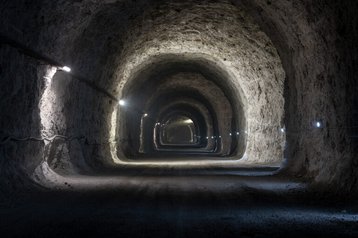
Compute Goes Underground
On June 29, a public-private venture called Trentino DataMine opened what it bills as Europe's first data center built inside an active mine. The facility, named Intacture, sits 100 meters underground in the Tuenetto di Predaia quarry in Val di Non, in the Italian Dolomites, in storage rooms historically used to age apples, sparkling wine, and cheese. It carries 6MW of capacity, cost 50 million euros, and was delivered in just over two years from design to operation. It is a small build with an unusually clever thesis.
The thesis is thermal. The biggest operating headache for any data center is heat, and the biggest controversy around the industry is the water it burns to shed that heat. By burying the facility deep in rock, Intacture exploits the stable, cool underground temperature to run a water-free cooling system. In a year when data center water consumption has become a political flashpoint from Arizona to Spain, a site that needs no cooling water at all is not a gimmick, it is a genuine engineering answer.
The Numbers and the Public Money
The construction figures are striking. Builders extracted 63,000 square meters of rock and excavated 15 kilometers of tunnels, with more than 80 percent of the facility built underground. The 50 million euro total cost included 18 million euros drawn from Italy's National Recovery and Resilience Plan, the EU-funded program designed to modernize the Italian economy. Trentino DataMine itself is a partnership between the University of Trento and local businesses, established in September 2023, which makes the two-year delivery timeline genuinely fast for a project of this complexity.
The public funding component is worth dwelling on. This is not a hyperscaler chasing AI training revenue, it is a regionally rooted venture using recovery-plan money to anchor digital infrastructure in a remote alpine valley. That changes the incentives. The goal is local economic development and sovereign capacity, not maximum return on GPUs. For European policymakers wrestling with how to keep compute on the continent, Intacture is a template for how state money can de-risk unconventional builds.
Renewable Power, No Water
Intacture runs on 100 percent renewable energy and uses water-free cooling, which together give it an environmental profile most surface data centers cannot match. The combination matters because the two loudest criticisms of the data center boom are its electricity draw and its water consumption. A facility that addresses both at once, by siting underground and powering from renewables, sidesteps the very objections that are fueling moratoriums and rezoning fights across the US and Europe.
We should be honest about the limits. At 6MW, Intacture is a rounding error next to the gigawatt campuses dominating the headlines, and the underground approach does not obviously scale to the multi-hundred-megawatt loads that AI training demands. You cannot carve a 1GW Stargate out of an apple cellar. But for edge, sovereign, and latency-sensitive workloads in regions where surface land and water are contested, the model is compelling. Not every problem needs a gigawatt, and not every site needs a river.
The Edge and Latency Angle
Beyond sustainability, the site type points at a real workload fit. Underground facilities carved into stable rock offer physical security, natural thermal regulation, and resilience against surface weather and disruption that conventional sheds cannot match. Those properties matter for sovereign archives, financial record-keeping, defense-adjacent data, and latency-sensitive edge processing in regions where the alternative is shipping data to a distant hyperscaler region. A 6MW alpine facility is never going to train a frontier model, but it can host the kind of resilient, regulated workloads enterprises increasingly want kept close and kept safe.
That is the unglamorous but durable market for builds like Intacture. As AI pushes inference closer to users and regulators push data closer to home, the demand for distributed, sustainable, secure capacity in unconventional locations only grows. Trentino DataMine has shown that a university, local businesses, and recovery-plan funding can deliver such a site in two years. The lesson for executives is that the future map of European compute will include far more of these small, specialized nodes than the gigawatt-campus headlines suggest.
Italy's Mediterranean Ambition
The political framing was explicit. Adolfo Urso, Italy's Minister for Enterprise and Made in Italy, declared that Italy has everything it takes to establish itself as a Mediterranean hub for data and computing power. That is a bold claim for a country not usually mentioned alongside the Nordics or Ireland in data center conversations, but Italy has cheap renewable potential, geographic centrality, and now a flagship project that demonstrates technical creativity. The Mediterranean hub pitch is aimed squarely at hyperscalers shopping for European capacity.
For enterprise technology leaders, the takeaway is not that they should rush to put workloads in a Dolomites mine. It is that the playbook for sustainable, sovereign compute is widening. Underground siting, water-free cooling, renewable power, and public co-funding are now a demonstrated combination, not a thought experiment. As water and community opposition keep tightening the screws on conventional builds, expect more operators to study Intacture and ask whether their next site belongs below the surface rather than on a contested field.