What Disney Actually Launched
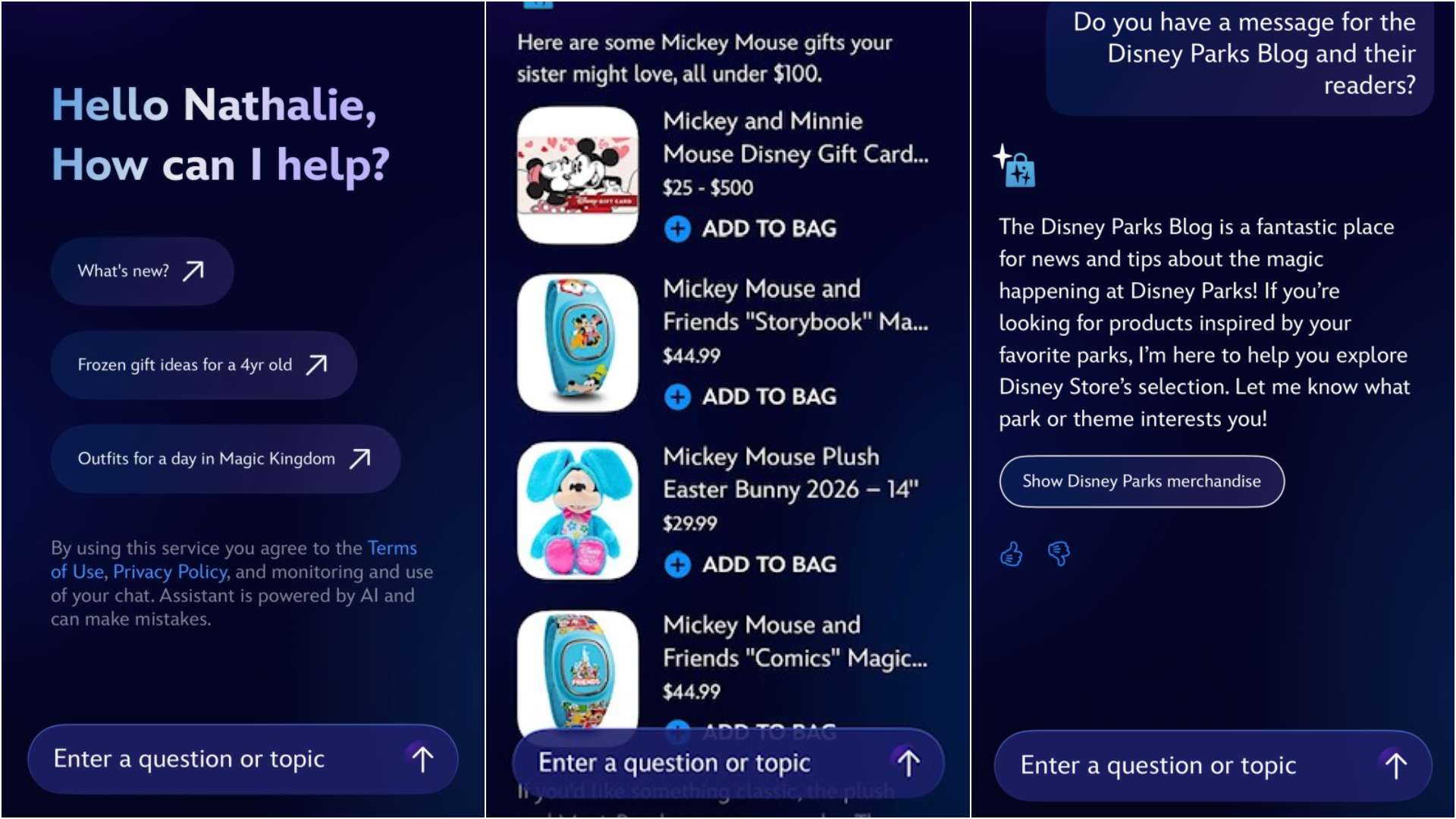
Disney Store took the wraps off an AI Personal Shopping Assistant, rolling it out as a pilot to select shoppers inside its iOS app before a planned expansion to all iOS users with registered Disney Store accounts. Android and browser support are described as coming in the months ahead. The tool is a conversational layer over product discovery, letting shoppers search in natural language instead of relying on keywords or endless scrolling through the assortment.
The feature set is conventional for this category. Shoppers can ask for picks by character, age, occasion or budget and get instant recommendations with real-time availability, plus one-click shopping, sale alerts and order tracking. Disney describes the assistant as mirroring its brand voice and character knowledge across the full product range. On paper it is a competent, on-trend deployment, the kind of conversational commerce layer that retailers from Walmart to Newegg have been shipping all year.
The Backlash Was Immediate
The reception is the story. The Disney Parks Blog Instagram announcement drew more than a thousand comments, with hundreds more on Facebook, and the response was close to uniformly hostile. One outlet covering the launch reported it "could not find a single comment that was clearly supportive of the new tool." For a brand whose announcements normally attract reflexive praise from fan accounts, an absence of supportive comments is not noise, it is a signal.
The complaints clustered around a few themes. Many commenters raised job-loss concerns, questioning whether replacing human help was worth the cost to staff livelihoods. A frequently liked reply simply asked Disney to "bring human staff back into physical stores instead." Others expressed general fatigue with generative AI rollouts and urged Disney to pause its AI expansion. Several Facebook users said the announcement alone would stop them shopping at Disney Store, a direct commercial threat rather than abstract grumbling.
Why a Beloved Brand Pays More
The lesson for executives is that brand equity cuts both ways with AI. The same emotional attachment that makes Disney customers loyal also makes them protective of the human, hand-crafted associations the brand has spent a century building. An AI shopping bot reads as efficient and impersonal precisely where the brand promises wonder and human warmth. The technology that is neutral at Newegg becomes a values violation at Disney Store, even when the feature itself is identical.
We think this is the most underpriced risk in retail AI right now. Companies benchmark these assistants on conversion and containment rates, not on whether the rollout contradicts the brand's emotional contract with its customers. Disney's assistant may well lift discovery and basket size in the data. But if the launch narrative reads as cast-member replacement to the most loyal segment, the reputational cost can swamp the operational gain. The bar for AI is higher when people love you.
Disney's Muted Response
Disney has been careful to position the assistant as additive rather than substitutive, confirming that human representatives remain available and are "only a phone call away." That framing is plainly meant to defuse the job-loss critique, and it is the right instinct. But as of the coverage, Disney had issued no formal response to the wave of negative comments, leaving the loudest interpretation of the launch to its critics. In a fast-moving backlash, silence is itself a position.
The communications gap matters more than the feature gap. A pilot that quietly improves product discovery is defensible, even welcome. A pilot announced into an emotionally invested audience without a clear story about what it does for people, and what it does not do to staff, invites exactly the reaction Disney got. The technology was ready. The narrative was not, and for a brand built on storytelling, that is an unusually self-inflicted wound.
The Broader Signal for Retail
This episode lands amid a year of aggressive conversational commerce launches, and it is a useful counterexample to the assumption that shoppers universally want AI assistants. Adoption research already showed a meaningful share of consumers finding agentic shopping intrusive or unnecessary, and many willing to abandon an AI agent after a single mistake. Disney's customers did not even wait for a mistake. They objected to the premise. That is a different and harder problem to engineer around.
For CTOs and CMOs, the takeaway is to treat AI deployment as a brand decision, not merely a product one. Sequence the rollout, pair it with a credible human-augmentation story, and pressure-test the announcement against the most loyal customers before it ships, not after. Disney will likely keep the assistant and the noise will fade, as it usually does. But the cleaner path was available, and the cost of skipping it was a day-one revolt that no conversion metric will fully erase.