What was announced at Ignite
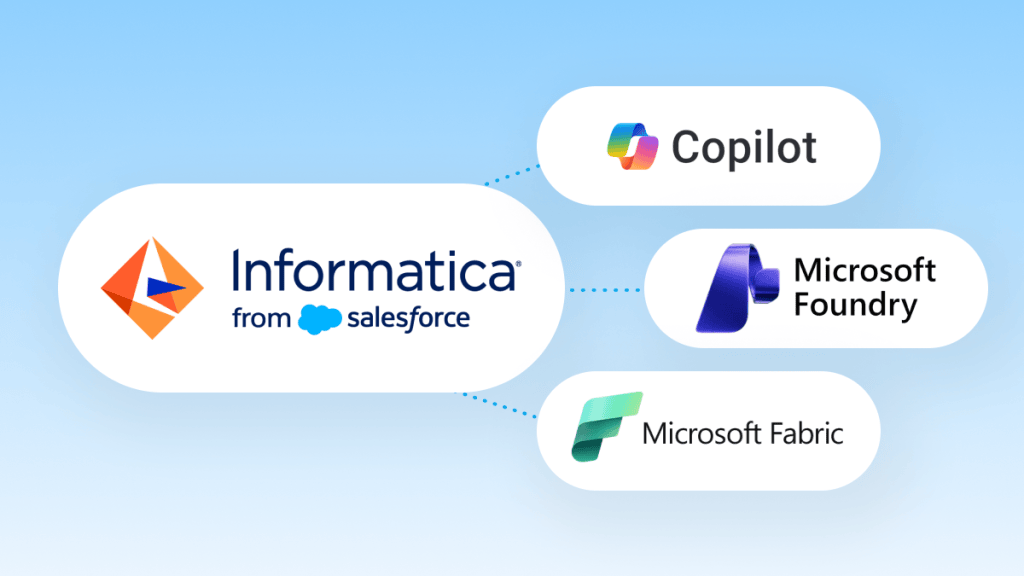
Informatica, now operating as a Salesforce company, used Microsoft Ignite 2026 to announce a deeper collaboration spanning Copilot, Foundry, and Fabric. The headline piece is general availability of Informatica's Headless MCP server inside Microsoft Foundry, which gives AI agents built on Foundry access to Informatica's governance layer, catalog metadata, lineage, and quality signals, plus identity and administrative controls and audit trails for agent activity specifically. Microsoft Copilot and Teams also gained general availability access to the same Informatica Headless capabilities, surfacing glossary terms, lineage, and quality indicators directly inside the assistant experience.
A third piece extends Fabric scanning to notebooks and data pipelines, broadening lineage and impact analysis beyond the tables and reports most scanners already cover, with consolidated administration across scanner types so a data engineering lead no longer has to check several separate scanner configurations to understand full coverage. The fourth is more mundane but practically important for any team running latency-sensitive workloads: a new Azure U.S. East Coast point of delivery for Informatica's Intelligent Data Management Cloud, bringing data integration, governance, quality, and master data management physically closer to compute rather than routing through a more distant region by default.
The governance gap this targets
Savinay Berry, who leads data management for Salesforce, framed the announcement around a specific problem: giving every employee an assistant is not the hard part of enterprise AI anymore, embedding trustworthy context into what that assistant can act on is. The statistic backing that framing comes from Deloitte's 2026 State of AI in the Enterprise report: 85 percent of organizations expect to customize AI agents for their own workflows, but among those actively planning agentic deployments, only 21 percent describe their agent governance as mature.
That 64-point gap between intent and governance readiness is the real story here, and it matches what we hear directly from CIOs running pilots right now. Agents that can read and write across systems without a consistent permission and audit model are the single most common reason agentic pilots stall before reaching production. Informatica and Microsoft are betting that bundling governance into the platform layer, rather than leaving each team to build it per agent, is what finally closes that gap at scale.
Why headless matters more than the Copilot integration
The Copilot and Teams integration is the visible, demo-friendly piece, but the Headless MCP server generally available in Foundry is the one worth your architecture review. Headless governance means the catalog, lineage, and policy enforcement travel with the agent regardless of which interface invokes it, Copilot, a custom Foundry agent, or something built entirely outside Microsoft's stack that still calls the MCP server. That is a meaningfully different commitment than a point integration with one chat assistant.
For a CIO running a multi-vendor AI stack, which is most of them, the question to ask Informatica directly is how portable that governance layer actually is outside the Microsoft ecosystem. A governance server that only enforces policy when an agent happens to run inside Foundry is a feature. One that enforces policy consistently across Foundry, a different cloud's agent runtime, and a homegrown agent framework is infrastructure. The MCP protocol choice suggests the latter is the intent, but intent and current implementation are not the same thing, and that gap is worth a direct question in your next vendor call.
The quiet procurement change
Buried in the announcement is a change to how Informatica purchases interact with Azure Consumption Commitments. Customers can now apply the full pre-tax amount of Informatica offers bought through Microsoft Marketplace toward their MACC, subject to eligibility. For an enterprise sitting on a large committed Azure spend that it is racing to draw down before a renewal deadline, this effectively makes Informatica cheaper relative to a standalone contract, purely through accounting mechanics rather than list price.
This is worth routing to whoever owns your Azure commitment relationship before your next Informatica renewal conversation, not after the fact once the budget cycle has already closed. Marketplace-based procurement has been quietly reshaping how enterprise software gets bought for two years now, and governance and data management vendors folding themselves into that mechanism changes the actual cost comparison against competitors who have not done the same. Two products that look identically priced on a vendor's list price sheet can end up meaningfully different in net cost once one of them draws down a commitment you were going to spend anyway.
What a reference customer actually said
Desigan Reddi, who leads enterprise architecture and innovation at Wescom Financial, described the Foundry and Fabric integration as giving his team a contextual, trusted data layer specifically for deploying AI, rather than framing it as a catalog or lineage upgrade. That framing matters: it suggests the governance tooling is being evaluated by practitioners primarily through the lens of what it unblocks for agent deployment, not as a compliance checkbox exercise running in parallel to the AI work.
That is the right lens for any CTO evaluating this announcement too. The test is not whether your catalog tool now has an AI feature bolted on. It is whether a new agent your team wants to deploy next quarter can get to production faster because the governance, lineage, and audit trail already exist at the platform level, rather than needing to be built bespoke for that one agent's specific data access pattern.
The decision this creates
If your organization is already running Informatica and Microsoft Foundry or Fabric side by side, this announcement should move up the priority of connecting them, because the integration work Deloitte's survey implies most teams are still doing manually is exactly what the Headless MCP server is meant to remove. If you are running a different catalog or governance vendor alongside Foundry, use this as leverage: ask your current vendor directly whether they have an equivalent headless, protocol-based integration, and on what timeline.
Either way, treat the 21 percent agent governance maturity figure as a benchmark for your own organization, not just a market statistic. Run the honest internal assessment: if an auditor asked for the full access trail of every agent currently in production against your governed data, could you produce it today. If the answer is no, that gap is the actual roadmap item this announcement is pointing at, regardless of which vendor eventually closes it for you.