A lot happened in six weeks, and almost none of it made headlines
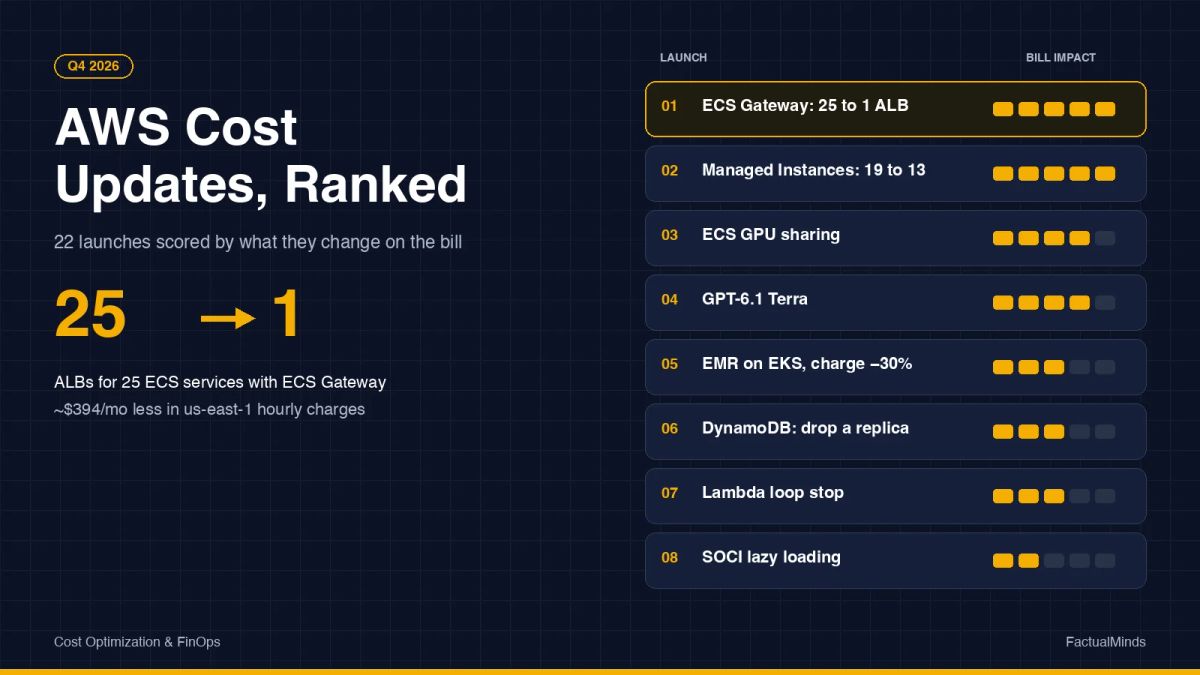
Between October 14 and November 3, 2026, AWS shipped at least 22 distinct launches that move the needle on a customer's monthly bill, according to a detailed review by AWS-certified cloud architect Palaniappan P. None of these were announced as cost changes. They were framed as new features, capacity improvements, or service tier upgrades, the standard AWS pattern of bundling financial impact inside product announcements that most FinOps teams only skim.
That framing matters because it is exactly why these launches tend to slip past the teams responsible for tracking cloud cost. A feature release gets routed to an engineering team evaluating whether to adopt it technically. A pricing change gets routed to finance for review. When the two are the same announcement, it frequently gets reviewed by neither function with the full picture, and the organization ends up discovering the cost impact on the next invoice instead of in the planning meeting where it belonged.
The genuine savings are real, if you act on them
Several launches in this window are straightforward wins. The new ECS Gateway lets up to 25 services share a single Application Load Balancer instead of each running its own, cutting roughly 394 dollars a month in hourly ALB charges for that service count in us-east-1 alone, a saving that scales further with larger service counts. ECS Managed Instances, in AWS's own published test, raised CPU utilization from 42% to 91% and memory utilization from 41% to 88%, while shrinking a compute fleet from 19 instances to 13, worth more than 10,000 dollars a month at on-demand pricing for that workload shape.
These are not launches that save money automatically. ECS Gateway and ECS Managed Instances both require a migration decision, re-architecting how services are load balanced or how compute fleets are provisioned, before the saving materializes. A team that reads the announcement, nods, and moves on captures none of it. The saving exists in the AWS documentation starting the day of the announcement, but it only reaches your invoice after someone on your team actually does the migration work.
Not every launch is free money
The same six week window included changes that add cost, and they received less attention precisely because nobody expects a feature launch to be a price increase. ElastiCache for Valkey's new synchronous write option costs 18% more than the standard node-hour price, a premium for a durability guarantee some workloads need and many will adopt without checking the cost delta first. AWS Config's addition of ten new resource types can add configuration-item charges to accounts that have Config enabled broadly, a change that shows up as a creeping line item rather than an announced increase.
Both of these are easy to miss in exactly the way the genuine savings are easy to miss, just in the opposite financial direction. A team evaluating Valkey's new synchronous write mode for its reliability benefits may never connect that evaluation to a FinOps review, and an account with broad AWS Config coverage absorbs the new resource type charges automatically unless someone actively audits what Config is tracking and why.
The pattern that should change how you track AWS pricing
The specific dollar figures in any single launch matter less than the pattern across all 22 of them: AWS's cost-relevant changes arrive continuously, in small increments, framed as product news, and split roughly evenly between launches that save money and ones that quietly add it. A FinOps function that reviews AWS's announcement feed quarterly, or relies on the annual reinvoice to catch surprises, will structurally miss both halves of this pattern until the gap has already compounded across several billing cycles.
This is not an argument for reading every AWS announcement line by line. It is an argument for a standing monthly process, owned jointly by platform engineering and finance, that specifically screens new launches for bill impact regardless of how the announcement is framed. The 18% Valkey premium and the 394 dollar ECS Gateway saving were announced the same way, in the same tone, in the same channel. Only a process built to catch both will catch both.
The decision this reader owns
If your organization's cloud cost governance still runs on an annual review cycle, this six week window is a concrete argument for moving to monthly. The volume of changes AWS ships that affect your bill, in either direction, has outpaced what a quarterly or annual review can reasonably catch before the financial impact has already accumulated across several invoices, and a PE-backed business under scrutiny on unit economics can least afford to discover either direction of surprise after the fact rather than in the planning cycle.
The practical first step is assigning ownership, not building new tooling. Someone on your platform or FinOps team should read AWS's What's New feed with a specific lens: does this change our bill, and does it require action to capture a saving or avoid a new cost. That single habit, applied monthly, would have caught both the ECS Gateway opportunity and the Valkey cost increase in this window, well before either one became a surprise line item on a board report, and it costs nothing beyond the hour or two a month it takes someone to actually do the reading.