What shipped in the Q4 2026 release
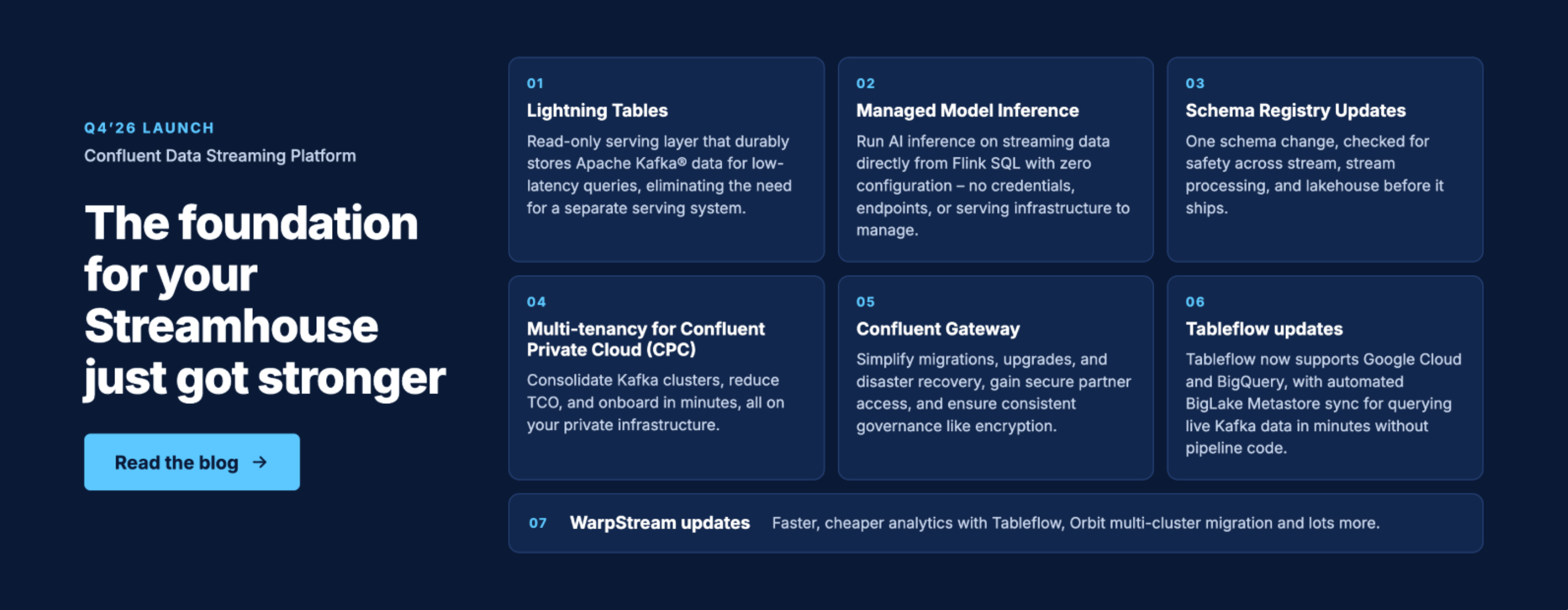
Confluent used its Q4 2026 launch to introduce Lightning Tables, a fully managed, read-only layer that makes Kafka topic data queryable without first landing it in a warehouse or a bolted-on cache. Confluent says changes become available for serving within hundreds of milliseconds of arriving in a topic, and query responses return in 10 to 100 milliseconds even at more than 1,000 queries per second. That is a different performance class from the batch-oriented analytics most streaming teams settle for once data leaves Kafka.
The release bundled five other pieces worth noting together: Managed Model Inference, which lets Flink SQL call LLMs and embedding models in Bedrock, Vertex AI, and Azure OpenAI with zero extra configuration; a generally available Streamhouse Accelerator, which packages migration help starting at a $25,000 commitment against $50,000 of list value; multi-tenancy for Confluent Private Cloud; a generally available Confluent Gateway across all three deployment modes; and Tableflow on Google Cloud reaching general availability with BigLake Metastore sync. None of these individually is headline material. Together they read as a coordinated push to make Confluent the system of record for the entire real-time data path, not just the transport layer.
The serving layer has been the weak link
Every CTO who has run a Kafka estate at scale knows the real cost center is rarely ingestion. It is the second hop, the pipeline that copies topic data into Postgres, Redis, or a warehouse table so an application or dashboard can query it fast enough to be useful. That hop adds a consumer group to operate, a schema to keep in sync, and a failure mode where the serving copy drifts from the source of truth during an incident. Confluent is betting that removing the hop entirely is worth more to buyers than any single new connector or SQL feature.
That bet lands at a reasonable moment. Teams that spent 2024 and 2025 building retrieval layers for AI agents now have two live data stores to reconcile: the operational one and the one the agent reads from. Lightning Tables, positioned as the thing an agent or application queries directly, reduces that to one. Whether it replaces a dedicated OLAP store for every workload is unproven in production at scale, and we would not take Confluent's own benchmarks as the ceiling. But as a default for request-response reads off recent streaming data, it closes a real gap.
Governance catches up to a multi-engine reality
The less flashy change may matter more operationally: Schema Registry now enforces a Logical Compatibility Policy that checks a proposed schema change against every downstream consumer type at once, Flink jobs, Tableflow syncs, and Lightning Tables queries included. Anyone who has shipped a schema change that passed basic compatibility checks and then silently broke a Flink job three services downstream will recognize the problem this solves. Multi-engine streaming architectures have outpaced the governance tooling built for single-consumer Kafka, and this is a direct admission of that.
Confluent also added explicit topic-subject binding and SQL-style logical schemas to the registry, which matters for teams running compliance reviews on data lineage. For a reader managing risk across a PE-backed portfolio of SaaS platforms, the governance layer is the part worth testing before the performance claims. A serving layer that is ten milliseconds faster does not help if a schema change breaks three consuming systems during a migration window, and that is exactly the failure mode this policy targets.
What this means for build versus buy
If your team maintains a custom pipeline that copies Kafka data into a serving store today, this release is the moment to run the honest comparison. The relevant cost is not Confluent's list price against your current infrastructure bill. It is that price plus your current price, against the fully loaded cost of the engineers maintaining the custom hop, the incident history tied to drift between source and serving copy, and the opportunity cost of those engineers' time on anything else.
We have seen teams underprice the custom path because the infrastructure line item looks cheaper than a vendor contract, while the headcount line item hides in a broader platform budget. A fair evaluation puts both lines in front of the same decision maker. If Lightning Tables genuinely removes a maintained hop, the math usually favors consolidation, particularly for teams already paying for Confluent Cloud or Private Cloud elsewhere in the stack.
Where WarpStream fits the bigger picture
Confluent folded WarpStream improvements into the same release cadence, including Orbit for multi-source migrations and new Protobuf validation. WarpStream remains the lower-cost, object-storage-backed Kafka-compatible tier Confluent acquired to compete with self-hosted and cheaper managed alternatives. Shipping it alongside the premium Lightning Tables and Streamhouse features tells you Confluent is deliberately building a ladder: cheap entry point, premium serving and AI layer, and a migration path between them that does not require a rewrite.
For a CIO managing a multi-year Kafka contract, that ladder is the more important signal than any single feature. It suggests Confluent expects to compete on total lifecycle cost across the whole data path, from cheap ingestion through premium serving, rather than on peak feature set alone. Expect the discount conversation at your next renewal to increasingly be framed around which tier of the stack you actually need, and how much of WarpStream's lower-cost footprint you can shift workloads onto, rather than a single negotiated price per broker across the entire estate.
The decision this creates for your roadmap
Treat this release as a trigger to re-scope any open ticket for a new real-time serving layer. Before approving a new database or cache specifically to serve Kafka-sourced data to an application or an AI agent, get a proof of concept running against Lightning Tables first. The capability is new enough that production war stories are still thin, so pair the trial with a clear rollback plan and a short time box.
Longer term, watch whether the governance changes in Schema Registry actually reduce incident counts in multi-consumer pipelines over the next two quarters. That is the metric that tells you whether Confluent solved a real operational problem or just added a policy layer on top of one. Either way, the direction is clear: streaming vendors are no longer competing only on throughput, they are competing on how much of the downstream data lifecycle they can own.