What was announced
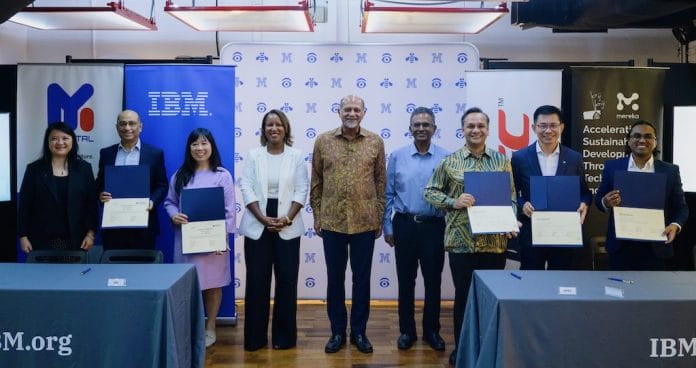
Malaysia Digital Economy Corporation (MDEC), IBM, and the Biji-biji Initiative have committed to equipping 41,000 students, youth, and adult learners with free AI and digital skills training by the end of 2026. The stated goal is to strengthen Malaysia's technical and vocational education and training pipeline, widen access to digital jobs, and build a workforce ready for the country's digital economy. The program pairs IBM SkillsBuild, IBM's free online learning platform, with Biji-biji's community reach and industry connections to move learners from coursework toward employment.
Gobind Singh Deo, Malaysia's Minister of Digital, framed the effort in economic terms, saying access to quality AI and digital skills development is essential so all Malaysians can participate meaningfully in the digital economy. The structure is deliberately layered: high school students receive AI fundamentals grounded in real industry use cases, while a TVET track delivers job-relevant skills in agentic AI, software development, and web development. An industry symposium sits on top, designed to connect trained talent to IBM clients so the pipeline ends in hiring conversations rather than certificates.
Free training is a distribution channel
IBM SkillsBuild is free to learners, and that is precisely why it is strategic for IBM. The Malaysia program ladders up to IBM's global commitment to skill 30 million people by 2030, including 2 million in AI by the end of 2026. Numbers at that scale only work through partnerships with governments and community organizations that supply reach IBM does not have on its own. Biji-biji provides the local delivery, MDEC provides the policy mandate and legitimacy, and IBM provides the curriculum and the brand. Each party gets something the others cannot manufacture alone.
For IBM, the payoff is ecosystem gravity. A generation of learners trained on IBM tooling, methods, and platform concepts becomes a talent pool tilted toward IBM technology and, through the symposium, a recruitment channel for IBM clients. This is the same playbook cloud vendors run with free certification programs, applied to national skilling. Enterprise buyers should read free vendor training for what it is: a durable, low-cost way to shape the skills supply in a vendor's favor. That does not make it a bad deal for learners, and it does make the incentives worth naming.
Why TVET and agentic AI in the same program
Pairing vocational education with agentic AI content is a bet about where entry-level work is heading. TVET pipelines traditionally feed skilled trades and technical roles, and folding agentic AI, software development, and web development into that track signals that Malaysia views AI fluency as vocational infrastructure rather than an elite specialization. The choice to teach agentic AI specifically, meaning systems that plan and act rather than only generate text, is notable because it targets the capability enterprises are actively trying to deploy in 2026.
The risk is depth. Free, scaled programs are strong at breadth and awareness, and they struggle to produce the applied, job-ready competence that employers actually hire for. Teaching 41,000 people the fundamentals of agentic AI is achievable; producing enough of them who can build and govern an agent in production is much harder. The industry symposium is the mechanism meant to bridge that gap, and its real test is placement rates, not attendance. Without published outcome data, the program's success stays a claim rather than a result.
The national-skilling pattern is spreading
Malaysia is one instance of a pattern now visible across many economies: a government agency, a global technology vendor, and a local delivery partner combine to run AI skilling at national scale. The appeal to policymakers is obvious. AI skills gaps threaten competitiveness, building public training capacity from scratch is slow, and a vendor with a ready platform and a global commitment offers a shortcut. The 2026 IBM CEO Study, which the announcement cites, reports that 77% of surveyed CEOs believe talent and technology leadership roles are converging, which is the anxiety these programs are built to answer.
The trade for the host country is a degree of dependency on a foreign vendor's curriculum and platform. That is a reasonable trade when the alternative is a widening skills gap, and it is one worth entering with eyes open. Sovereignty-minded governments will want to know whether the skills transfer, or whether the training mainly deepens reliance on the vendor's stack. Malaysia's inclusion of MDEC as a policy anchor and Biji-biji as a local partner suggests an attempt to keep the program locally grounded, though the curriculum and platform remain IBM's.
What enterprise L&D leaders should take from it
The most transferable lesson for corporate learning teams is structural. This program works because it connects three things most internal skilling initiatives keep separate: content, a delivery partner with real reach into the target population, and an employer-facing endpoint where trained people meet hiring demand. Enterprise L&D functions too often stop at content and completion, then wonder why the skills do not show up in the work. The symposium model, imperfect as it is, at least designs for the handoff from learning to deployment.
The second lesson is measurement. A 41,000-learner target is a headline, and it is an input metric. The number that determines whether this program matters is how many of those learners land in AI-relevant roles or apply the skills in existing jobs. L&D leaders evaluating their own AI-upskilling spend should hold their programs to the same standard, tracking role placement and applied usage rather than course completions. Free vendor curricula can be a genuine accelerant, and they only pay off when the organization owns the outcome data that tells you whether the training changed what people can do.