The raise and who wrote the checks
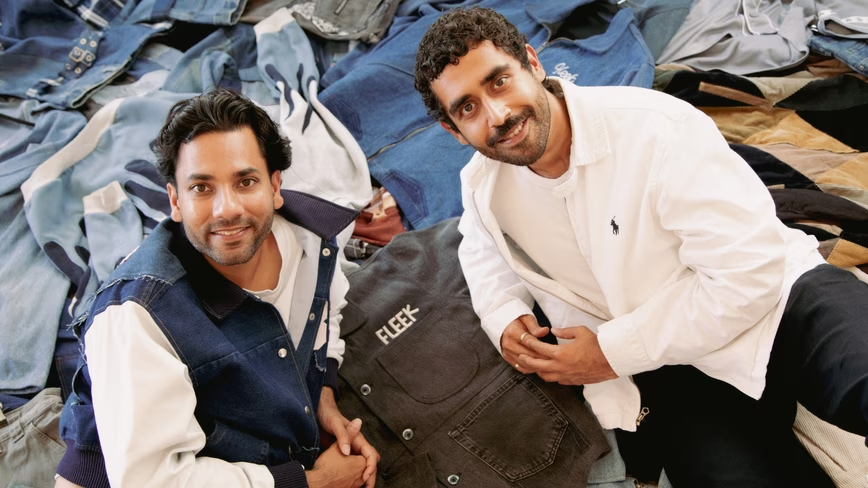
Fleek, a London-based startup founded in 2021, has raised $25 million in Series B funding to scale the AI infrastructure behind the global secondhand clothing trade. Reported on 8 July by The Next Web, Fortune and others, the round was led by Burda Principal Investments, with participation from eBay, FJ Labs and H14, alongside existing backers Andreessen Horowitz, HV Capital and Y Combinator. The new capital brings Fleek's total funding to $45 million. The money will go toward marketplace development, engineering hires, platform scaling and growth of its global buyer and supplier network. Founders Abhi Arora, the CEO, and Sanket Agarwal, the CTO, have built the company around digitizing a supply chain that still runs largely on manual sorting and offline deals.
The investor mix is the story as much as the amount. eBay's involvement is strategic: the marketplace incumbent is backing the infrastructure layer beneath resale rather than only competing at the consumer front end. Burda previously backed Vinted, and partner von Eckartsberg noted the firm supported that company when secondhand fashion was still considered niche. That signals conviction that the category has moved from fringe to structural. Fleek currently connects more than 2,000 verified wholesale suppliers and graders with over 50,000 retailers, resellers and boutiques across more than 100 countries, positioning it as B2B plumbing rather than a consumer-facing app.
Fleek Sort is the actual asset
The center of Fleek's pitch is Fleek Sort, a custom vision-language model the company says was trained on millions of secondhand transactions gathered over the past four years. Using photos or video, Fleek Sort identifies, categorizes, grades and merchandises individual garments, then learns from what actually sells to sharpen its accuracy over time. That closed loop is the point. Secondhand inventory is the hardest kind to digitize because every item is unique: no clean SKU, no manufacturer feed, no standard condition grade. A model that can look at a used jacket and produce a reliable category, grade and price is doing the work that has kept this market offline and unscalable for decades.
The AI is deployed where the friction actually lives. Fleek Sort runs in sorting hubs in Pakistan, India and Dubai, with pilots launching in the UK, Europe and the US, embedding the model at the physical choke points of the resale supply chain. Agarwal argues there is more data locked inside the global secondhand supply chain than almost any other market, and that is the moat Fleek is trying to build: proprietary training data from real transactions that competitors cannot easily replicate. For a technology leader, this is a clean example of vertical AI, a model trained on a specific, messy, high-value data set that generic foundation models cannot match without the same domain corpus.
Why circular commerce is a real enterprise category now
The macro case is straightforward. Fleek's argument, echoed by its investors, is that secondhand fashion is expanding roughly three times faster than traditional apparel, driven by cost-conscious and sustainability-minded shoppers, yet the sector cannot meet that demand while so much of it stays manual and offline. The company says it has helped keep 12 million items in circulation, with estimated savings of 13 billion liters of water and 23,000 tonnes of avoided carbon. Those figures are self-reported and should be read as directional, but the underlying growth trend is well established across the resale market and explains why capital is flowing to the infrastructure layer rather than only to consumer resale brands.
For enterprise retail leaders, the signal is that circular commerce is maturing into a supply-chain discipline with real operational demands. Brands and retailers facing resale, take-back and recommerce programs need exactly what Fleek is building: automated grading, categorization and pricing for non-standard inventory at volume. The build-versus-buy logic favors buying, because training a vision-language model on millions of secondhand transactions is not a side project a retail team can spin up, and the data advantage compounds for whoever gets there first. Fleek's raise, and eBay's presence on the cap table, suggest the infrastructure for resale at scale is consolidating around specialist AI vendors, and retailers planning recommerce should be evaluating those partners now rather than building from zero.
What this means for your recommerce roadmap
If resale is anywhere on your roadmap, intake is the operational bottleneck. Every returned or traded-in garment has to be identified, graded, priced and listed, and doing that by hand does not scale past a boutique. Fleek's bet is that this intake layer is a horizontal service that many brands and marketplaces will rent rather than build, the same way they rent payments or fulfillment. The presence of eBay and a16z on the cap table suggests sophisticated buyers agree that the grading-and-merchandising engine, not the consumer app, is the defensible asset in this category.
The caution for CTOs is to treat the sustainability metrics as marketing and the data moat as the substance. What makes Fleek investable is a proprietary transaction corpus and a model that improves as it processes more inventory, which is a durable advantage if the volume keeps flowing. Retailers weighing a recommerce program should ask any vendor how their grading accuracy is measured, how the model handles edge cases, and who owns the resulting data. The companies that industrialize secondhand intake first will set the economics for the category, and this round is a clear signal that the infrastructure race is already underway.
Why eBay is on the cap table
eBay's decision to invest, rather than compete head-on, is one of the most telling signals in the round. The marketplace has run peer-to-peer resale for decades and operates its own authentication and grading programs in categories like sneakers and watches. Backing Fleek says the company sees the wholesale, supply-chain layer of secondhand as a distinct and valuable position, one worth owning a stake in. For an incumbent, a minority investment buys a window into where the infrastructure is heading and an option on a deeper relationship later, without the cost and distraction of constructing a vision-language grading model from scratch inside an organization built for something else.
That pattern, incumbents taking strategic stakes in the AI infrastructure beneath their own market, is worth watching across retail. It is how large players hedge against being disintermediated by a specialist that owns the hard technical layer. For retail CTOs, the read-through is that the grading-and-merchandising engine for resale is consolidating into a small number of well-capitalized vendors, and the companies that partner early will shape the standards and economics everyone else inherits. Building an equivalent capability in-house later means competing against a compounding data advantage that started accumulating years ago. The strategic move is to evaluate these infrastructure providers now, while partnership terms are still favorable.