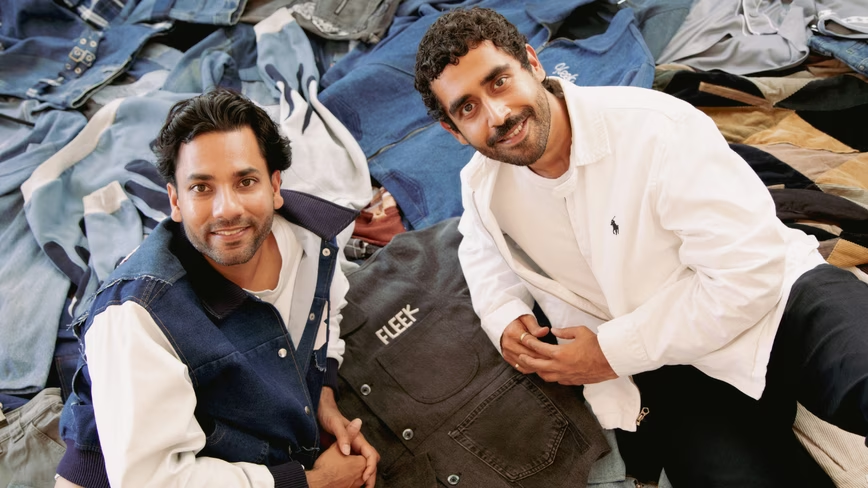
What Fleek raised and why it matters
Fleek, a London-based B2B marketplace for secondhand and vintage clothing, said on July 8 that it raised $25 million in a Series B round led by Burda Principal Investments, with eBay, FJ Labs, and H14 participating alongside existing backers Andreessen Horowitz, HV Capital, and Y Combinator. The round brings total funding to $45 million. Fleek connects more than 2,000 verified wholesale suppliers, most based in India, Pakistan, and Dubai, to over 50,000 vintage resellers and boutiques across more than 100 countries. It has kept an estimated 12 million items in circulation. The company will use the capital to accelerate an AI-native rebuild of that marketplace.
The reason a wholesale used-clothing marketplace attracted eBay and a Vinted backer is the structural size of the opportunity. Resale is one of the fastest-growing segments in apparel, and its supply chain is almost entirely offline, opaque, and run on relationships and gut feel. Fleek's pitch is that the market is exploding while nobody has built the software layer underneath it. Julian von Eckartsberg, a managing director at Burda, drew the parallel directly: "We backed Vinted when secondhand fashion was still considered niche." The investors are wagering that the same digitization wave now moves upstream, into the wholesale trade that feeds every resale storefront.
The data problem AI is being pointed at
Secondhand inventory is the opposite of a clean catalog. Every garment is a single unit with its own brand, era, condition, and defects, and most of it never had a structured product record to begin with. Conventional ecommerce tooling assumes SKUs, standardized attributes, and repeatable listings, all of which collapse when the next item in the pile is a one-off. That is why resale has stayed manual and expensive to scale: a human has to look at each piece, identify it, grade it, and guess a price. Multiply that across thousands of suppliers and millions of items and the labor cost becomes the ceiling on the entire market.
Fleek's answer is Fleek Sort, a custom vision-language model trained on millions of transactions from its own marketplace. It identifies brand, style, and category from photos or video, flags defects, grades condition, and estimates both a sale price and a likely selling timeline, then learns from what actually sells to sharpen its predictions. Co-founder and CTO Sanket Agarwal put the thesis bluntly: "There's more data locked inside the global secondhand supply chain than almost any other market." The model turns a photograph of a jumbled bale into structured, priceable inventory, which is precisely the bottleneck that has kept resale from scaling.
Why proprietary data is the moat
The defensible part of this business is not the model architecture, which competitors can approximate, but the data it trains on. Fleek has four years of transactions describing what specific used garments looked like, what they were graded, what they were priced at, and how fast they sold. That feedback loop is very hard to replicate from the outside, because it requires already operating the marketplace at scale to generate it. Each transaction makes the next price estimate better, which attracts more supply and demand, which produces more transactions. That is the flywheel investors are paying for, and it explains why the round funds engineering and data expansion above all.
Co-founder and CEO Abhi Arora framed the origin around a gap rather than a product: "We started Fleek because that system is broken, the market it serves is exploding, and nobody is building the technology and infrastructure to fix it." The strategic read for anyone building in commerce is that the highest-value AI applications often sit on top of data no one else has bothered to collect and clean. A crowded, well-mapped domain leaves little room for a durable edge. A messy, offline market with real transaction volume is exactly where a proprietary dataset can become a moat that capital alone will not overcome.
The sustainability angle is real, and it is a byproduct
Fleek reports that its marketplace has kept 12 million items in circulation, saved an estimated 13 billion litres of water, and avoided roughly 23,000 tonnes of CO2 emissions by extending garment life rather than sending it to landfill or incineration. Those figures are the natural output of making resale more efficient: the better the software routes used clothing to a buyer who wants it, the less of it is wasted. For brands and retailers under pressure to show circularity progress, infrastructure like this is more credible than a marketing campaign because the environmental benefit is mechanically tied to the transaction volume.
That said, the sustainability story works because the unit economics work, and technology leaders should read it in that order. Fleek is not asking buyers to pay a premium for virtue. It is lowering the cost and risk of sourcing secondhand inventory so that more of it moves, and the environmental math follows. This is the pattern worth internalizing: durable green outcomes in retail tend to come from efficiency gains that would be worth pursuing on cost grounds alone. When circularity depends on shoppers accepting worse products or higher prices, it stalls. When it rides on a better supply chain, it compounds.
What operators should take from this
For technology leaders, Fleek is a clean template for where applied AI actually pays off. The team did not point a model at a solved problem. They found a large, growing market whose core asset, the inventory itself, was unstructured and therefore invisible to standard software, then built the vision system to structure it and the marketplace to monetize it. If you are hunting for AI investments inside your own operation, the equivalent question is where your most valuable data currently sits trapped in images, PDFs, or human judgment that no system has captured. That is usually where a model earns its keep.
The build-versus-buy lesson is equally direct. Fleek treated the model and the data flywheel as the company, not a feature bolted onto a generic marketplace. For an incumbent retailer, the temptation is to license a general vision API and call it done, but the enduring advantage comes from the proprietary training data that only your operation generates. Decide early which datasets are strategic enough to own end to end, instrument them so every transaction improves the model, and resist the urge to outsource the exact loop that would otherwise become your moat. Fleek's investors are betting $45 million that this loop is the whole game.