What Dell actually shipped
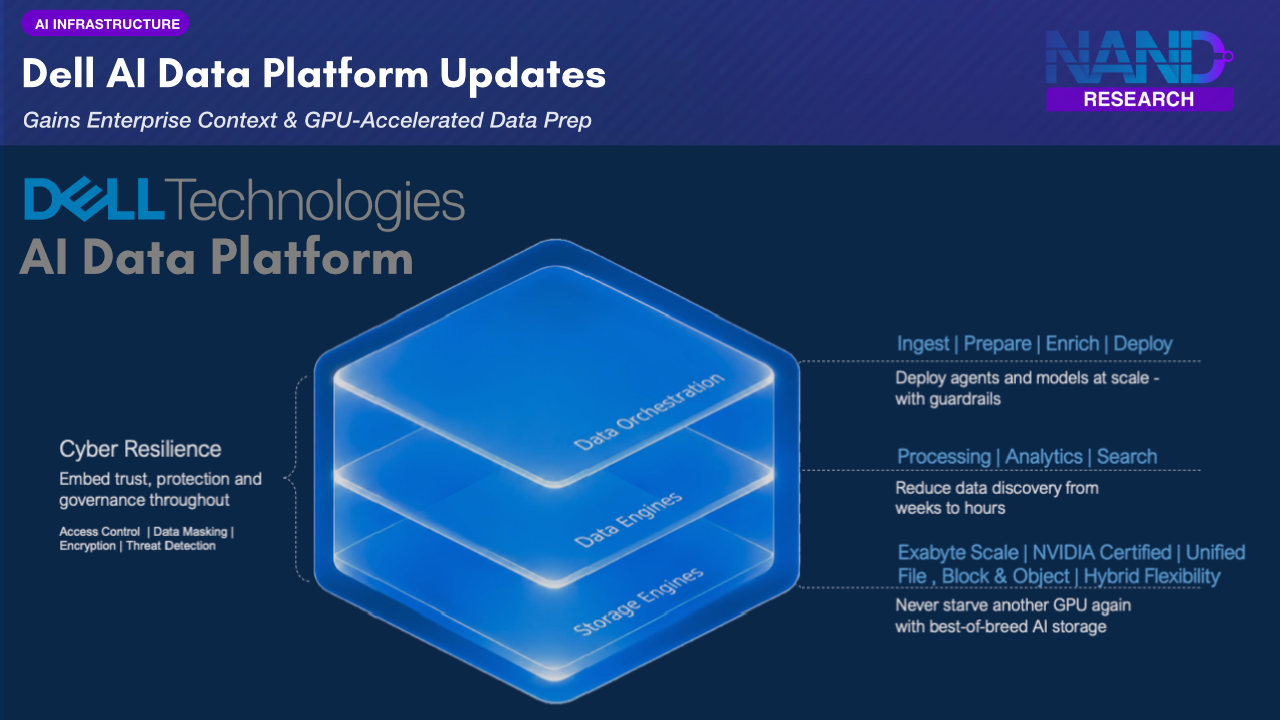
On October 6, Dell detailed an expansion of its AI Data Platform, the data foundation underneath what it calls the Dell AI Factory. The update spans orchestration, processing, storage, and services, and the centerpiece additions are a unified semantic layer and an enterprise knowledge graph. The semantic layer applies shared business definitions and a searchable glossary across both structured and unstructured data, and customers can import ontologies they already maintain rather than starting from a blank schema.
The knowledge graph layer builds on that foundation, mapping relationships across metadata, lineage, and query history, and adjusting as usage patterns change over time. Dell also enables NVIDIA's Auto-Ontology capability to help build these knowledge graphs automatically rather than requiring manual schema design. On top of both layers sit knowledge agents, topic-specific AI agents that run with customer-set guardrails covering data access scope, quality thresholds, and spending limits, executing inside the Dell Data Orchestration Engine on the customer's own hardware.
The knowledge graph bet
Dell's framing here is a direct response to a problem enterprises keep running into with AI agents: an agent that can call any tool and query any table is not useful if it also returns answers built on data it should never have touched, or data that was deleted or renamed three systems ago. A knowledge graph that tracks lineage and query history gives an agent a map of what currently exists and who is allowed to see it, rather than requiring every agent builder to re-implement that logic from scratch.
That bet treats data context as the limiting factor on agent usefulness, not model capability or raw compute. It is a reasonable read of where many enterprise AI deployments actually stall today. The model itself is rarely the problem. Confidently wrong answers built on data the agent should not have accessed, or on data that no longer reflects current reality, undermine user trust fast enough to stop a rollout cold, often within the first few weeks of a pilot reaching real business users instead of a test audience.
Guardrails as a selling point, not an afterthought
Knowledge agents ship with customer-set limits on data access scope, quality thresholds, and spending, built into the product rather than bolted on through a separate governance tool. That positioning matters for CTOs who have watched agent pilots get stuck in procurement and security review precisely because nobody could answer basic questions about what an agent could access, how its output quality would be checked, or how its compute spend would be capped before it ran unsupervised.
Running these agents inside the Dell Data Orchestration Engine on customer-owned hardware is the other half of that pitch. For regulated industries and any workload where data cannot leave a controlled environment, an agent platform that never sends data to an external API removes an entire category of compliance review that a cloud-hosted alternative would otherwise require, and that removal is often the difference between a pilot that ships and one that stalls in legal review indefinitely.
The NVIDIA dependency underneath the numbers
The headline performance claims come from NVIDIA components layered into Dell's processing engine: cuDF for GPU-accelerated dataframes, cuVS for vector search, and a new integration with Apache Arrow. Dell reports a 3.9x average speedup across workloads and a 20.4x peak on one batch data-mining job, both measured using untuned default settings rather than hand-optimized configurations, which is a reasonable and fairly conservative way to present the numbers. Dell also points to its NVIDIA Nemotron Retriever models as part of the same search pipeline, underscoring how deeply the current release leans on one chip vendor's full software ecosystem rather than just its hardware.
Every one of those gains depends on GPU availability and NVIDIA's own software stack, which ties Dell's roadmap, and by extension its customers' infrastructure planning, to NVIDIA's release cycle and supply. Buyers evaluating this platform should ask directly how performance changes on hardware generations Dell is not currently emphasizing, and what the migration path looks like if NVIDIA's own pricing or availability shifts meaningfully during the life of the contract being signed. That question matters more here than in a typical software purchase, because the performance case for this entire release rests on a single vendor's silicon roadmap staying on schedule.
Storage updates aimed at the same data-sovereign buyer
Alongside the AI-focused features, Dell updated PowerScale to support up to 500 tenants per cluster, added mutual TLS over NFS, and introduced per-tenant role-based access control. Dell also released an open-source Storage Performance Tool on GitHub for benchmarking S3-compatible object storage, and brought Dell-managed PowerScale for Microsoft Azure to general availability, claiming up to 4x read throughput per namespace, 4x namespace size, and 2x cluster resiliency against an unnamed competitor.
Multi-tenancy at that scale, paired with per-tenant access control, targets large enterprises and managed service providers running many business units or client workloads on shared infrastructure, where strict isolation between tenants is a hard requirement rather than a nice-to-have. The Azure-hosted PowerScale option extends that same control model into a hybrid deployment, letting a customer keep PowerScale's governance characteristics even when the storage itself sits in Microsoft's cloud rather than Dell's own data center hardware.
The decision on-prem data leaders now face
This release is a clear bet that a meaningful share of enterprise AI workloads will stay on-premises, driven by data sovereignty, regulatory requirements, or simple unwillingness to move petabytes of sensitive data into a public cloud. For CTOs in that position, the question is no longer whether an on-prem AI data platform exists with governance features comparable to what cloud-native platforms offer. It does now, with a semantic layer, a knowledge graph, and per-agent spending and access limits built directly into the stack rather than assembled from separate tools.
The remaining question is how much of this platform's value depends specifically on NVIDIA's current hardware generation and software stack, and whether that dependency is acceptable given the multi-year commitment an on-premises deployment of this scale typically requires. Get a direct answer on upgrade paths and pricing protection before treating the benchmark numbers in this announcement as representative of performance over the full life of the contract, and build that answer into the procurement timeline rather than leaving it for a renewal conversation years from now.