A flat round is more informative than a markup
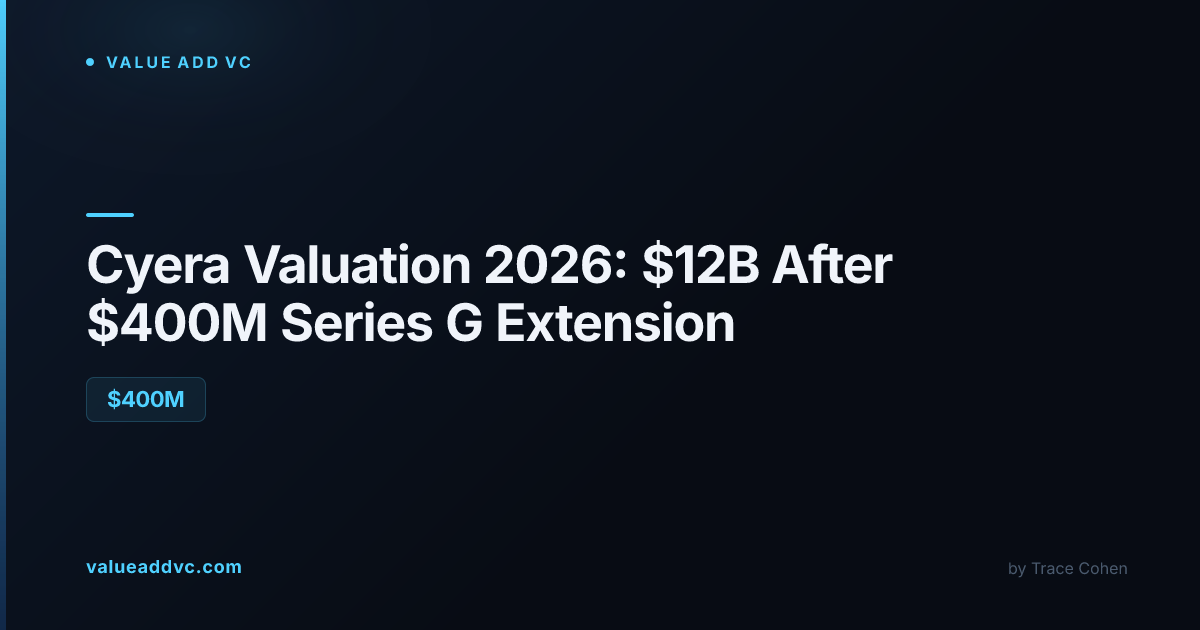
Cyera closed a $400 million Series G extension, supplied entirely by the growth equity arm of Goldman Sachs Alternatives, priced at the same $12 billion valuation that Evolution Equity Partners set three months earlier with a $600 million tranche. A flat valuation across two large rounds in the same year is a different signal than a markup would be: it suggests investors are confirming the price already set rather than bidding it up further, which is a more conservative, and arguably more credible, data point about the company's actual worth than a rapid repricing would be.
The round brings Cyera's total funding since its 2021 founding to more than $2 billion, with roughly $1.4 billion of that raised in 2026 alone across three separate rounds. That pace of capital raising in a single year, even accounting for the flat final price, tells enterprise buyers that data-security posture management has become one of the more heavily capitalized corners of enterprise security, which matters when evaluating vendor stability for a multi-year contract.
What Cyera actually does, and why it's expanding into agents
Cyera's core product scans cloud storage, databases, and SaaS applications to inventory where an organization's sensitive data actually lives, then applies access controls that show who or what can reach it. That is a data-security posture management category that already existed before the AI boom, built around the simple but persistently hard problem of enterprises not actually knowing where their sensitive data sits across a sprawling cloud footprint.
The company's extension of that same model to AI agents, deciding whether a given agent may query or summarize a specific dataset and logging exactly what it did, is the more consequential part of this round for enterprise data leaders. It treats an AI agent as just another identity that needs the same access governance a human employee or a service account would get, rather than as a special case requiring entirely new tooling, which is a sound architectural instinct worth evaluating against whatever agent-governance approach your own organization is currently improvising.
The Oasis acquisition tells you where the risk is concentrating
Cyera has a signed letter of intent, dated July 28, 2026, to acquire Oasis Security, an AI-agent identity startup, for roughly $1 billion, with the deal expected to close later in 2026. Oasis's roughly 170 employees are set to share more than $100 million from vested options at closing, a detail that signals real acquisition economics rather than a token acqui-hire. Buying an identity-focused company to bolt onto a data-access-focused platform is a direct bet that agent identity and agent data access are converging into the same governance problem.
For enterprise data and security teams, that convergence is the practical takeaway worth internalizing now, independent of whether Cyera specifically ends up as a vendor of choice. If a well-funded, rapidly consolidating player sees agent identity and agent data governance as inseparable, any internal effort treating them as two separate workstreams, one owned by the identity team and one by the data team, is likely to produce exactly the kind of governance gap this round is implicitly betting enterprises will pay to close.
Sizing the market against the hype
Grand View Research puts the global data-security posture management market at roughly $2.5 billion in 2026, growing to about $6.2 billion by 2033 at a 13.9% compound annual growth rate. Against that backdrop, a single company commanding a $12 billion valuation, nearly five times the entire current market's size, only makes sense if investors believe the market itself is about to expand dramatically, driven specifically by AI-agent adoption creating data governance needs that did not meaningfully exist as a budget line before this year.
That is a reasonable bet directionally, agent adoption is accelerating across the categories this newsletter covers every day, but it is still a bet on a market that does not yet exist at the scale the valuation implies. Enterprise buyers evaluating Cyera or its competitors should price that uncertainty into their own vendor risk assessment, since a company valued well ahead of its addressable market today carries real execution risk if agent governance spending grows more slowly than investors are currently pricing in.
What this means for enterprise data governance budgets right now
The practical move for any enterprise data leader is to treat agent-level data access logging and permissioning as a near-term procurement line item this budget cycle, not a future consideration to revisit once agent deployments mature further. Cyera's bet, backed by Goldman Sachs's capital and reinforced by its own acquisition strategy, is that enterprises will need this capability now, while most internal data governance programs are still treating AI agents as an extension of existing application access policies rather than a distinct risk category requiring its own controls.
Whether or not Cyera specifically wins that budget line, the underlying requirement it is built around, knowing exactly what data an agent touched and why, is one every enterprise running agentic workflows against sensitive data should be able to answer today. If your organization cannot currently produce that answer for its own deployed agents, this round is a useful external signal that the gap is becoming a competitive and regulatory liability, not just a theoretical governance nicety.