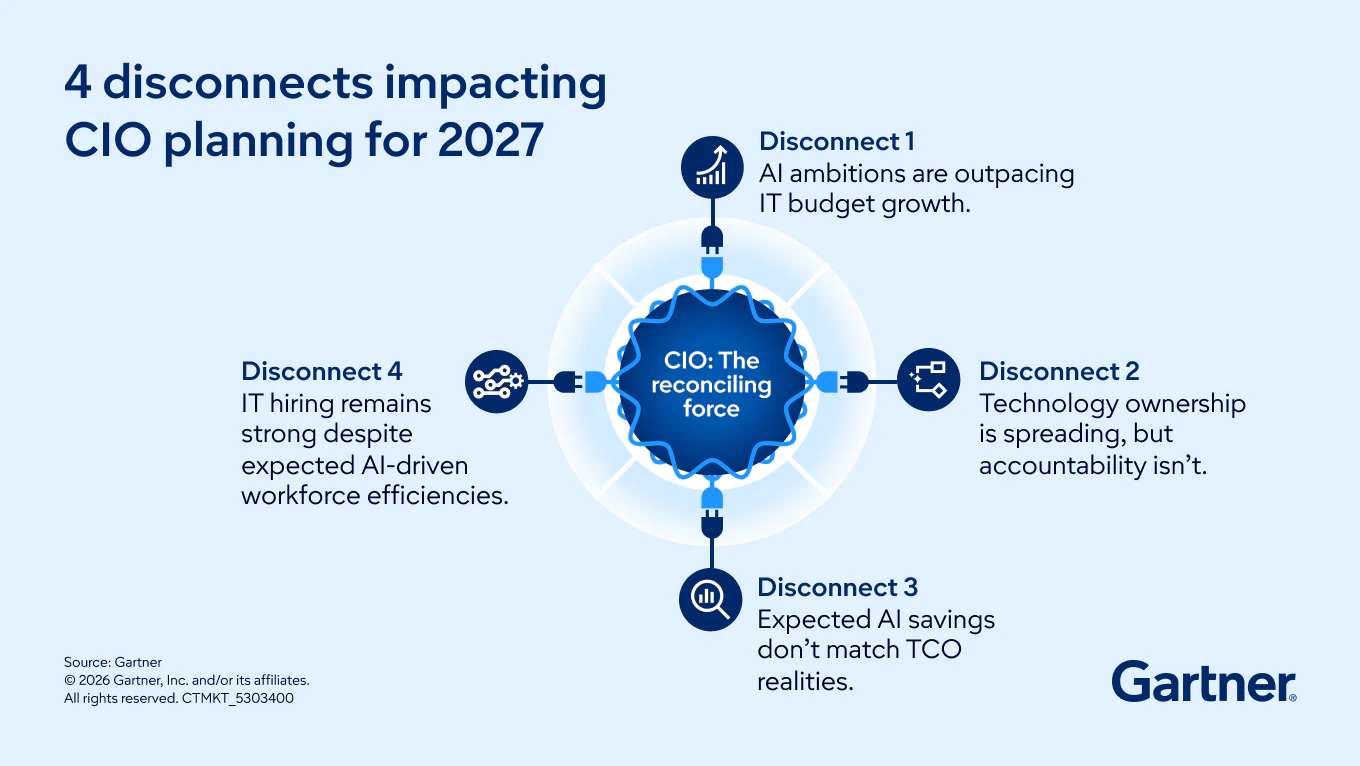
The gap Gartner is naming directly
Gartner's latest CIO and Technology Executive Survey, aimed at how CIOs should plan 2027 budgets, puts a number on a tension most enterprise technology leaders already feel: agentic AI funding is projected to rise an average of 31.8%, the fastest-growing technology investment category by far, while overall IT budgets are projected to grow just 3.7%, which leaves marginal gains once inflation is factored in. Gartner frames this directly as an AI ambition gap, where enterprise AI ambitions are growing faster than the budget, governance, and workforce structures built to support them.
Daniel Sanchez Reina, a Gartner Vice President Analyst, puts the stakes in blunt terms: failing to close the gap exposes CIOs to severe financial, organizational and political risk. That framing matters because it shifts the conversation from whether a CIO's AI strategy is ambitious enough to whether the organization around that strategy, budget process, governance structure, workforce plan, can actually absorb the pace the CIO is setting.
The value numbers behind the gap
The results on actual AI value delivered are the most sobering part of the survey. Only 13% of CIOs report significant value from AI tools so far, and only 36% believe they will meet their own cost-reduction targets, even as 58% face growing pressure to deliver AI-driven cost savings and 51% expect AI to increase total cost of ownership over the technology life cycle rather than reduce it. Put plainly, most CIOs are being asked to deliver savings from a technology that, by their own admission, is more likely to raise their total costs than lower them in the near term.
Adoption itself is not the bottleneck: 37% of respondents have already deployed AI agents and another 34% plan to within twelve months, meaning agentic AI will touch roughly seven in ten enterprises within a year. The gap is between deployment and demonstrated value, which is exactly the distinction Gartner's ambition-gap framing is built to surface before boards start asking harder questions about returns.
Ownership is drifting away from IT, accountability is not following
An average of 15.3% of technology solutions are already developed outside centralized IT, and 80% of technology executives expect AI to increase business-developed solutions by 2030, with nearly 40% expecting a significant increase. That shift toward business-unit-built AI tools is not itself the problem Gartner flags. The problem is that 73% of enterprises have no plans to create rules for who owns the resulting technology costs and solutions, meaning the spending and the risk are decentralizing faster than the governance needed to track either one.
That disconnect between ownership and accountability is where Gartner expects the real financial and political exposure to surface, not in the AI tools themselves. A business unit that stands up its own agentic workflow without a clear cost owner or risk owner creates a liability that shows up on the CIO's desk eventually, regardless of who built it, simply because IT remains the default owner of technology risk in most organizations even when it did not build or approve the thing causing the risk.
What Gartner is telling CIOs to actually do about it
The recommendations split into three concrete moves. First, contain costs by creating curated AI marketplaces for approved tools, killing what Gartner calls zombie AI projects that consume resources without delivering value, and requiring every new AI investment to demonstrate business value within 90 days or be shut down. Second, strengthen governance by aligning technology ownership with cost allocation and setting accountability guardrails before adoption outpaces the organization's ability to track it, using fusion teams that share responsibility for value, support, and risk across business and IT.
Third, and least discussed in most AI strategy conversations, model AI economics enterprise-wide by working directly with CFOs to define what AI actually costs across token consumption, platform fees, governance overhead, and workforce impact, not just the sticker price of a model subscription. Gartner also urges workforce redesign: classifying roles as strategic, core, foundational, or misaligned, and identifying where automation augments existing staff before creating new headcount, especially since 44% of CIOs already cite insufficient technical talent as a major barrier to scaling AI responsibly.
Why this lands differently during budget season
This survey arrives at exactly the moment most enterprises are finalizing 2027 technology budgets, which makes its central number, a 31.8% funding increase against a 3.7% overall budget increase, a figure CIOs should expect to be asked about directly in budget review meetings this quarter. A board member who has seen this survey, or a summary of it, will reasonably ask where the other roughly 28 points of AI funding growth are coming from if the overall IT budget is not growing to match it.
The honest answer for most organizations is that it comes from somewhere else in the technology budget, which means every CIO walking into a 2027 planning conversation should already know which existing line items are being cut or slowed to fund the AI increase, rather than discovering that tradeoff mid-negotiation. Gartner's own recommendation, the 90-day value test for new AI spending, is as much a political tool for defending that tradeoff to a skeptical board as it is a financial discipline practice.