Factories Instead of Construction Sites
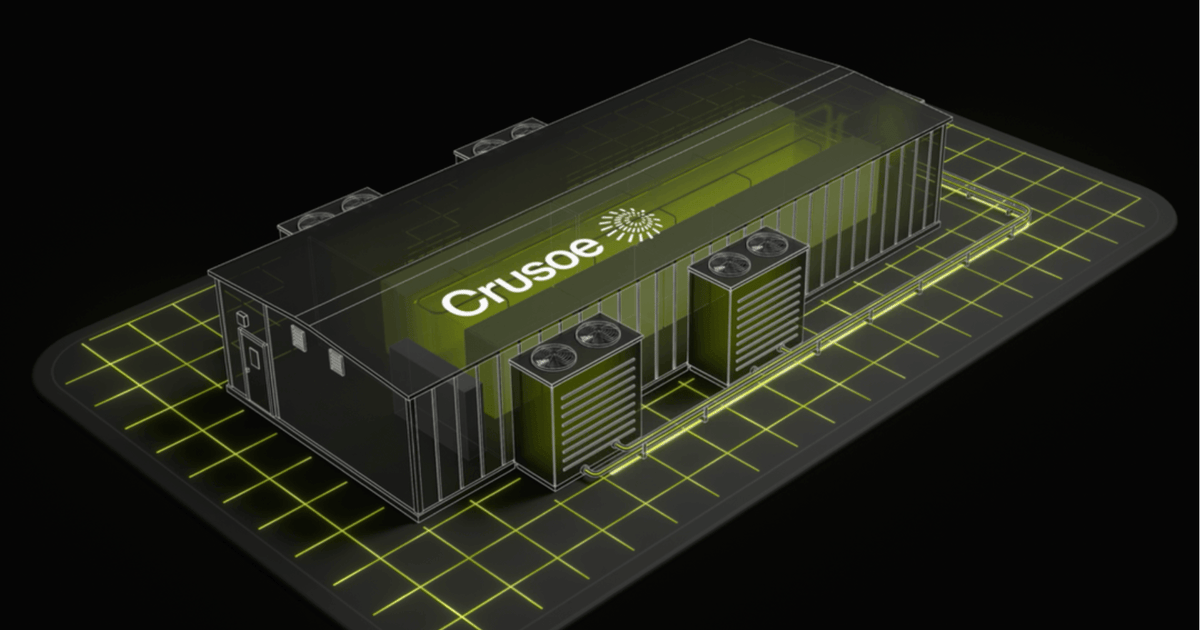
Crusoe has spent nearly a decade building factory-made data center infrastructure rather than relying on traditional construction crews, and its newest product, Spark Liquid, is the clearest statement yet of that bet. The sixth generation of Crusoe's modular platform delivers up to 3.5 megawatts of compute per unit, five times the density of earlier Spark generations, and is built to run in clusters so operators can scale by adding units rather than redesigning a facility.
The units are compatible with Nvidia's GB300 NVL72 and Vera Rubin NVL72 rack platforms, meaning they are built to the same standards hyperscalers are already deploying at scale. Production joins Crusoe's existing Spark line at its 352,000 square foot Brighton, Colorado factory starting in 2027. Crusoe brought manufacturing fully in-house after acquiring electrical manufacturer Easter-Owens Electric in 2022, a move that now underpins its ability to ship complete racks rather than assemble them on site.
The Pitch Is Speed, Not Just Density
Bryan Schramm, who heads Crusoe's Spark business, frames the problem the product is built to solve with a short list: "Three constraints are converging: power, predictability, and time to token." His argument is that modular design helps with all three at once, mainly by making the construction half of a project predictable in a market where grid connections routinely stretch two years or more past announcement, according to recent industry analysis. Modular hardware removes construction variability as a second source of delay stacked on top of the power problem every operator is already fighting, even though it leaves the interconnection queue itself untouched.
Crusoe says factory-built capacity can come online in as little as a few months once a site has power, water, and network connections ready, a sharp contrast with multi-year conventional builds that still dominate the industry. Schramm also pointed out that large grid interconnects can take years on their own, and that customers reserving modular capacity in advance get firmer delivery dates than they would from a site still working through permitting and construction scheduling. For a buyer trying to commit a budget to a specific go-live quarter, that predictability is worth real money even before accounting for any density or efficiency gains the hardware itself delivers.
Closed-Loop Cooling Changes the Water Math
Spark Liquid uses closed-loop direct liquid cooling, where water recirculates through the system in a sealed loop rather than evaporating off in open cooling towers. That design keeps ongoing water consumption minimal and eliminates evaporative loss entirely, a meaningfully different profile from the evaporative cooling systems that have drawn community opposition and water-rights scrutiny in Texas, Arizona, and other drought-exposed data center markets this year. Water use has become one of the most reliable ways to kill a project at a public hearing, and a vendor that can point to a sealed, low-consumption cooling loop has a genuinely different conversation to have with a skeptical county commission.
Efficiency still varies by deployment site because of local climate conditions, and Crusoe designs each installation around those local factors rather than shipping one universal configuration everywhere. For operators facing permitting friction tied specifically to water use, a closed-loop design is a concrete, demonstrable answer to one of the most common objections raised at public hearings, even though it does nothing to resolve the power or grid access constraints that remain the dominant source of delay across the industry this year.
Nvidia Is Picking Winners in Modular Design
The more significant signal here may be Nvidia's own move. Schramm noted that "Nvidia standardizing on modular reinforces the approach we've taken for nearly a decade," a reference to Nvidia's DSX POD blueprint for its upcoming Vera Rubin platform, which is explicitly modular and container-based rather than a conventional raised-floor design. Nvidia named eight container solution providers for that blueprint, putting Crusoe alongside established power and infrastructure players Eaton, Schneider Electric, and Vertiv, companies with decades of experience in industrial electrical systems rather than cloud computing.
That list matters because it tells enterprise buyers which modular vendors Nvidia itself considers credible enough to build its reference designs around, which functions as a useful shortlist for procurement teams trying to separate serious vendors from marketing decks. Nvidia is careful to note that customers still need a fully prepared site with power, water, and network connections ready before any modular unit can be deployed, so modular hardware does not eliminate the site-readiness problem on its own. What it does is compress the part of the timeline that sits entirely within a vendor's control, which is a real gain even if it is a partial one.
Where This Fits Against the Shipping-Container Pitch
Modular and prefabricated data centers are having a moment broadly, with multiple vendors now pitching factory-built capacity as the answer to construction delays, from shipping-container campuses to skid-mounted power systems. What distinguishes Crusoe's approach is the combination of Nvidia's latest reference rack compatibility, in-house electrical manufacturing dating back to its 2022 acquisition of Easter-Owens, and a specific technical answer, closed-loop liquid cooling, to the water objections that have become a recurring theme in community opposition to new sites across drought-prone states.
Crusoe is betting that the winning modular product combines fast deployment with engineering that directly clears the regulatory and community objections, water use chief among them, that increasingly determine whether a site gets approved at all. Speed alone is a commodity feature in a market where several vendors now promise it. Speed paired with a credible answer to the water fight that stalls projects at the county level is a harder combination for competitors to match quickly.
What This Means for Buyers Evaluating Capacity
For enterprise infrastructure teams, the practical question when a provider offers modular capacity is what exactly the module solves and what it leaves untouched. Spark Liquid compresses construction and commissioning time and reduces water consumption meaningfully, but it still depends entirely on a site having power and grid access already lined up, the two constraints that GlobalData and IDC both identify as the actual binding bottleneck on delivery timelines across the industry today.
The right question to ask any provider pitching modular or factory-built capacity is where the power comes from and how firm that commitment is, rather than stopping at how fast the physical unit ships from the factory. Crusoe's own Spark Liquid units will still sit idle without an energized grid connection or onsite generation behind them. Speed to deploy and speed to power are two separate problems, and buyers who only ask about the first one are missing the half of the timeline that actually determines when a site goes live.