From Chatbot to Workspace
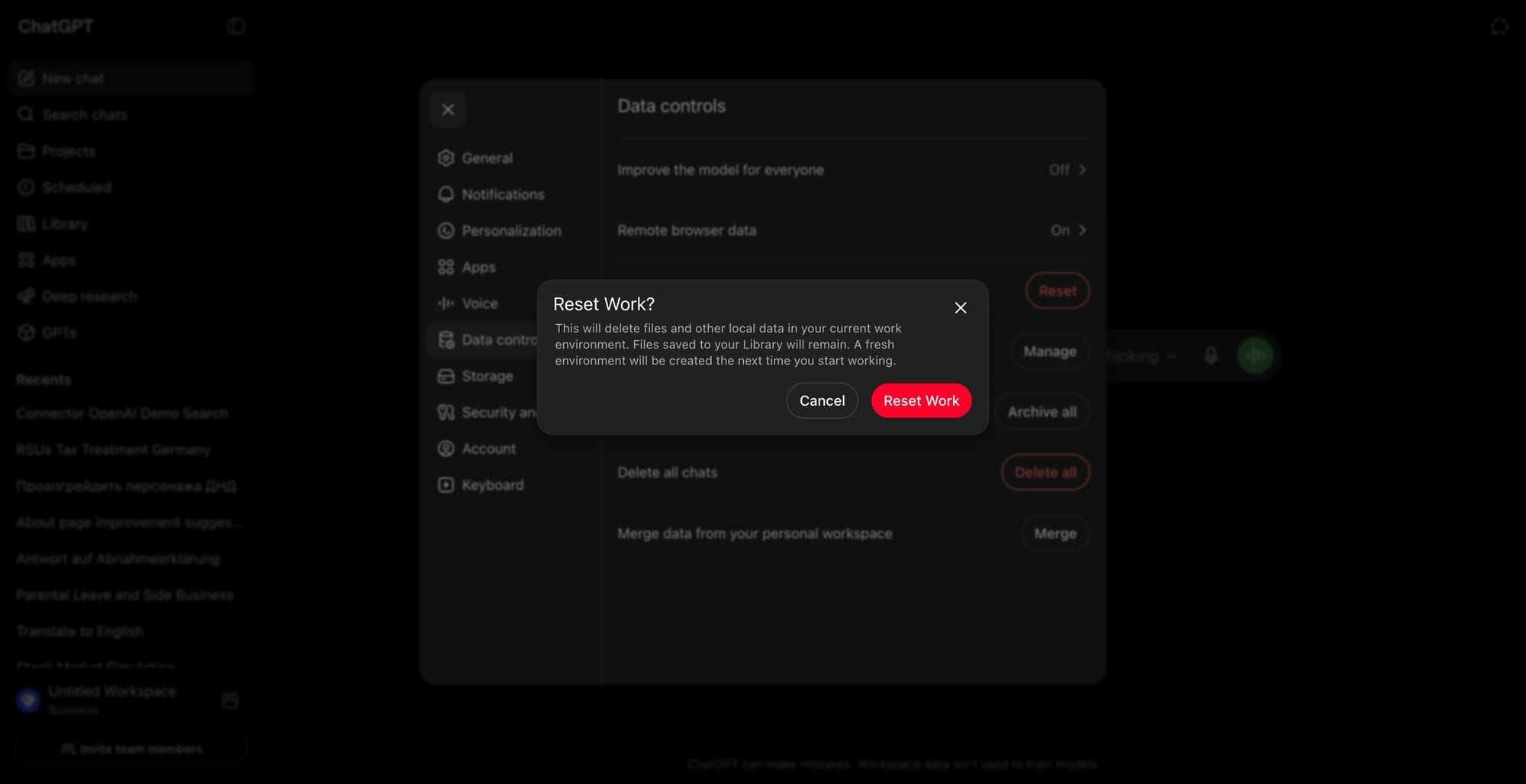
OpenAI billed its July 9 livestream as its biggest update for work in ChatGPT, and the framing is telling. The centerpiece is a dedicated workspace layer that sits apart from personal file storage, giving teams a shared environment for company work rather than a single-user chat history. Alongside it comes an environment reset feature that can wipe a ChatGPT Work environment clean without touching anything stored in the user's library. That separation between a resettable work surface and a persistent personal library is a small design decision with large implications: it acknowledges that enterprise work has different lifecycle and governance needs than an individual's ongoing conversation with an assistant.
This is OpenAI conceding, in product form, that a chat box is not an enough of a container for real organizational work. Knowledge work happens in shared spaces, against shared context, with permissions and resets and audit needs that a personal thread cannot satisfy. By carving out a workspace layer, OpenAI is trying to move ChatGPT from a tool people reach for occasionally into a place where teams actually operate. Whether it succeeds depends less on the model and more on the unglamorous surrounding machinery: collaboration, administration, and integration with the systems where enterprise data already lives.
The Pets, and Why Custom Assistants Matter
The most eye-catching feature is what OpenAI calls workplace Pets, custom assistants that administrators can create and populate with company-specific context. The playful name obscures a serious ambition. A generic assistant is useful; an assistant that knows your policies, your terminology, your systems, and your role is a different proposition entirely. By letting administrators build and distribute these context-loaded assistants, OpenAI is trying to solve the single biggest gap between an impressive demo and a deployed tool, which is that the model does not know how your particular organization works until someone teaches it.
This is also where the enterprise governance conversation gets real. A custom assistant loaded with company context is, functionally, a new interface to sensitive information, and every one of those assistants is something a CIO's team will need to inventory, permission, and monitor. The convenience of letting administrators spin these up quickly cuts both ways. Done well, it puts curated, governed AI into the hands of employees who would otherwise paste company data into consumer tools. Done carelessly, it scatters ungoverned assistants across an organization. The feature is powerful precisely because it centralizes context, which means the controls around it will determine whether it is an asset or a liability.
Codex, Skills, and the Move Toward Doing
ChatGPT Work does not stop at conversation. The update integrates Codex-powered plugins aimed at specific business roles, and adds email management, skills, and asset creation to the mix. The direction of travel is unmistakable: OpenAI wants ChatGPT to do work, not merely describe it. Email management alone, if it works as advertised, moves the product into territory that Microsoft and Google have long owned through their productivity suites. Asset creation and role-specific plugins push further into the daily workflows of marketers, analysts, and operators. The assistant is being repositioned from advisor to operator.
That ambition is exactly where the hard problems live. An assistant that drafts a memo is low stakes; an assistant that manages your inbox or generates deliverables that go out under your name is not. The value proposition improves as the assistant takes on more, but so does the cost of error and the need for review, permissions, and clear boundaries on autonomous action. Enterprises evaluating ChatGPT Work should look past the feature list and ask the operational questions: what can these plugins touch, what do they log, and how does an administrator revoke or constrain them. The features are compelling, but the deployment work is where the risk and the value both concentrate.
Running on GPT-5.6
Underpinning all of this is the new model generation. ChatGPT Work is expected to run on GPT-5.6, the Sol, Luna and Terra models that OpenAI cleared for public release the same week. That coupling is strategically neat. The workplace update gives enterprises a concrete reason to care about the model release, and the model release gives the workplace update its horsepower. For OpenAI, bundling the two means the frontier capability and the enterprise surface reinforce each other rather than competing for attention.
For buyers, the coupling is worth scrutinizing. Tying a workplace platform to the newest model generation means the platform inherits both the strengths and the constraints of that generation, including the reality that GPT-5.6 access itself passed through a government evaluation before broad release. Enterprises standardizing on ChatGPT Work are, implicitly, standardizing on OpenAI's model cadence and its release dependencies. That is a reasonable bet for organizations already committed to the ecosystem, but it is a commitment, and it should be made with eyes open rather than by default because the demo looked good.
The Fight for the Enterprise Desktop
Step back and the strategic picture is clear. With ChatGPT Work, OpenAI is making a direct move on the enterprise desktop, the same ground Microsoft occupies with Copilot woven through Office and Google contests with Gemini across Workspace. OpenAI's advantage is that ChatGPT is already where hundreds of millions of people, including employees, have formed a habit. Its disadvantage is that Microsoft and Google own the surrounding infrastructure, the identity, the files, and the compliance stories that enterprises already trust. ChatGPT Work is the attempt to convert consumer habit into an enterprise foothold before those incumbents fully close the gap.
We think the outcome hinges on integration and trust rather than model quality, where OpenAI is already strong. Enterprises do not adopt a work surface because it is clever; they adopt it because it connects to their systems, respects their permissions, and survives an audit. ChatGPT Work's workspace layer, custom assistants, and administrative controls are the right ingredients, and their presence shows OpenAI understands the assignment. The company that turns a beloved chatbot into a governed operating surface will have earned a durable enterprise position. This launch is a serious step toward that goal, and it makes the contest for the AI-native desktop genuinely three-sided.


