A uranium enrichment site becomes an AI address
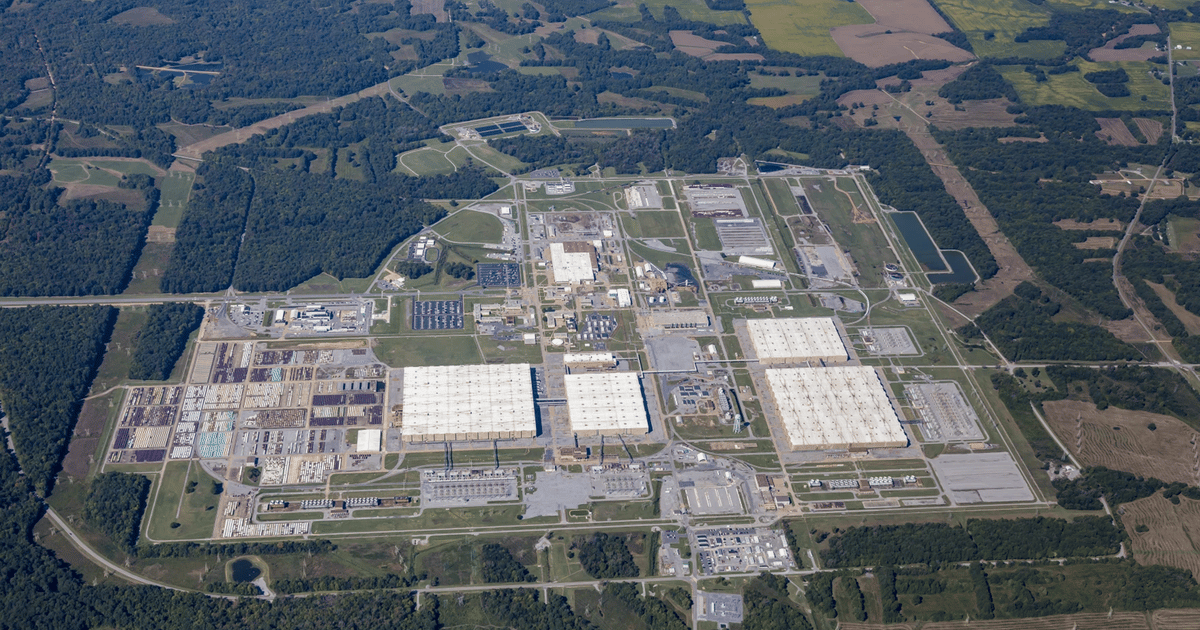
Brookfield and NextEra Energy announced on July 29 a plan to invest up to $100 billion developing an AI data center campus at the Department of Energy's former Paducah Gaseous Diffusion Plant in western Kentucky. The site enriched uranium for decades before it was shut down, leaving behind exactly the kind of heavy infrastructure hyperscalers now compete for: high-voltage transmission lines, industrial water rights, fiber connectivity, and thousands of acres of already-graded, already-permitted land that would take years to replicate from scratch on an undeveloped site. Cleanup of the legacy enrichment infrastructure has been underway for years under DOE oversight, and the agency's willingness to hand the site a second industrial life rather than leave it dormant is itself part of the story.
Energy Secretary Chris Wright framed the deal as a template rather than a one-off, saying the planning and investment by NextEra and Brookfield provide a roadmap for future projects. That framing matters, because the federal government holds a substantial inventory of decommissioned industrial and nuclear sites nationwide, and Paducah's reuse suggests Washington now sees repurposing them for AI infrastructure as a faster path to new compute capacity than permitting greenfield sites from a standing start.
Power-first deal structuring
The deal's structure is the real story for infrastructure buyers. NextEra is building and owning the generation assets, targeting up to 2 gigawatts of new natural gas capacity plus 2.6 gigawatts of battery storage, while Brookfield handles the data center development and operations. That split lets each company deploy capital against what it does best, and it mirrors a pattern showing up across the industry: power developers and data center operators increasingly co-invest as separate but coordinated partners rather than one party attempting to own the entire stack from generation through compute.
NextEra CEO John Ketchum described the arrangement plainly, saying the data center will bring its own power, pay for its own power infrastructure, and create good-paying jobs for local workers. That last point addresses the ratepayer backlash that has slowed data center approvals elsewhere, since the generation is dedicated to the campus rather than drawn from the shared grid that residential and commercial customers in the surrounding region depend on for their own electricity needs.
Local utilities as junior partners
Big Rivers Electric, Jackson Purchase Energy Cooperative, and Paducah Power System are named as partners in the deal, giving three local and regional utilities a direct role in a $100 billion project rather than being sidelined by out-of-state developers moving into their territory. That inclusion is likely a deliberate choice to smooth local political approval, since utility cooperatives carry credibility with state regulators and communities that a national developer alone typically does not have when proposing a project of this scale.
It also creates a financing structure where regional utilities can benefit directly from the capital investment flowing through their territory, an incentive that could accelerate cooperation on interconnection studies and permitting, historically the two biggest bottlenecks slowing hyperscale data center timelines nationwide and the reason many projects announced with fanfare take years longer than expected to reach commercial operation. Utilities with equity in the outcome tend to move faster on the paperwork than ones simply asked to accommodate a new industrial customer.
Jobs, timelines, and what remains unresolved
The companies project roughly 8,000 construction jobs and 600 permanent operations roles once the campus is running, with utility-delivered capacity potentially reaching 1.8 gigawatts by 2032. Those are meaningful figures for a region of western Kentucky that lost thousands of jobs when the original enrichment plant wound down operations over the past two decades, leaving behind exactly the kind of underused industrial infrastructure this deal is now built around reactivating for a very different purpose.
What is missing from the announcement is just as notable as what it includes. Brookfield and NextEra have not named an anchor tenant, have not set a construction start date, and describe the project as subject to negotiating definitive agreements and clearing regulatory approval. Enterprises evaluating this site for future capacity should treat the announcement as a serious commitment of capital and reputation from two credible infrastructure players, not as a signed lease with guaranteed delivery dates, and should press for firm milestones before counting on Paducah capacity in any near-term deployment plan.
Why this matters beyond Kentucky
The Paducah deal previews a broader shift in where new AI capacity gets built. Instead of competing purely on land price and tax incentives, developers are now bidding for federal and state government sites that come with pre-existing heavy infrastructure, since building that infrastructure from scratch has become the actual bottleneck constraining new capacity, not construction of the data center buildings themselves once the underlying power and connectivity are already in place.
Expect more announcements involving decommissioned military bases, retired power plants, and former industrial sites as developers race to secure locations where transmission capacity already exists. For enterprise buyers, this is a useful signal worth tracking: the fastest-arriving new capacity over the next three years will likely come from these repurposed industrial sites rather than purpose-built campuses on undeveloped land waiting years for interconnection approval. Procurement teams sourcing multi-year capacity commitments should ask vendors directly which projects sit on brownfield sites with existing power infrastructure.