Attacking Retail Media's Oldest Seam
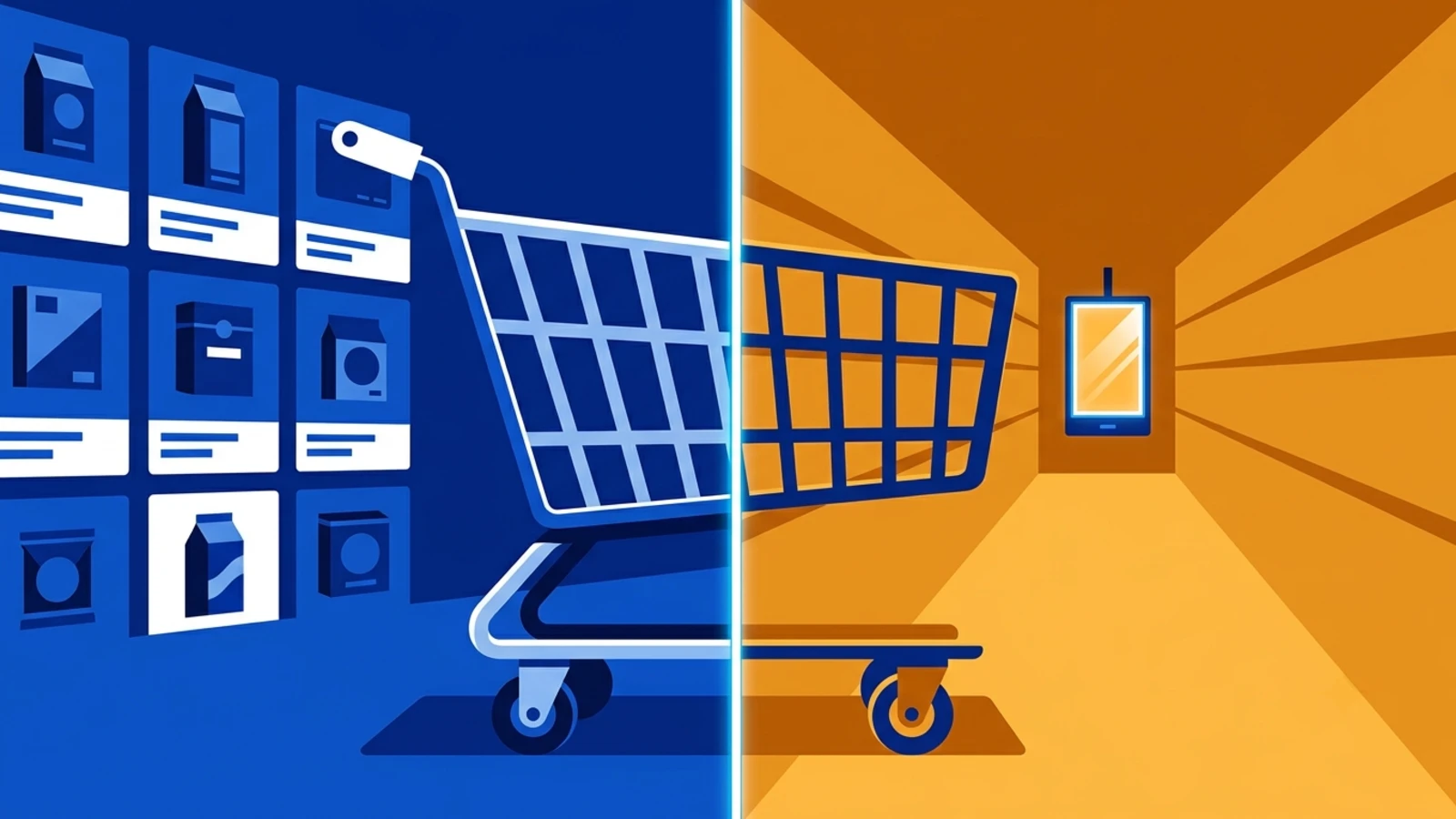
Retail media has grown into one of advertising's fastest-expanding channels, but it carries a structural flaw that vendors have mostly tiptoed around: online and in-store operate as separate worlds. A brand can run sophisticated sponsored-product campaigns on a retailer's website and, entirely separately, buy screens at the store entrance, with no common framework tying the two together. Broadsign and Mirakl Ads used Cannes Lions to announce an integration aimed squarely at that seam, and the news, reported on 28 June, positions the pairing against one of the category's most stubborn inefficiencies.
The ambition is to let retailers offer advertisers a single campaign that spans ecommerce placements and in-store digital screens, with consolidated reporting that follows the shopper across both. That sounds modest until you consider how rarely it is actually delivered. Most retail media networks bolt their in-store digital out-of-home inventory onto a different system than their online sponsored listings, run by different teams with different measurement. Collapsing that into one buy is a genuine architectural change, and it is the kind of plumbing work that determines whether retail media keeps scaling or hits a ceiling of complexity.
What Each Side Brings
The asset complementarity is the reason this partnership is worth attention. Broadsign manages roughly 2.8 million digital and static signs globally and already powers more than 35 in-store retail media networks, giving it deep reach into the physical screen layer that brands struggle to buy at scale. Mirakl Ads comes from the opposite end, supporting more than 450 marketplaces and over 100,000 third-party sellers, with the sponsored-listing and online ad machinery that retail media networks run on the web. Neither could credibly bridge online and in-store alone.
That division is exactly why the integration is interesting rather than redundant. Broadsign owns the in-store screen relationships; Mirakl owns the online marketplace ad demand. Wiring them together means a retailer using Mirakl for its digital storefront can extend the same advertiser campaign onto Broadsign-powered store screens without standing up a separate in-store ad operation. For mid-tier retailers that lack the engineering muscle of an Amazon or Walmart to build unified retail media in-house, an off-the-shelf bridge between the two layers is a meaningful shortcut to a full-funnel offering.
The Executives' Framing
Mats Klevjer, Broadsign's director of partnerships, named the problem directly. "Retail media has evolved rapidly, but online, offline, and in-store are often still treated as separate channels, leading to missed opportunities and revenue," he said. That is an unusually candid admission from inside the industry that its own structure leaves money on the table. The pitch is not that anyone lacks inventory; it is that the inventory is sold in silos that prevent advertisers from seeing or acting on the full shopper journey.
Octavie Gosselin, a Mirakl Ads vice president, framed it from the demand side. "Retailers are asking for solutions that maximize the value of every customer touchpoint, both digital and physical," she said. The phrasing matters because it locates the pressure with retailers, not just advertisers. As retail media matures into a core profit line, retailers are under growing pressure to monetize every surface a shopper passes, and the ones still treating their store screens and their website as unrelated ad products are leaving the most valuable inventory, the moment near purchase, underexploited.
Timeline and the Bigger Prize
The rollout is staged rather than instant. Beta testing is already underway, with a full launch planned for the third quarter of 2026. That cadence is sensible for a product whose entire value proposition is unified measurement, because the measurement layer is the hard part. Promising advertisers a single dashboard that accurately tracks a shopper from a website impression to a store-screen exposure to a purchase is far easier to announce than to deliver, and a beta period is where that claim either survives contact with real campaigns or quietly gets walked back.
The stakes justify the effort. Retail media is projected to exceed 300 billion dollars globally by 2030, and the share of that growth captured by any given network will depend heavily on whether it can offer advertisers a coherent full-funnel buy. Networks stuck selling fragmented online and in-store products will look increasingly primitive next to those offering one campaign across both. Broadsign and Mirakl are betting that unification, not more inventory, is the next axis of competition, and they are probably right that the seam between physical and digital is where the next round of retail media share will be won.
What Enterprise Buyers Should Watch
For retailers evaluating their retail media roadmap, this partnership is a signal about where the build-versus-buy line is moving. The hyperscale networks will continue to engineer unified online and in-store stacks themselves. Everyone else now has an emerging alternative: license a pre-integrated bridge rather than attempt the integration alone. That changes the calculus for a regional grocer or specialty chain that wants a credible full-funnel media product without a multi-year platform project, and it is the kind of consolidation the fragmented retail media tooling market badly needs.
The open risk is the one common to all measurement promises in this space: whether the consolidated reporting is genuinely accurate or merely convenient. Tying a store-screen exposure to an online conversion involves identity and attribution assumptions that are easy to oversell. Enterprise buyers should press hard on how the joined-up measurement actually works before treating it as ground truth for ad pricing. But the strategic direction is sound. The future of retail media is full-funnel and measured as one, and the vendors racing to erase the online-offline line are aiming at the right target.