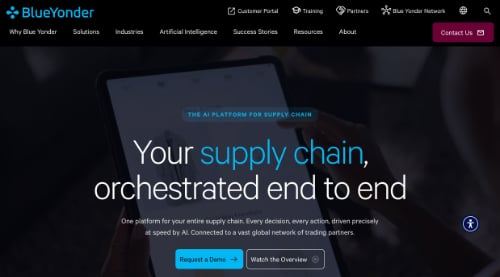
What Blue Yonder is selling
Blue Yonder, the supply chain software vendor best known for planning and fulfillment systems at large retailers, launched what it calls AI native order management, covering delivery promise calculation, order fulfillment, customer service and returns in a single integrated system. Practical Ecommerce flagged the launch in its November 11 roundup of new commerce tools, describing it as covering the full order lifecycle end to end rather than acting as a point solution aimed at any single function within that lifecycle, which is the framing Blue Yonder itself is using to pitch the product to existing customers.
The pitch is consolidation, plainly stated. Instead of a delivery promise engine, a separate order management system, a customer service platform and a returns workflow tool stitched together by a retailer's own integration team over years of patchwork investment, Blue Yonder wants to be the single AI layer that owns the decision at every one of those stages, using the same underlying data and the same models throughout the entire order lifecycle rather than handing off between disconnected systems at each step.
The seam this is built to fix
The gap between the delivery date promised at checkout and the delivery date actually achieved is one of the most expensive and least visible failure points in retail operations today. A promise engine without real time visibility into warehouse capacity, carrier constraints and inventory location will promise dates it cannot keep, and the cost of that gap shows up downstream as customer service tickets, failed deliveries and refunds, functions usually measured and owned by entirely different teams than the ones that set the original promise at checkout.
By putting promise calculation and fulfillment execution on the same AI system, Blue Yonder is targeting that handoff directly rather than treating it as someone else's integration problem. The theory holds that a system which understands both sides of the promise, what was told to the customer and what the supply chain can actually deliver on a given day, will make fewer of the mismatches that generate downstream cost. Whether that theory holds up in a live, multi warehouse, multi carrier retail environment under real holiday volume is the test that actually matters.
Why bundling customer service and returns is the bolder bet
Delivery promise and fulfillment have always been close cousins in supply chain software, so unifying them is a logical, almost expected move that most vendors in this space have already attempted in some form. Pulling customer service and returns into the same AI layer is a different kind of bet entirely, because those functions typically sit with different organizational owners, often a CX team reporting outside of supply chain altogether, running on entirely different platforms from vendors such as Zendesk or Salesforce Service Cloud that have their own long term contracts and integrations.
That organizational seam explains why order status, return eligibility and delivery problems are so often handled inconsistently today, because the system that made the promise and the system that handles the complaint when the promise breaks do not share the same underlying data model. Blue Yonder's bet is that retailers will accept a single vendor owning both sides of that seam in exchange for consistency, a meaningful ask given how entrenched most CX platform decisions already are inside large retail organizations.
The build vs buy calculus for retail technology leaders
Large retailers have spent years building custom integration layers between order management, warehouse management and customer service systems, partly because no single vendor covered the whole lifecycle convincingly and partly because that integration layer was itself seen as a competitive differentiator worth protecting. Blue Yonder's launch directly challenges that assumption, betting that AI native, vertically integrated order management is now good enough that the custom integration layer becomes a maintenance cost to eliminate rather than an advantage worth continuing to fund year after year.
For a retailer evaluating this offer, the question is not simply whether Blue Yonder's individual modules are competitive, since most are from a vendor with a long track record in retail supply chain software. The real question is whether consolidating four previously separate decision points onto one vendor's AI reduces risk through consistency across the whole order lifecycle, or instead concentrates risk by removing the checks and balances that came from having separate systems catch each other's mistakes along the way.
What to watch from here
Expect Blue Yonder's established base of large grocery, apparel and general merchandise retailers to be the first real test bed for this bundle, since they already run Blue Yonder's planning and fulfillment modules and face the lowest switching cost to add order management on top of an existing relationship. Mid-market retailers without any existing Blue Yonder footprint are a considerably harder sell for a full lifecycle platform swap of this scale, and Blue Yonder likely knows that going in.
The more interesting signal to watch for is whether other supply chain vendors, Manhattan Associates and SAP chief among them, respond with their own unified order lifecycle pitch within the next few quarters. If they do, it confirms this is a genuine shift in how order management gets bought industry wide, not just a single Blue Yonder product launch. If they do not, it suggests the market still believes best of breed integration, however costly to maintain over time, beats vertical consolidation for this particular set of functions.