Agents That Compound Value, in AWS's Framing
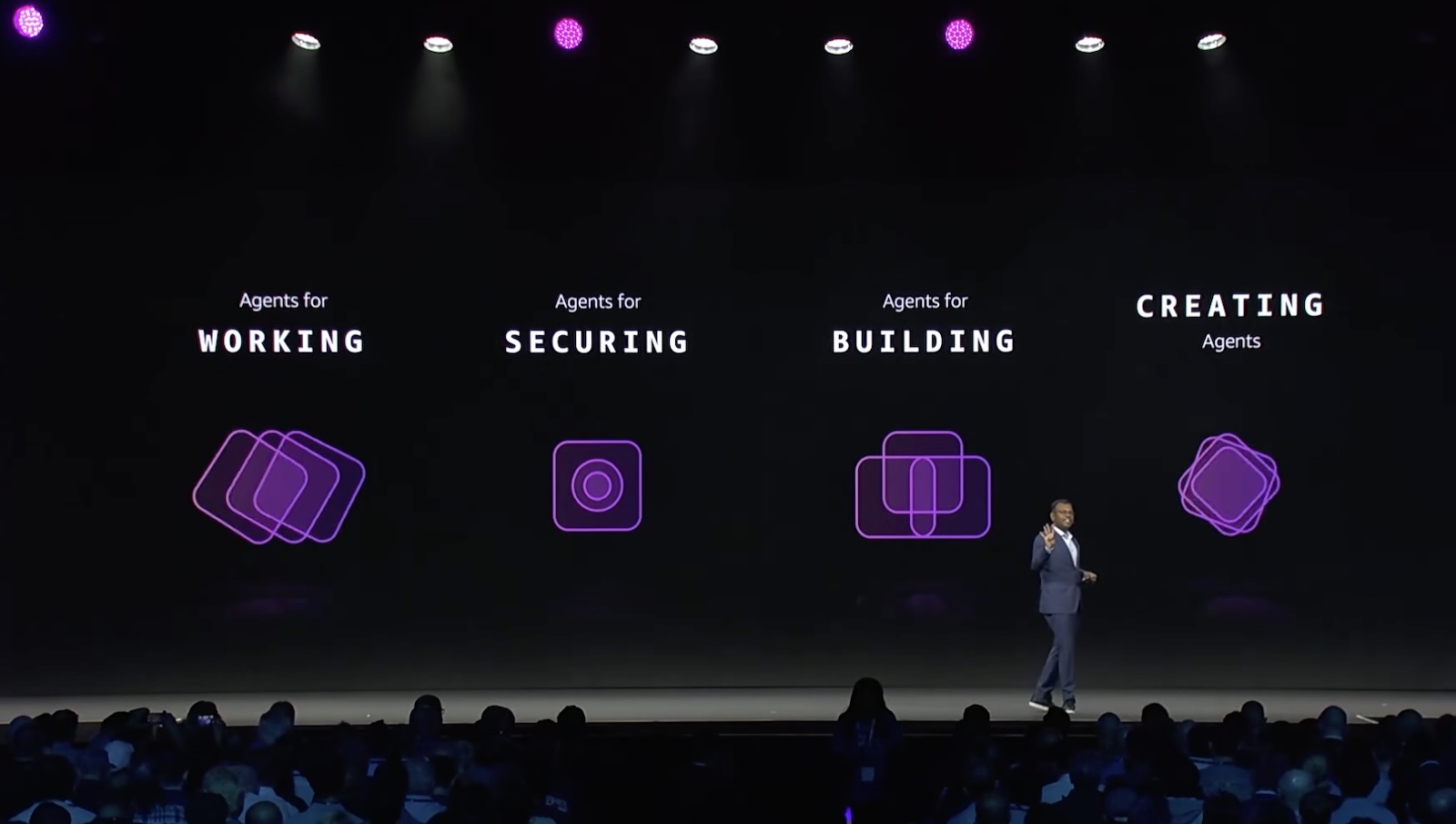
AWS used its New York Summit to make a claim about where the cloud is heading, and it built the entire keynote around it. Swami Sivasubramanian, the company's vice president for agentic AI, framed the agenda around the idea of agents that compound value over time, a deliberate contrast with the one-shot chatbot demos that defined the early generative AI cycle. The headline launch was Amazon Bedrock AgentCore reaching general availability, no longer a preview but a supported foundation for building production-grade agents without hand-coding the orchestration layer. AWS paired that with a managed Knowledge Base, native data connectors, and a Web Search capability that lets agents pull current, cited information with, as AWS put it, zero data egress.
We read the positioning as a strategic answer to a real enterprise complaint: building agents in-house has been brittle, expensive, and hard to govern. By moving the hard parts, orchestration, retrieval grounding, web access, into managed services, AWS is betting that customers would rather assemble agents from supported building blocks than maintain their own scaffolding. The risk for AWS is lock-in skepticism, since every managed primitive ties workloads tighter to Bedrock. The opportunity is that for most enterprises, the alternative is a fragile internal stack that no one wants to own. AWS is wagering the convenience wins.
A Hanoi Local Zone and the Data Residency Game
Quieter than the agent launches, but arguably more consequential for global enterprises, was a new AWS Local Zone in Hanoi, Vietnam, one of the first AWS Local Zones in Asia Pacific. The zone supports Amazon S3 and EBS Local Snapshots, which means customers can store and back up data inside Vietnam to satisfy local data residency requirements. Enabling it is a matter of switching on the ap-southeast-1-han-1a zone through AWS Global View or an API call. On its face this is a small infrastructure footnote. In context it is part of a deliberate push to put compute and storage inside more national borders as data sovereignty rules proliferate.
For CIOs operating across Southeast Asia, the Hanoi zone removes a genuine obstacle. Vietnam, like a growing list of countries, has tightened expectations that certain data stays within its borders, and until now meeting that bar on AWS often meant awkward architectural compromises. A local zone that handles object storage and snapshots locally turns a compliance headache into a configuration choice. We expect the pattern to keep repeating: as sovereignty rules spread, the hyperscalers will answer with ever finer-grained local infrastructure, and the ability to land data in a specific country will become a routine procurement checkbox rather than a special project.
Price Cuts as a Competitive Weapon
Tucked into the same roundup were price reductions that deserve more attention than they usually get. AWS cut query charges for large S3 Vectors indexes by up to 80 percent, made network bandwidth free for newer GameLift Servers instances, and dropped the AWS Marketplace professional services listing fee from 2.5 percent to 0.5 percent. The S3 Vectors cut is the most strategically pointed. Vector storage and search sit at the heart of retrieval-augmented generation, the technique most enterprises use to ground AI on their own data, and query costs at scale have been a real friction point. Slashing them makes the AWS-native RAG path cheaper precisely when customers are deciding which platform to standardize on.
These are not random discounts. They cluster around the workloads AWS most wants to win: agentic AI, retrieval, and marketplace distribution. By making vector queries dramatically cheaper, AWS lowers the running cost of exactly the agent architectures it spent the keynote promoting, a tidy bit of strategic alignment between product and pricing. For enterprise buyers, the lesson is to read hyperscaler price cuts as a map of where the provider is steering you. The places they make cheap are the places they intend to compete hardest, and right now that map points straight at AI-native data and agents.
Security and Operations Agents Move Into the Toolchain
Beyond the marquee launches, AWS pushed autonomous agents deeper into security and operations. It previewed AWS Continuum, an AI-native service for code vulnerability management that prioritizes findings by business impact, and added STRIDE-based threat modeling to an AWS Security Agent. A DevOps Agent gained autonomous release testing and readiness reviews, while AWS Transform offered continuous modernization that can generate pull requests on its own. The through line is agents that do not just answer questions but take graded actions inside the software lifecycle, from flagging a vulnerability to proposing the fix.
This is where the enterprise governance conversation gets serious. Agents that open pull requests, run release tests, and triage vulnerabilities are operating on production systems, and the controls around them have to be as rigorous as the controls around the humans they assist. We would advise platform teams to treat these capabilities as powerful but probationary: pilot them in bounded environments, insist on audit trails and human approval gates, and measure whether they actually reduce toil before expanding their reach. AWS has laid out an ambitious vision of agents woven through the entire stack. The harder, and more valuable, work for customers is proving that vision is safe at scale.
Reading the Summit as a Competitive Signal
Taken together, the New York Summit reads less like a grab bag of features and more like a coordinated positioning move against Microsoft and Google. All three hyperscalers are now racing to own the agent layer, the place where enterprises decide whose primitives their automation will run on, and AWS used this event to argue that it has the most complete and most production-ready set. The emphasis on general availability rather than preview, on managed services rather than raw models, is a direct appeal to the risk-averse buyer who has watched the AI hype cycle and wants supported, billable, supportable building blocks. AWS is competing on operational maturity as much as on raw capability.
For enterprise architects, the practical response is to resist the temptation to standardize prematurely on any one provider's agent stack. The features AWS shipped are genuinely useful, but the same week's announcements from rivals will look comparably compelling, and the switching costs of committing deeply to managed orchestration are real. The smarter posture is to keep the abstraction layer in your own hands where you can, treat AgentCore and its peers as accelerators rather than foundations, and let the price cuts AWS is dangling lower your costs without quietly lowering your optionality. The cloud agent wars are just beginning, and the customers who keep their leverage will be the ones who benefit most from them.