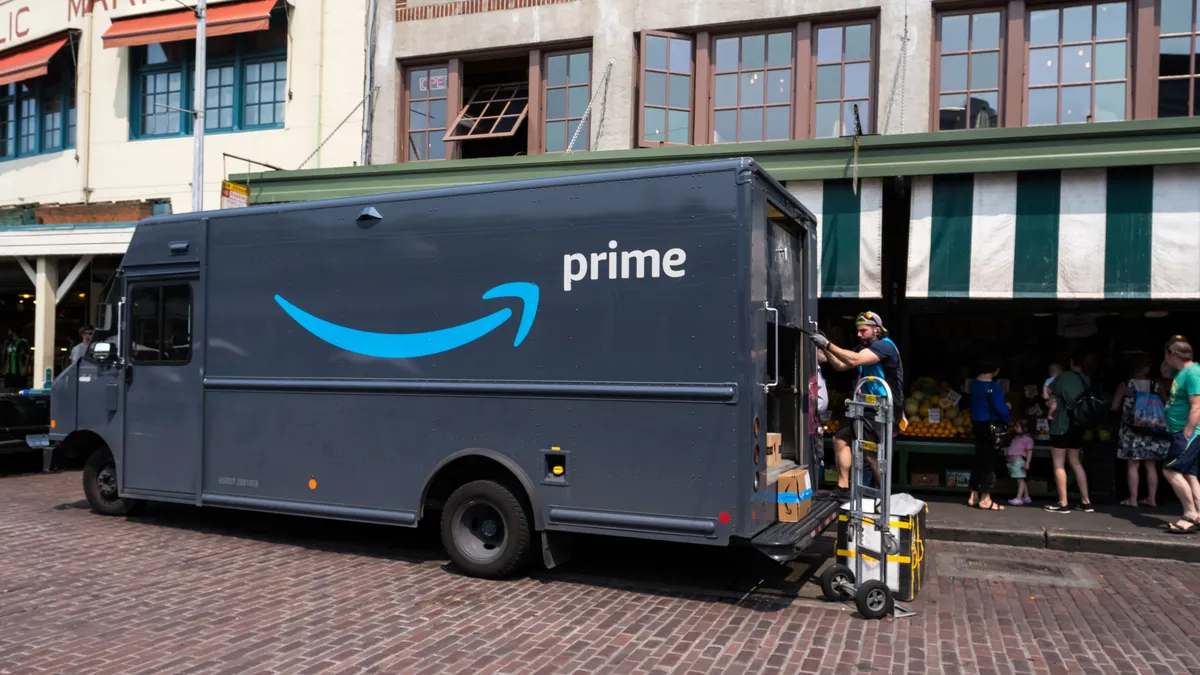
The numbers behind the world's biggest retail event
AWS published its Prime Day 2026 infrastructure figures in its October 13 weekly roundup, and the scale is a useful stress test for any assumptions about cloud ceilings. Amazon ElastiCache peaked at 2.3 quadrillion daily requests. DynamoDB processed more than 59 trillion requests across the four-day event, with a peak of 192 million requests per second while maintaining single-digit millisecond response times. AWS Lambda handled over 2.3 trillion invocations per day, and Amazon EBS moved more than an exabyte of data daily while peaking above 24.8 trillion I/O operations.
Two figures stand out for infrastructure planning purposes. AWS Fargate launched an average of 158.3 million tasks per day, a 47.7 percent jump from 2025, which suggests containerized, orchestrated workloads are growing faster than raw compute demand. And AWS Graviton, Amazon's custom Arm-based chip, powered up to 49 percent of the EC2 compute Amazon.com itself used during the event, a strong signal about where AWS wants its own workloads, and by extension its customers' workloads, to land over the next few years.
Breaking things on purpose, at a scale most teams can't match
The number that should matter most to any CIO managing uptime commitments is this: Amazon ran more than 44,000 AWS Fault Injection Service experiments ahead of Prime Day, more than six times the roughly 7,000 run in 2025. These are deliberate, controlled failures injected into production-adjacent systems to find weak points before real traffic does. The scale of that increase says Amazon does not consider last year's chaos-engineering program sufficient anymore, even after a successful event.
Most enterprises will never run tens of thousands of failure experiments a year, nor should they try to match AWS's specific numbers. The useful takeaway is the ratio of growth: a 6x increase in deliberate failure testing ahead of a known high-stakes traffic event. If your organization's resilience testing program has stayed flat while your traffic, architecture complexity, or AI workload footprint has grown, that gap is worth raising with your infrastructure team before your own highest-stakes week arrives, whether that's a holiday peak, a product launch, or a board-visible SLA commitment.
The same week, AI inference got a lot cheaper
Alongside the Prime Day numbers, AWS announced Claude Haiku 5.5 on Amazon Bedrock, priced at roughly 75 percent less than Claude Haiku 4.5 for most tasks. It is also the first Haiku model with effort controls, letting teams dial cost and intelligence up or down per task rather than accepting a single fixed tradeoff. AWS suggests pairing it with the larger Claude Opus 5.5 model to orchestrate many Haiku subagents in parallel, an architecture pattern that only makes financial sense because the per-call cost of the smaller model has dropped so sharply.
Amazon Nova 2.5 Sonic, a speech-to-speech model for real-time voice agents, launched the same week with improved reasoning, tool-calling accuracy, lower latency, a 256K context window, and expressive voices across seven languages. It pairs with Strands Bidi Agents, now generally available. Taken together, these releases continue a pattern enterprise AI budgets need to account for directly: capability per dollar on inference is falling fast enough that cost models built even two quarters ago are likely already stale.
Security is quietly becoming a platform feature, not an add-on
AWS also shipped Amazon GuardDuty RDS Protection, which now detects data exfiltration and destruction attempts on Aurora PostgreSQL and RDS for PostgreSQL by analyzing query patterns against behavioral baselines, using machine learning to flag anomalies. It requires no agents and no database configuration changes, which matters for security teams who have historically had to choose between deeper protection and the operational burden of deploying and maintaining additional agents across every database instance.
Separately, AWS Continuum for Penetration Testing moved into public preview as a CI/CD pipeline integration, automatically reporting findings with severity ratings and remediation guidance, then re-testing to confirm fixes actually worked. Both tools point toward the same strategic shift: AWS is building security validation directly into the platform layer rather than leaving enterprises to assemble third-party scanning and pentesting tools around their infrastructure. For security leaders, that changes the buy-versus-build calculus on tooling budgets that have traditionally gone to specialized vendors.
What CIOs should take from this one week
No single announcement here is transformative on its own. Together, they describe a cloud provider treating resilience testing, AI inference pricing, and security tooling as a single competitive surface rather than three separate product lines. The Fault Injection Service numbers suggest AWS expects demand volatility, whether from retail events or AI-driven traffic, to keep increasing, and is scaling its own failure-testing discipline to match rather than assuming last year's playbook still holds. That is a meaningfully different posture than treating chaos engineering as a once-a-year pre-holiday checklist item owned by a single reliability team.
The practical move for enterprise technology leaders is to treat this week's numbers as a planning input rather than a press release to skim past. If your resilience testing budget and cadence have not grown in proportion to your traffic or architectural complexity, that is a gap worth closing before your own peak event arrives. If your AI inference budget still assumes last quarter's per-token pricing, it is already out of date. And if your security program still relies entirely on bolted-on third-party tooling, it is worth checking what your cloud provider now offers natively before renewing that contract.