An Admission Dressed as a Feature
Anthropic has rolled out a set of cost controls and analytics for Claude Enterprise, and while the company frames it as empowering administrators, we read it as a candid admission: agentic AI has a billing problem. The new capabilities include spend caps at the team, department, and organization level, model level entitlements, a usage analytics dashboard, effort controls, and real time spend alerts. Enterprises asked for these because their bills were surprising them.
The reason is structural. Agentic workloads, where models autonomously chain many steps and call tools repeatedly, consume tokens in ways that are hard to predict from a simple prompt count. A single agent run can quietly balloon into thousands of model calls. When you multiply that across an organization, costs can escape the tidy budgets that finance teams assumed, which is exactly the pain these features address.
Spend Caps and Tripwires
The centerpiece is hard spend caps at multiple levels of the organization, paired with alerting. Administrators receive spend threshold alerts at 75 and 90 percent of an organization limit, while users see in app notifications at 75 and 95 percent and can request limit increases without leaving Claude. It is a familiar pattern borrowed from cloud cost management, applied to AI consumption.
We think the multi level design is the right instinct. A single organization wide cap is a blunt instrument that either strangles productive teams or fails to catch runaway spend in a specific pocket. Caps at the team and department level let finance apply nuance, giving heavy users room while containing experimentation elsewhere. The user facing alerts also matter, because they push cost awareness down to the people actually generating the spend.
Controlling Which Models Run
Model level entitlements are the quietly consequential feature. Admins can now control which Claude models each user or group can access, across chat, Cowork, and Claude Code. That means an organization can reserve the most capable and expensive models for the teams that genuinely need them while routing everyone else to cheaper options that handle the majority of everyday work.
This is FinOps discipline arriving in the AI stack. The most expensive frontier model is overkill for a huge share of tasks, and letting every employee reach for it by default is how budgets evaporate. Entitlements give administrators a governance lever to match model capability to actual need, which is precisely the kind of control that turns AI from an uncontrolled cost center into a managed line item.
Bringing the Data Home
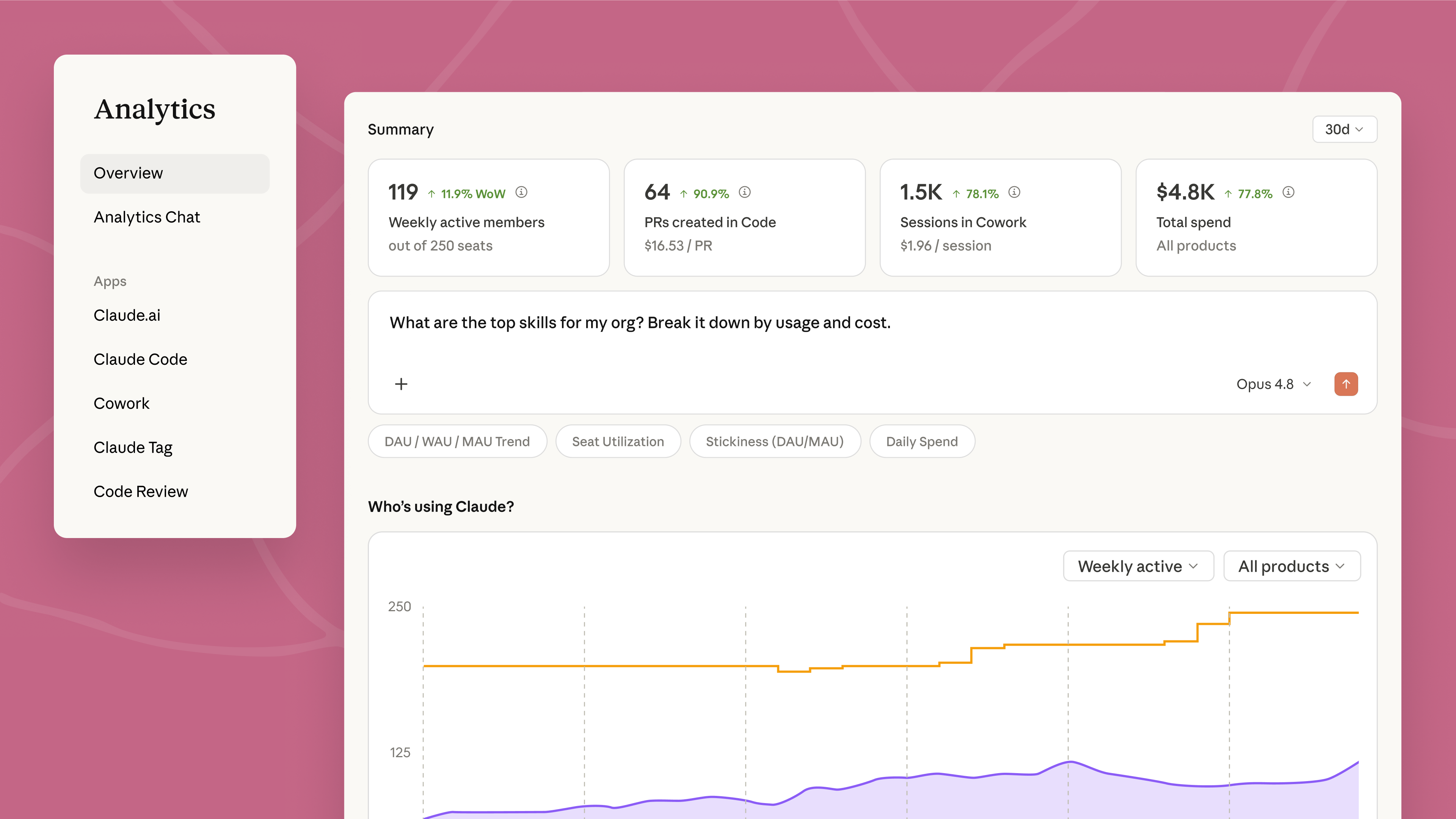
Anthropic also shipped a usage analytics dashboard with exports and an Analytics API, and it made a point of integration. "Cost visibility isn't a once a month exercise," said product manager Kyra Abbu. "With the Analytics API, we can bring that data into the tools we already use every day." The API supports piping usage into platforms like Datadog and CloudZero, meaning AI spend can live alongside the rest of an organization's observability data.
Product director Ciro Yamada pointed to a subtler need. "Token usage alone doesn't tell you much," he said. "What I actually want to see is which skills get run again and again." That distinction, between raw consumption and the specific workflows driving it, is what separates useful cost governance from a meaningless number. Understanding which agents and skills recur is how organizations optimize rather than just cap.
The Maturity Signal
Features like these are unglamorous, and that is precisely why they matter. Spend caps and entitlements are the plumbing of enterprise software, the boring controls that finance and IT demand before they will commit at scale. Their arrival signals that Claude Enterprise is being hardened for serious, budgeted, governed deployment rather than enthusiastic experimentation.
We see this as the market maturing in real time. The first phase of enterprise AI was about capability and access. The next is about control, predictability, and accountability. Vendors that fail to give administrators these levers will struggle to win the largest, most cost conscious buyers, and Anthropic is signaling it understands where the enterprise conversation has moved.
From Novelty to Utility
The arrival of spend governance marks a quiet but important transition in how enterprises relate to AI. In the novelty phase, cost was an afterthought because usage was small and the point was to learn. As agentic workloads scale into genuine production, that indulgence ends, and AI spend starts to behave like any other major operating expense that finance expects to forecast, control, and justify.
We read Anthropic's move as evidence that its largest customers have crossed that threshold. You do not build spend caps and entitlement systems for tire kickers, you build them for organizations spending enough that the finance team is now paying attention. That is a healthier place for the market to be than the era of unmonitored experimentation, even if it is less exciting, because durable adoption is built on predictability, not novelty.
What Finance and IT Should Do
For organizations running Claude at scale, the immediate move is to actually configure these controls rather than admire them. Set caps that reflect real budgets, assign model entitlements that match capability to need, and wire the Analytics API into whatever observability platform already governs cloud spend. Cost governance that exists but goes unconfigured is no governance at all.
The broader takeaway extends beyond any single vendor. Agentic AI changes the cost profile of software in ways traditional budgeting was never designed for, and treating AI spend with the same rigor as cloud spend is now table stakes. The organizations that build this discipline early will be the ones that scale agentic AI without the quarterly bill shock that has caught so many off guard.