Curriculum as Public Infrastructure
Oak National Academy, a publicly funded curriculum body, and the Raspberry Pi Foundation, a charity devoted to computing education, have released 54 free digital literacy lessons spanning Years 1 through 9, covering roughly ages five to fourteen. The lessons are structured as nine units, one per year group, each containing six one hour lessons, and they are offered completely free through separate primary and secondary collections that schools can adapt to their own contexts. It is a substantial, coherent body of teaching material, given away rather than sold.
The model matters as much as the content. Producing a high quality, progressive curriculum and releasing it free to every school is a form of public infrastructure, the educational equivalent of a road or a library. It levels access, so that a well resourced school and a struggling one can draw on the same materials, and it counters the fragmentation that occurs when digital literacy is left to whatever patchwork of commercial products each school happens to afford. In an era of paid edtech, a free, comprehensive, publicly minded curriculum is a deliberate and welcome statement.
Nine Themes for a Complicated World
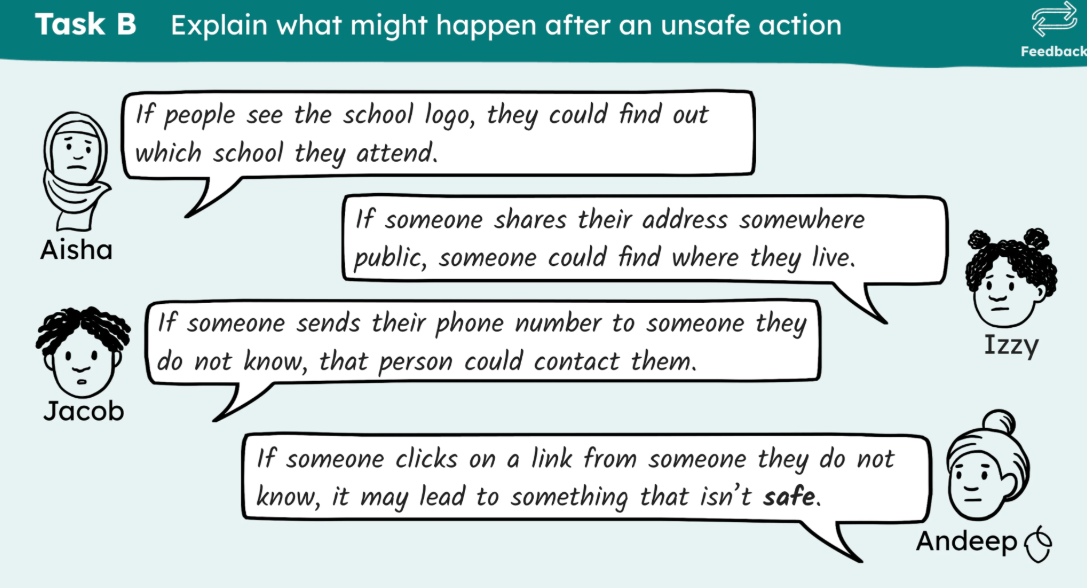
The curriculum's scope reflects how much digital literacy now has to encompass. Its nine themes are online safety, information reliability, personal data protection, security, digital wellbeing, artificial intelligence, accessibility, sustainability, and responsible digital participation. That list has traveled a long way from the era when digital literacy meant knowing how to use a word processor. It treats the digital world as a social, ethical, and civic environment, not merely a set of tools, and it asks students to navigate it thoughtfully.
The progression is thoughtfully sequenced. The lessons move from basic online safety concepts in the early years to advanced topics like algorithmic bias and evaluating the reliability of AI generated answers by Year 9. That arc mirrors how children's actual relationship with technology deepens as they grow, from simple rules about staying safe to the harder critical thinking required to assess whether the confident answer a chatbot just produced is actually true. Teaching that skepticism early is exactly what the AI age demands.
Questioning, Not Just Operating
Oak's chief executive, John Roberts, captured the philosophy in a single line, defining digital literacy as the ability to understand, question, and participate in the digital world, not just operate the devices in it. That distinction is the entire point. A generation that can swipe, tap, and scroll fluently is not thereby literate, any more than a person who can sound out words is thereby able to read critically. Operational fluency and critical understanding are different capabilities, and the second is far scarcer and far more important.
This framing is quietly radical in its implications for AI. If digital literacy means the capacity to question, then the central skill for students growing up with generative AI is not prompting a chatbot but interrogating its output, recognizing when it is plausible but wrong, understanding where its information comes from, and knowing when not to trust it. A curriculum built around questioning rather than operating is building precisely the mental habits that make young people resistant to the confident errors and manipulations that AI systems produce.
The Timeliness of the AI Reliability Thread
The inclusion of evaluating AI reliability is especially well timed. Recent research has found that students frequently fail to verify what AI tools tell them, accepting confident answers at face value even when those answers are wrong, with measurable consequences for their learning. A curriculum that explicitly teaches children to check, question, and evaluate AI generated information addresses that documented weakness head on, at the age when the habit can still be formed rather than corrected later.
This is the difference between banning AI from classrooms and equipping students to handle it. Prohibition is a losing strategy, because students will encounter these tools regardless of school policy. Teaching them to use AI critically, to treat its output as a claim to be checked rather than a fact to be accepted, is the durable answer. Embedding AI reliability into a broader digital literacy curriculum, alongside data protection and information reliability, situates it correctly as one facet of a general capacity for critical engagement with technology.
Free as a Strategic Choice
The decision to give the curriculum away is worth dwelling on, because it runs against the grain of a heavily commercialized edtech market. Free, high quality public curriculum materials do more than save schools money, they set a floor on quality and a shared reference point that fragmented commercial offerings cannot provide. When every school can reach for the same well designed lessons, the gap between the best resourced and the least narrows, and the overall standard of what gets taught rises. That equalizing effect is the quiet strategic payoff of the free model.
It also changes the competitive dynamics of the market itself. Commercial providers now have to justify their price against a credible free alternative, which pushes them toward genuine differentiation rather than filling a vacuum. Publicly funded bodies producing open materials are, in effect, setting a public option in education content, and the discipline that imposes on the wider market benefits schools and students. Oak and Raspberry Pi are demonstrating that some of the most important educational infrastructure is best provided as a commons, not a product, and that choice is as consequential as the lessons themselves.
A Model Other Systems Should Copy
The Oak and Raspberry Pi collaboration is a template worth emulating well beyond Britain. A public curriculum body providing pedagogical structure, paired with a computing charity providing subject depth, producing free materials that any school can use and adapt, is a model that sidesteps both the cost barriers of commercial edtech and the quality inconsistency of do it yourself resources. It is unglamorous, systematic work, and it is exactly the kind of foundational investment that pays off across an entire education system.
For education leaders everywhere, the lesson is that digital literacy deserves the same curricular seriousness as reading or mathematics, with a proper scope, sequence, and progression rather than a one off assembly or an optional module. The stakes are only rising as AI makes the digital environment more powerful and more confusing at once. Sending children into that world able to operate devices but unable to question them is a failure of education. Oak and Raspberry Pi have shown, concretely and for free, what taking the alternative seriously looks like.