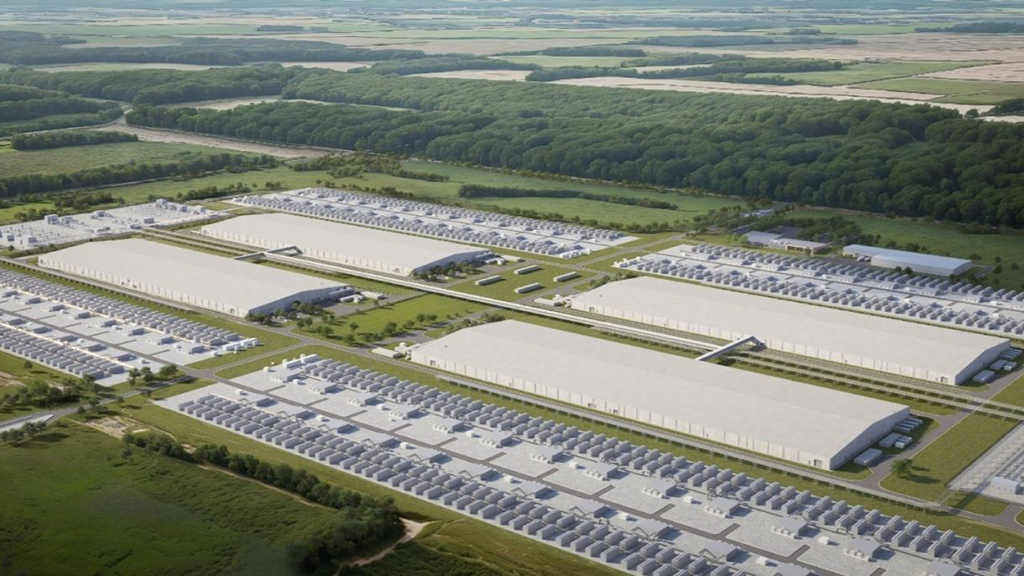
A Single Campus the Size of a Power Plant
AirTrunk has committed to spending 21 billion dollars on a single data center campus, and the number that matters most is not the dollars but the watts. The planned facility at the Raigad Pen Growth Centre, a 1,217-acre development in Pen Taluka in Maharashtra's Raigad district near Mumbai, is designed to deliver 3 gigawatts of IT capacity at completion. Three gigawatts is not a data center in the sense most executives still picture. It is the electrical draw of a mid-sized city, dedicated entirely to computation. The agreement takes the form of a letter of intent signed with the Maharashtra government, a preliminary and non-binding step, but the ambition it encodes is unmistakable.
The scale reframes what enterprise infrastructure now means. When a campus is measured in gigawatts rather than square feet, the binding constraint shifts from real estate and servers to power generation, grid interconnection and cooling at industrial scale. AirTrunk's commitment reflects the reality that AI workloads have decoupled compute demand from the historical growth curve of digital services. Building three gigawatts on a single site is a bet that the demand for AI training and inference in and around India will not merely continue but compound, and that the operator who secures the land and power now will own a scarce resource later.
The Anchor of a 30 Billion Dollar India Bet
The Maharashtra campus does not stand alone. It is the anchor of AirTrunk's wider India strategy, a commitment of 30 billion dollars and 5 gigawatts of capacity to be delivered by 2030. The 21 billion dollar Raigad project accounts for the majority of that total on its own, which tells you how central the Mumbai region is to the plan. AirTrunk entered India earlier in 2026 after acquiring Blackstone's Lumina CloudInfra platform, and it now operates or develops facilities in Mumbai, Chennai and Hyderabad. The Maharashtra announcement is the moment that regional footprint tips into national ambition.
For a company that was itself acquired by Blackstone and the Canada Pension Plan Investment Board for 16.1 billion dollars in 2024, the India push is a statement about where the next decade of returns will come from. The operator is not chasing incremental capacity in mature markets but planting a flag in a geography where digital demand, government appetite and land availability align. The 2030 horizon on the 5-gigawatt target signals that this is infrastructure thinking, measured in decades rather than quarters, the kind of long-duration bet that only patient capital of Blackstone and CPPIB's scale can underwrite.
The State as Kingmaker
The letter of intent was signed by Devendra Fadnavis, the Chief Minister of Maharashtra, and his direct involvement is not ceremonial. At gigawatt scale, a data center campus is inseparable from the state that hosts it. It needs power allocation, grid upgrades, water access, land at the Raigad Pen Growth Centre and the regulatory clearances that only a government can expedite. Fadnavis confirmed the 3-gigawatt capacity target in announcing the agreement, positioning Maharashtra as a destination for the cloud and AI infrastructure that global operators are racing to site. The state has effectively made itself a partner in the buildout rather than a passive landlord.
This is the new political economy of AI infrastructure. Governments have recognised that hosting hyperscale campuses brings investment, construction jobs and a claim on the digital economy's future, and they are competing to attract it. But the same scale that makes these projects attractive also makes them contentious, straining local power grids and water supplies in ways communities elsewhere have begun to resist. Maharashtra's enthusiasm today will be tested by delivery, because a letter of intent is a promise, and 3 gigawatts of load is a decades-long obligation to keep a campus powered without leaving surrounding demand in the dark.
The Buildout Moves East
For most of the current AI infrastructure cycle, the headline numbers have come from North America, from the American Midwest, from Texas and from the American Southwest. AirTrunk's India commitment marks a visible eastward shift in that story. The economics that drove hyperscale campuses to cluster near cheap power and permissive jurisdictions in the United States apply just as forcibly in a country with a vast domestic market, a large and growing developer base, and a government eager to be part of the AI economy. India is not a peripheral market absorbing overflow capacity. It is becoming a primary theatre of the buildout in its own right.
That shift carries strategic weight for enterprise technology leaders far beyond India. Where compute is built determines where it is cheap, where latency is low, and where data can legally reside. As gigawatt-scale capacity comes online near Mumbai, Chennai and Hyderabad, enterprises with operations or customers in the region gain options they did not have before: local training capacity, in-country inference and a hedge against concentration risk in Western cloud regions. The map of global compute is being redrawn in real time, and AirTrunk's 21 billion dollar campus is one of the largest new landmarks on it.
What Executives Should Read Into It
The temptation is to treat a 21 billion dollar announcement as a headline about someone else's balance sheet. The more useful reading is what it reveals about the direction of the market that every technology buyer depends on. Operators are willing to commit tens of billions of dollars to single campuses years before the demand fully materialises, which is a strong signal about how durable they believe the AI compute shortage to be. When infrastructure providers are pre-building at gigawatt scale in new geographies, they are pricing in a future where compute remains scarce and valuable enough to justify the risk.
For enterprises, the practical implication is that geography is becoming a first-class variable in infrastructure strategy. The question is no longer only which cloud provider to use but where the underlying capacity physically sits, how exposed a workload is to regional power and policy, and whether diversifying across emerging compute hubs reduces risk. AirTrunk's India bet is a preliminary letter of intent, and much can change between signing and switch-on. But the intent itself is the signal worth heeding: the AI buildout is globalising, and the enterprises that plan for a multi-region compute map will be better placed than those still assuming the center of gravity stays where it has been.