AI chatbots are misstating the basics for most UK retailers
New research from AI visibility platform Searchable put more than 72,000 questions about UK high street retailers to ChatGPT, Google Gemini and Perplexity, then graded each answer against verified information. The result, published July 16, is unflattering for the models and worse for the retailers. Sixty-four percent of businesses had at least one false fact returned about them, and one in 16 answers overall was simply wrong. The questions were not obscure. They covered store locations, contact details and brand identity, the exact facts a shopper checks before deciding whether to visit or buy. The machines answered 98 percent of the time. They were confidently incorrect often enough to matter.
We flag this because it cuts against the prevailing narrative. Most coverage of agentic commerce assumes the models are competent narrators of the retail world and the only question is how to get recommended. This data says the foundation is shakier than that. If an AI assistant sends a shopper to the wrong postcode or a dead website, the sophisticated question of ranking becomes moot. The immediate risk for retailers is being actively misrepresented by AI, at scale, in the tools a growing share of shoppers now trust for research. That is a brand-safety problem hiding inside what everyone has been selling as a pure AI-opportunity story.
The errors are specific, and some models are worse than others
The failure modes are concrete. Wrong postcodes appeared in one in 10 location answers, and in 15 percent of those wrong-location cases the address was 20 miles or more from the actual shop. One in 15 website answers pointed to dead links, lookalike sites or an entirely different business. One in 40 answers attached the wrong brand to a shop name. These are blunt factual errors, the digital equivalent of printing the wrong address on a storefront sign, and they route ready-to-buy customers to a competitor or a void. A shopper acting on that answer does not know it is wrong, and the retailer never sees the lost visit.
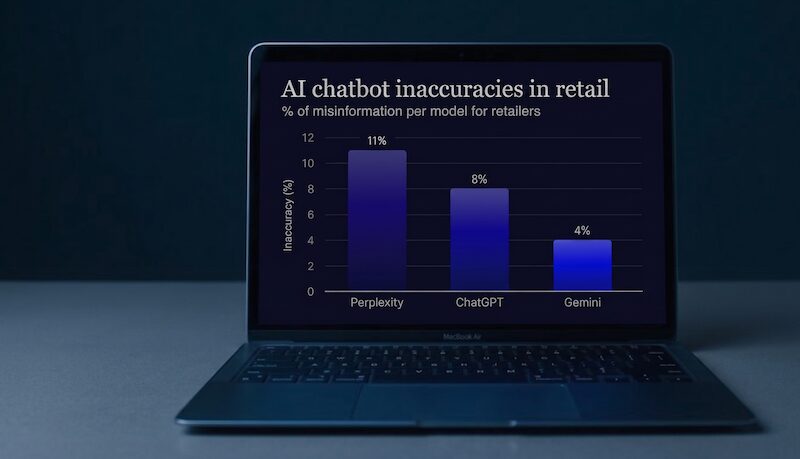
The accuracy gap between models is wide enough to matter for anyone monitoring this. Perplexity returned inaccurate answers in 10 percent of cases, more than double ChatGPT at 4 percent and Gemini at 5 percent. That spread tells retailers two things. First, your exposure depends on which assistant your customers use, so you cannot treat AI answers as a single monolithic channel. Second, the model landscape is uneven and moving, which means monitoring accuracy across engines is now an ongoing operational task rather than a one-time audit. Retailers already track their Google rankings obsessively. Very few yet track what three chatbots are telling customers about them.
Smaller retailers pay the highest price
The pain is not evenly distributed. "AI inaccuracies are more likely to impact smaller businesses than larger brands across multiple sectors," said Chris Donnelly, co-founder of Searchable. The mechanism is straightforward. A thin online footprint gives the models less reliable material to learn from, so they fill gaps with guesses. Large chains with dense, consistent data across directories, maps and their own sites give the models more to anchor on and get misrepresented less. That inverts the usual assumption that AI democratizes visibility for small players. In practice, the retailers least equipped to monitor and correct AI errors are the ones most likely to suffer them in the first place.
This matters for the mid-market retailers and franchises many of our readers run, where individual store data is often inconsistent across hundreds of locations. Each store with a stale directory listing or a mismatched phone number is a candidate for misrepresentation. The larger the estate, the more surface area for the models to get something wrong, and the harder it is to police manually. We see this as the local-SEO problem of the last decade returning in a more punishing form. A shopper who got a wrong Google result could scroll to the next one. A shopper who trusts a single confident chatbot answer usually acts on it without a second source.
Shoppers blame the brand, not the bot
The reputational math is what should move budgets. Searchable found that 58 percent of shoppers lose trust in a brand when an AI tool provides wrong product information about it. Meanwhile 90 percent of surveyed LLM users employ these tools for product research and 53 percent use them to choose which retailer to buy from. Put those together and the exposure is obvious. A majority of AI users are making retailer choices partly on AI output, and when that output is wrong, most of them hold the retailer responsible for the mistake. You are being judged on statements you did not make and, in most cases, cannot even see.
That is a genuinely new category of brand risk. For decades, brand safety meant controlling your own channels and adjacencies in advertising. AI answers break that model, because a third-party system is now generating unvetted claims about your business and presenting them as fact to purchase-ready customers. The retailer carries the reputational cost with none of the editorial control. We would treat this the way security teams treat an unmonitored external attack surface. You cannot patch what you are not watching, and right now most retailers have no visibility into what the major assistants are telling their customers on any given day.
The fix is unglamorous data hygiene
The remedy Searchable points to is not exotic. "Ensure your website and third-party business directories are up to date and clearly state your company's essential services," Donnelly advised. In practice that means treating structured data, consistent name-address-phone details across every directory, accurate store locators and machine-readable service information as a live operational discipline. The models learn from the open web. Clean, consistent, authoritative data is how a retailer raises the odds that they get narrated correctly. This is the same catalog-and-data hygiene that drives AI discovery rankings, which means the work pays off twice: fewer damaging errors, and better odds of being recommended in the first place.
The organizational challenge is ownership. Correcting how AI describes your business sits awkwardly between SEO, brand, ecommerce and store operations, so it typically belongs to no one. We would assign it explicitly, fund monitoring across the major assistants, and set a cadence for correcting errors the way teams already triage bad reviews. The retailers that get ahead of this will protect trust and capture the AI-sourced demand that is growing regardless of how ready anyone feels. The ones that wait will keep paying for mistakes they never made and cannot see. In an AI-mediated market, being described accurately is table stakes, and most retailers have not yet claimed their seat.