What Ahold Delhaize actually shipped
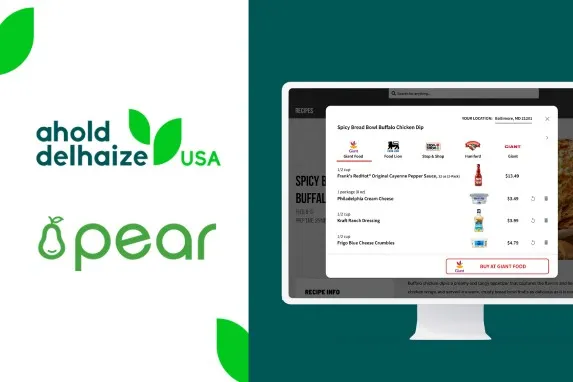
Ahold Delhaize USA said this week that shoppers across Food Lion, The Giant Company, Giant Food, Hannaford, and Stop & Shop can now add items to their digital carts directly from external CPG brand websites, recipe pages, and store locator tools. The retailer built the capability with Pear Commerce, a commerce infrastructure vendor that specializes in connecting brand content to retailer checkout flows. The rollout reached all five banners this month, giving roughly 26 million weekly omnichannel customers a shorter path from a recipe or a brand page to a completed order.
Keith Nicks, Ahold Delhaize USA's chief commercial and digital officer, described the move as evolving the company's digital ecosystem to better serve customers. Pear Commerce co-founder Alex Wyler put it more bluntly, telling reporters that shoppers now expect a seamless path from inspiration to purchase and that retailers need infrastructure built for that expectation. Neither framed this as a one-off feature. Both described it as an extension of a direct-to-cart strategy Ahold Delhaize has been building since April.
The pattern is headless commerce, not a recipe widget
The technical story here matters more than the recipe angle suggests. Ahold Delhaize's cart has become a service that external pages, brand sites, and media placements can call directly, rather than a feature locked inside its own app and website. That is the definition of headless commerce: separating the transaction layer from any single front end, so the retailer's cart becomes reachable from wherever the shopper already is, whether that is a brand's product page, a recipe blog, or eventually an AI agent acting on the shopper's behalf. Grocery has historically lagged fashion and electronics in adopting this architecture, which makes the move notable on its own.
This follows the same logic as the Click2Cart feature Ahold Delhaize introduced in April for social and display ads, which let shoppers add products straight from an ad unit without leaving the feed. Extending that pattern to CPG-owned recipe pages and product sites means the retailer is now exposing commerce APIs to third parties it does not control, which raises real questions about authentication, cart state syncing across sessions, and who owns the customer data generated at that touchpoint. Those are solvable problems, but they are the kind of problems that only show up once a cart stops being a single-app feature.
Retail media is the business case, and the honest one
Ahold Delhaize is explicit that this closes a loop for its AD Retail Media business. CPG brands spend on retail media because it is supposed to drive purchases, but attribution has always been fuzzy once a shopper leaves an ad or a brand page. A cart that shoppers can reach from that exact page removes a step in the funnel and gives the retailer a cleaner story to sell media buyers: click, cart, done.
That is a stronger justification than customer convenience alone, and it is worth taking at face value. Retail media is one of the few genuinely high-margin lines in grocery, and Ahold Delhaize has already said its e-commerce business reached profitability on a fully allocated basis in H1 2025, with initiatives like this cited as a contributor. Expect the company to talk about direct-to-cart adoption in terms CPG partners care about: incremental basket size and closed-loop measurement, not just app engagement.
What this means for the commerce stack
For a CIO running a grocery or CPG commerce platform, the harder question sits underneath the consumer feature: can your commerce backend expose a cart as a callable service to partners you do not fully trust, without creating a security or fraud surface you cannot monitor. Ahold Delhaize solved this by buying the capability from Pear Commerce rather than building it internally, which is itself a signal about how mature this category of infrastructure has become and how much specialized work sits behind what looks like a simple add-to-cart button on a recipe page.
If your commerce platform still treats the cart as something only your own front end can write to, this is the moment to revisit that assumption. Retail media budgets are growing faster than almost any other line in retail, and the retailers capturing that spend are the ones that can prove attribution end to end, from the exact ad or page where the customer decided to buy through to a completed order. A cart that only lives inside your app cannot make that argument to a CPG media buyer.
The roadmap implication
This also previews where agentic commerce is headed next. Once a cart can be called from a recipe page, the same API can be called from an AI shopping agent acting on a customer's behalf, whether that agent lives inside ChatGPT, a browser assistant, or the retailer's own app. The infrastructure investment is the same regardless of who or what is initiating the add-to-cart call, which means the engineering work Ahold Delhaize just did for CPG partners is largely reusable for whatever agentic checkout standard the industry settles on next.
Retailers that build headless, externally callable commerce layers now are building the exact plumbing that agentic checkout will require later. Those still treating checkout as a closed, app-only experience will find themselves retrofitting under pressure when a major AI platform partner asks for cart API access on a deadline they did not set. Better to build that muscle now, on a partnership with a CPG vendor you already trust, than to build it for the first time under a negotiating deadline set by a much larger platform.