The result
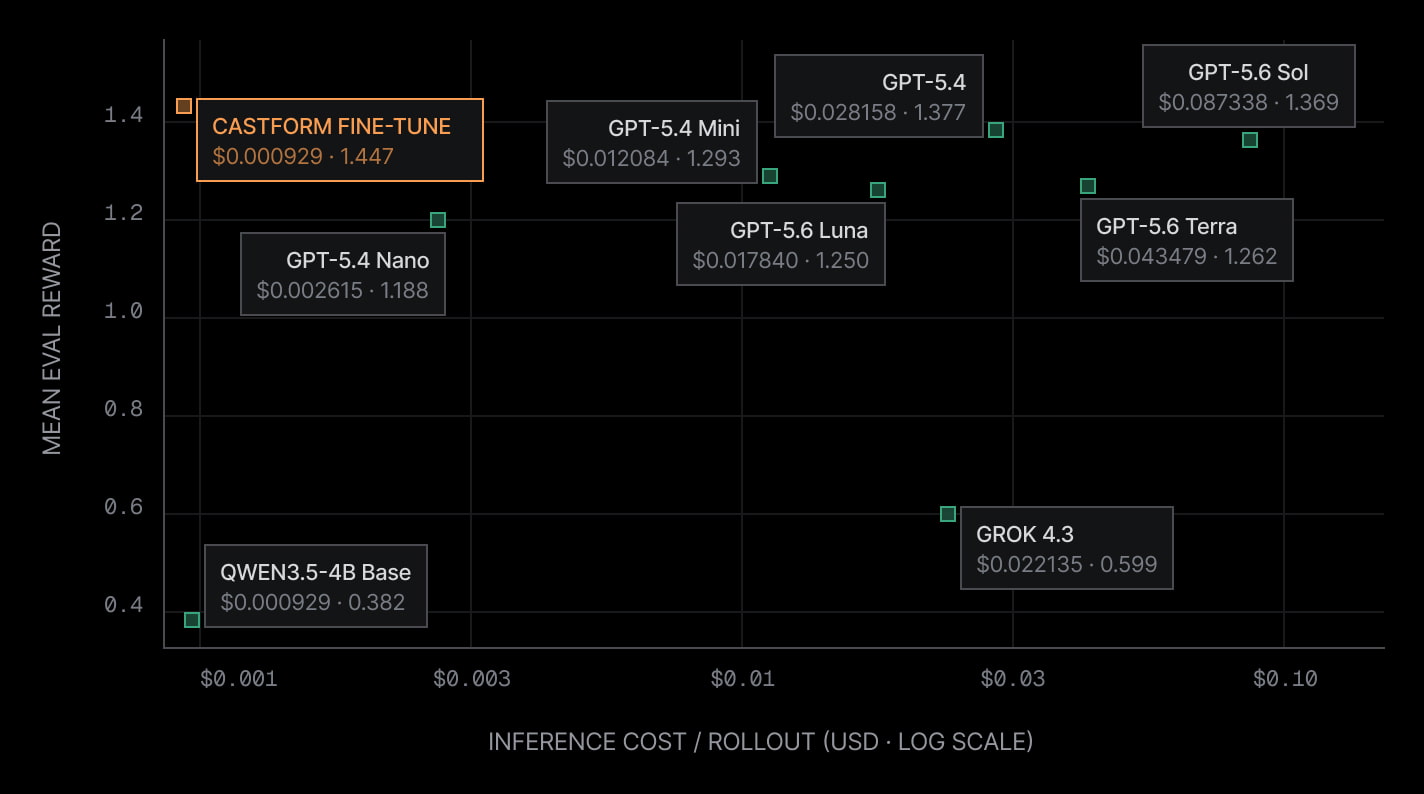
Castform and Neon published joint results on August 5 showing a 4 billion parameter open-source model, post-trained on top of Neon's Lakebase Search infrastructure, matching GPT-5.6 Sol's accuracy on retrieval tasks at roughly 100 times lower inference cost per query. The comparison here is specific to retrieval work, answering questions grounded in a company's own internal data, rather than general purpose reasoning across arbitrary tasks, and that scoping matters considerably for how enterprises should interpret and apply the headline claim being made.
The methodology behind the result used reinforcement learning post-training with reward functions built around three distinct signals: retrieval accuracy, citation correctness, and overall answer quality as judged against held-out examples. Rather than training on generic, web-scale data the way most foundation models are built, the pipeline generated synthetic training examples directly from each target customer's own knowledge base, which is precisely what let a model with a fraction of the parameters compete credibly against a much larger frontier system on this specific, narrowly defined task.
Why hybrid search mattered
The training setup combined traditional BM25 keyword search with modern vector-based semantic retrieval rather than relying on dense embeddings alone as most retrieval-augmented systems do today. That hybrid approach directly addresses a known and persistent weakness of pure vector search, namely missing exact-match terms like product SKUs, account numbers, or specific technical identifiers that a straightforward keyword index catches reliably almost every time and a purely semantic embedding sometimes simply does not surface at all.
Building this hybrid retrieval layer directly at the infrastructure level, inside Neon's own database engine rather than bolting it on as a separate application-layer service, removed a substantial share of the engineering cost that normally falls squarely on the team fine-tuning the model itself. That is the specific claim genuinely worth testing during any proof of concept: how much of the reported cost advantage comes from the model simply being smaller, and how much comes instead from the retrieval infrastructure quietly doing work the model no longer has to do on its own.
The pitch to data teams
Castform cofounder Ying Hang Seah put the underlying thesis directly in the announcement: most teams' best training data is just sitting in their databases already, and the real problem is that turning raw data into something usable is genuinely hard, while letting agents read, search, and mutate that data cheaply at scale requires advanced infrastructure most teams have not built. Pointing Castform at Neon, in his framing, skips both of those hard problems at once for a customer. That framing targets a real and extremely common blocker inside enterprise data teams, namely organizations that already have the raw data but simply lack the pipeline needed to turn it into usable training signal.
This positions the joint product less as a model directly competing with frontier labs on general capability and more as a packaged, opinionated workflow built for one specific, high-frequency enterprise need: answering questions accurately against internal documentation, support ticket archives, or product catalogs at scale. That is a considerably narrower claim than simply beating GPT-5.6 Sol outright, and it is also the more credible one of the two framings, since narrow task fine-tuning has repeatedly demonstrated it can match or exceed general purpose frontier models specifically on the exact task it was tuned for, without claiming any broader capability.
What to verify before betting on this
The 100x cost figure almost certainly compares inference cost per query measured on the specific retrieval benchmark used in this announcement, not the full total cost of ownership over time. Fine-tuning a model on your own proprietary data requires meaningful engineering time upfront, ongoing retraining as the underlying knowledge base changes and grows, and continuous monitoring for model drift, none of which shows up cleanly in a simple per-query cost comparison but all of which shows up eventually in the total bill after a full year of production use.
Enterprises evaluating this approach should also ask directly how the published benchmark task compares to their own actual production workload in practice. Retrieval accuracy measured on a controlled, curated test set does not automatically transfer cleanly to messier real-world queries involving ambiguous phrasing, genuine multi-hop reasoning, or underlying data that changes on a daily basis. Running a real proof of concept against your own support tickets or product data, rather than trusting the vendor's own benchmark numbers alone, is the only reliable way to know whether the advertised cost savings actually hold up in your specific environment.
The database as the differentiator
Neon's role in this result is worth separating out from Castform's, because it points to a broader shift in where competitive advantage sits in the AI stack. Neon is fundamentally a serverless Postgres database company, and its Lakebase Search capability turning into a meaningful contributor to a model training result suggests database vendors are becoming active participants in the AI training pipeline rather than passive storage layers that sit underneath it.
That shift matters for enterprise data architecture decisions well beyond this specific partnership. If the database layer itself can meaningfully improve model training outcomes through better retrieval infrastructure, then database vendor selection becomes an AI strategy decision as much as a data engineering one, and CTOs should expect their existing database vendors, not just their model vendors, to start pitching AI training and fine-tuning capabilities built directly into the data layer over the next year.
The broader implication for model strategy
This result adds to a growing and increasingly credible body of evidence that the default instinct to route every single workload to the biggest, most expensive frontier model available is often the wrong economic call for enterprises to make by default. For well-scoped, high-volume tasks like internal knowledge retrieval specifically, a considerably smaller model fine-tuned carefully on a company's own data can match frontier-level accuracy while cutting inference cost by orders of magnitude, and that shift meaningfully changes the underlying unit economics of any AI feature built around genuinely high query volume in production.
For CTOs actively managing AI infrastructure spend across their organization, the actionable next step is a straightforward audit of which production workloads are currently running on frontier models purely by default rather than through any deliberate evaluation process. Retrieval-heavy, narrowly scoped tasks are consistently the best candidates to test first against a properly fine-tuned small model, while reserving genuine frontier model spend specifically for tasks that require broad, general purpose reasoning no smaller model can currently replicate reliably.