A Claim, Not Yet a Confirmation
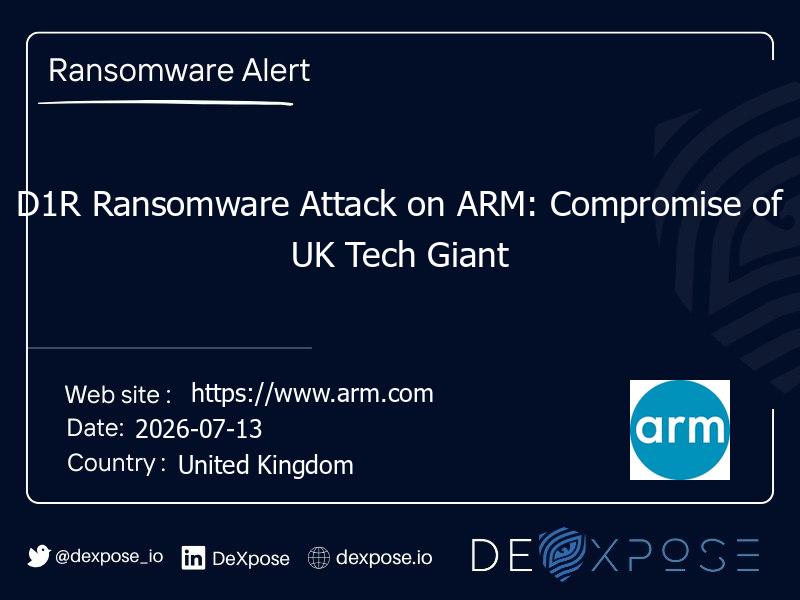
On July 13, 2026, a threat actor calling itself D1R announced that it had breached Arm, the UK based company whose chip designs sit at the heart of nearly every smartphone and a growing share of servers and laptops. The group claimed to have leaked an internal tool and framed the intrusion as a successful compromise of one of technology's most important intellectual property holders. It is the kind of claim that travels fast, because Arm occupies a position of extraordinary leverage in the global hardware supply chain, and any crack in its defenses carries implications far beyond a single company.
We want to be precise about what is known and what is not. As of this writing the claim rests on the attacker's own statements, relayed through threat intelligence reporting, and Arm has issued no public confirmation of a breach. That does not make the claim false, but it does place it in the large category of extortion posts that begin with a bold assertion and only later resolve into a verified incident or a debunked exaggeration. Executives reading this should treat it as an unconfirmed but credible enough claim to warrant attention, not as a settled fact.
The Athena Download Manager
The specific item D1R says it obtained is a tool described as the Athena Download Manager. According to the group, the tool requires an SSL certificate belonging to a company that owns Arm products, and it allegedly allows a user to bypass multiple two factor authentication checks that Arm's standard download portal requires. If that description holds, the tool is not customer data in the usual sense but rather a piece of internal tooling that governs how licensed partners retrieve Arm's products, which is a different and in some ways more interesting kind of exposure.
The concern with a tool like this is what it represents rather than its raw contents. A utility that streamlines authenticated downloads sits close to the trust boundary between Arm and the licensees who build on its designs. In the wrong hands, knowledge of how that mechanism works, or possession of the certificate it depends on, could in principle help an attacker impersonate a legitimate partner or reach material that is meant to be gated behind strong authentication. The scope D1R disclosed appears limited to this single tool, with no indication of broader data theft or operational impact, which again argues for measured concern rather than alarm.
A Breach Built From Other Breaches
The most instructive detail in D1R's account is how it says the intrusion began. Rather than exploiting a fresh vulnerability in Arm's own systems, the group claims it leveraged leaked data from Synopsys, an electronic design automation company deeply intertwined with the chip industry, and cross referenced that material with data from other company breaches to assemble a path into Arm. Whether or not the specifics are accurate, the method is entirely plausible and increasingly common. Attackers no longer treat each target in isolation. They mine the growing pool of stolen data from across an ecosystem and stitch fragments together into working access.
For the semiconductor world this is a pointed warning, because the industry is a tightly linked web of design tool vendors, foundries, IP licensors and integrators who share credentials, portals and trust relationships. A breach at one node becomes ammunition against the next. We have written before about supply chain risk in software, and this is its hardware analog. When Synopsys, Arm and their many partners are all connected by authentication and data flows, the security of any one of them is partly a function of the discipline of all the others, and leaked data has a long half life as a weapon.
Why 2FA Slowed but Did Not Stop Them
D1R was candid that Arm's two factor authentication posed a significant obstacle, and that candor is worth sitting with. It is a reminder that strong authentication works, in the sense that it raised the cost and effort required and forced the attacker to route around it rather than walking straight through. Organizations that have invested in multi factor authentication across their portals are not wasting their money, and the friction Arm's controls apparently created is exactly the kind of defense that turns a trivial compromise into a laborious one.
The sobering half of the lesson is that the group says it still got what it was after. A determined attacker treated 2FA as a speed bump rather than a wall, and the alleged prize was a tool that itself can bypass those very checks. That is the recurring shape of modern intrusions. No single control is decisive on its own, and attackers win by chaining together leaked data, patience and any tooling that erodes an authentication boundary. Defense in depth is not a slogan here. It is the recognition that even a control that works, like Arm's 2FA, needs layers behind it for the cases where a motivated adversary finds a way around.
What Arm's Silence Means for the Ecosystem
Arm's lack of public comment is neither surprising nor, by itself, meaningful. Companies routinely stay quiet while they investigate an unverified claim, and premature confirmation of an incident that turns out to be exaggerated carries its own costs. The responsible posture for partners and customers in the meantime is to watch for an official statement, apply any guidance Arm eventually issues, and treat the download tooling and certificate relationships described in the claim as areas worth reviewing regardless of how this particular episode resolves. Prudence does not require believing the attacker. It requires taking the described attack path seriously.
The larger point for enterprise leaders transcends whether D1R's specific boast holds up. The claimed method, building an intrusion from the accumulated debris of other companies' breaches, is the direction the whole field is moving, and it does not depend on this incident being true. Every organization now operates inside an ecosystem where its own security is entangled with the security of its vendors and peers, and where old leaked data keeps finding new uses. The defensive response is to assume your credentials and data may already be circulating, to rotate and scope them accordingly, and to build authentication that a motivated attacker has to fight for at every layer, not just the first.