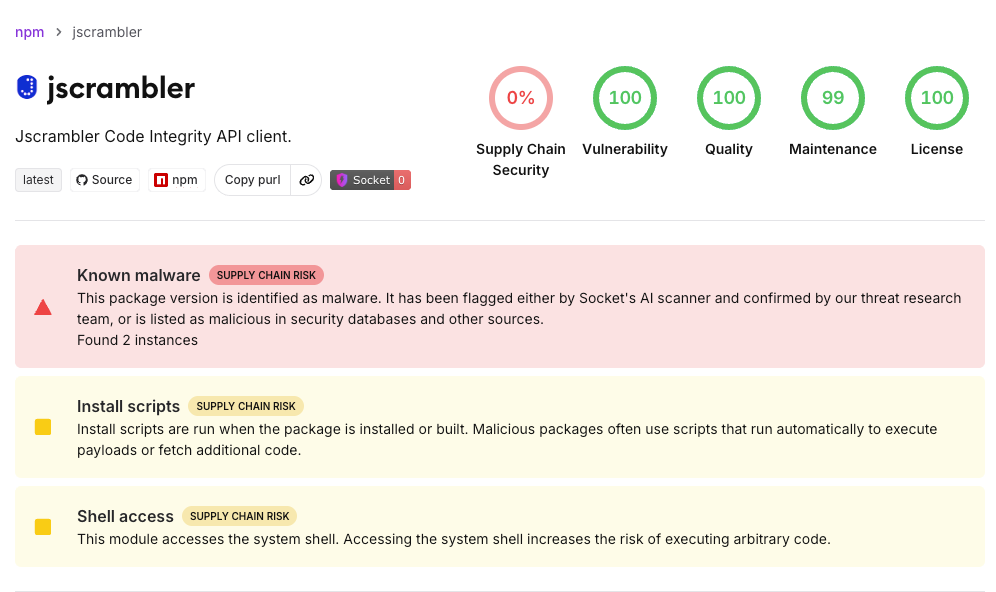
A security vendor's own package turned into malware
On July 11, attackers published poisoned versions of Jscrambler, a widely used JavaScript protection tool, straight to the npm registry using stolen publishing credentials. The compromise hit the core jscrambler package along with its build integrations, including the webpack, gulp, grunt, and metro plugins. Jscrambler sells code obfuscation and anti-tampering technology, so seeing its own supply chain weaponized carries an uncomfortable irony for the developers who trusted it. The malicious releases were downloaded 1,479 times before removal, a modest number that undersells the risk, because a single infected build machine can leak credentials that unlock an entire cloud estate. Socket flagged the first bad version six minutes after publication.
The affected releases spanned jscrambler 8.14.0 through 8.20.0, plus jscrambler-webpack-plugin 8.6.2, gulp-jscrambler 8.6.2, grunt-jscrambler 8.5.2, and jscrambler-metro-plugin 9.0.2. Clean builds now start at jscrambler 8.22.0, and the poisoned versions have been deprecated so normal dependency resolution avoids them. For teams that pinned or installed during the exposure window, that cleanup is not enough on its own. Any workstation, continuous integration runner, or build server that pulled a compromised version should be treated as a credential-exposure event, with secrets rotated and logs reviewed. The package touches front-end build pipelines directly, which places it exactly where sensitive tokens tend to live.
How the dropper evaded scanners
The attack evolved mid-campaign, which is the detail worth studying. The earliest malicious versions used an undocumented preinstall hook that silently dropped and ran a native binary tailored to the victim's operating system. That technique is well known, and many scanners watch for it. Starting with version 8.18.0, the attacker abandoned the install hook and injected the same dropper as self-executing code inside dist/index.js and the command-line binary. That shift defeated tools that only inspect install scripts, and critically it survived npm install with the ignore-scripts flag, a mitigation many teams rely on as a safety net. The lesson is that blocking install scripts cannot be the whole defense.
The payload was a cross-platform infostealer written in Rust, engineered to hunt secrets across a broad surface. It targeted cloud infrastructure through AWS Secrets Manager and Parameter Store, GCP metadata services, and Azure instance metadata endpoints. It scraped cryptocurrency wallets including MetaMask, Trust Wallet, Coinbase Wallet, Phantom, and Exodus, and it reached into messaging apps such as Discord, Slack, and Telegram. Sensitive strings were individually encrypted with ChaCha20-Poly1305, and researchers recovered roughly 2,400 decrypted configuration strings while analyzing the binary. This was a professional, well-resourced operation built to convert a single npm install into a wide credential harvest across a developer's environment.
The AI coding assistant angle
One target set stands out for enterprise leaders. The infostealer specifically hunted configuration and credential files for AI coding assistants, including Claude Desktop, Cursor, Windsurf, Zed, and Visual Studio Code Model Context Protocol server settings. Those files routinely hold API keys for large language model providers and, increasingly, tokens that let an assistant reach internal tools and data. As engineering teams wire AI agents deeper into their workflows, the assistant's local configuration becomes a high-value secrets store. This campaign shows attackers already treat that store as a first-class objective, which means the security model around developer AI tooling deserves the same scrutiny we apply to cloud credentials.
For organizations piloting agentic development tools, the practical takeaway is scope control. API keys granted to a coding assistant should be narrowly permissioned, short-lived where possible, and stored in a managed secrets system rather than a plaintext config in the developer's home directory. The Model Context Protocol makes it easy to connect an assistant to internal systems, and that convenience raises the blast radius when a workstation is compromised. Teams should inventory which AI tools hold which credentials, and confirm that a stolen assistant config cannot, by itself, reach production data. This incident is an early warning about a category of exposure that will only grow as adoption climbs across engineering organizations.
What to do now
The immediate response is mechanical. Audit lockfiles and build logs for any Jscrambler package installed since July 11, upgrade to the clean releases, and rotate every credential that could have been present on an affected machine. That includes cloud keys, npm tokens, wallet seeds, and the API keys tied to AI coding tools. Because the later payload ignored the ignore-scripts protection, teams cannot assume a hardened install command kept them safe. Where possible, rebuild affected continuous integration images from a known-good state instead of patching in place, since a dropped binary may have established persistence that lives beyond the package itself. Speed matters, because leaked keys get used quickly.
Structurally, this is another argument for treating the npm supply chain as hostile by default. Pinning versions with integrity hashes, isolating build runners, restricting outbound network access from CI, and monitoring for anomalous install-time behavior all reduce exposure. Vendors of security tooling are not exempt from compromise, so trust in a package should rest on verification and containment, with the reputation of its author counting for very little. The six-minute detection window here was fast, yet 1,479 installs still landed before removal. That gap is the reality of an ecosystem where anyone with stolen publishing credentials can reach millions of machines in a matter of minutes.
The bigger pattern in package attacks
Jscrambler joins a crowded 2026 roster of npm supply chain incidents, and the through line is credential theft aimed at developers who sit close to production systems. Attackers have learned that a build machine is often the softest path into a hardened cloud environment, because it holds deployment keys and runs code from dozens of transitive dependencies. The move from install hooks to self-executing module code is a deliberate response to the defenses teams deployed over the past year. Each iteration raises the bar for detection, and it confirms that dependency risk cannot be managed by a single control or a one-time audit of the manifest.
For technology leaders, the governance question is ownership. Someone needs to own third-party code risk end to end, from how dependencies are vetted and pinned to how build environments are isolated and how secrets are scoped. The reactive model, patching after a public disclosure, leaves a window that attackers exploit within minutes. A more durable posture treats every dependency update as a potential intrusion vector and builds the monitoring, network controls, and credential hygiene to contain one when it lands. The organizations that weather this steady drip of package compromises are the ones that assumed it was coming and engineered their pipelines accordingly.