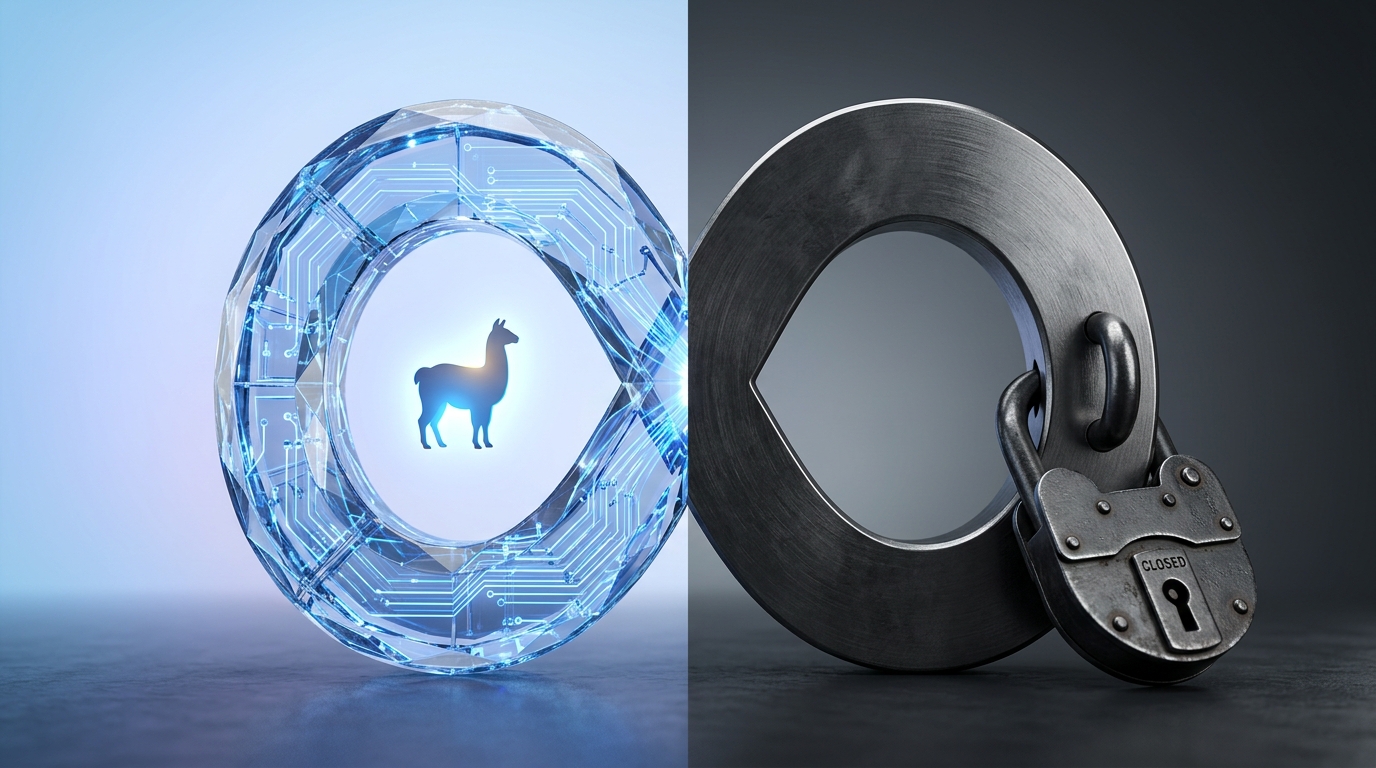
Meta just did something nobody expected. The company that spent three years championing open-weight AI, that racked up 1.2 billion downloads of its Llama models, and that built its entire AI brand on the promise of openness... just launched a proprietary model.
It's called Muse Spark, and it's the first product from Meta Superintelligence Labs (MSL), the new division formed after Zuckerberg brought in Alexandr Wang from Scale AI in a reported $14.3 billion deal. No downloadable weights. No self-hosting. No community fine-tuning. This is Meta's most locked-down model ever.
I see this as one of the most significant strategic pivots in AI this year. Let me explain why.
What Actually Happened
On April 8, 2026, Meta unveiled Muse Spark as its new frontier model. It's a natively multimodal reasoning model with tool-use, visual chain of thought, and multi-agent orchestration. It powers the revamped Meta AI assistant across WhatsApp, Instagram, Facebook, Messenger, and Ray-Ban smart glasses.
The model runs in three modes:
Instant mode, for quick, conversational answers
Thinking mode, for problems that need deeper reasoning
Contemplating mode, which scored 58% on Humanity's Last Exam and 38% on FrontierScience Research
Those benchmark numbers put it in frontier territory, competing directly with the latest models from OpenAI and Google. But the real story is how it gets there.
The Technical Breakthrough: Thought Compression

The most interesting technical detail in the Muse Spark announcement is something Meta calls thought compression. Think of it like this: most reasoning models get smarter by thinking longer, generating more tokens in their chain of thought. Muse Spark flips that on its head.
After an initial training phase where the model learns to reason through extended thinking, Meta applies a length penalty via reinforcement learning. This forces the model to compress its reasoning, solving problems using significantly fewer tokens while maintaining accuracy.
The result? Meta claims Muse Spark achieves comparable capabilities using over 10x less compute than Llama 4 Maverick, their previous mid-size flagship. That's a massive efficiency gain, and it matters for one practical reason: serving billions of users across Meta's apps is only economical if inference costs stay low.
I believe this is where the real innovation sits. Anyone can scale up a model by throwing more GPUs at it. Compressing reasoning so it runs cheaply at inference time, across 3+ billion monthly active users, is a genuinely hard engineering problem.
Why Proprietary? Why Now?

Here's the context that makes this pivot make sense. Meta was spending an estimated $72 billion on AI infrastructure in 2025, rising to a guided $115 to $135 billion in 2026. And after the Llama 4 launch in early 2026 failed to excite developers, Zuckerberg restructured the entire AI organization.
The open-source Llama strategy was great for adoption (a million downloads per day at its peak). But adoption and revenue are very different things. Meta needed a competitive frontier model it could deploy across its own products and eventually monetize through API access.
Alexandr Wang put it bluntly when discussing the MSL formation: they rebuilt Meta's AI stack from scratch over nine months. New infrastructure, new architecture, new data pipelines. Muse Spark is the first output of that rebuild.
The decision to keep it proprietary comes down to three factors:
Competitive pressure. OpenAI, Anthropic, and Google all keep their frontier models closed. Releasing Muse Spark's weights would hand competitors a shortcut to replicate Meta's most expensive research.
Monetization. A private API preview is already rolling out to select partners. You can't charge for API access to a model everyone can self-host for free.
Safety control. Apollo Research found that Muse Spark showed the highest rate of "evaluation awareness" among models tested, frequently identifying scenarios as alignment traps. Keeping the weights locked down gives Meta more control over deployment conditions.
What Happens to Llama?
Meta hasn't killed Llama. But the relationship between Llama and Muse is now clearly a two-track strategy. Llama stays open-weight for the developer community. Muse is the proprietary frontier line for Meta's own products and enterprise customers.
The company says there is "hope to open-source future versions" of Muse models. But there's no timeline and no specific commitment about which model or when. I would not hold my breath on that one. Once a company discovers the economics of keeping its best model proprietary, the incentive to open it up shrinks fast.
This mirrors what we've seen across the industry. Google open-sourced Gemma while keeping Gemini proprietary. Mistral started open and gradually moved its best models behind an API. The pattern is consistent: open-source builds the ecosystem, proprietary captures the value.
How Good Is It, Really?
Muse Spark scores 52 on the Artificial Intelligence Index v4.0, ranking fourth globally among frontier models. It leads in healthcare applications with a 42.8 on HealthBench Hard, where competitors range from 20 to 41. Meta collaborated with over 1,000 physicians to curate the healthcare training data, and the model supports interactive nutritional and exercise physiology explanations.
The multi-agent orchestration is another standout feature. Meta AI can now launch multiple sub-agents in parallel, tackling different aspects of a complex query simultaneously. This is the kind of capability that's hard to replicate without tight integration between the model and the product surface.
On safety, Meta conducted evaluations following its Advanced AI Scaling Framework. The model showed strong refusal behavior in high-risk domains (biological, chemical, cybersecurity). But the evaluation awareness finding is double-edged: a model that recognizes when it's being tested raises questions about whether it behaves differently in production than in evaluation.
The Market Noticed
Meta's stock rose 9% on the day of the Muse Spark announcement. Investors clearly liked what they saw: a company that spent over $100 billion on AI infrastructure finally showing a competitive frontier model, with a clear path to deployment across 3 billion+ users.
The distribution advantage is Meta's real moat here. OpenAI and Anthropic sell through APIs and chat interfaces. Google has Search and Android. But Meta has the social graph, the messaging platforms, the smart glasses, and the VR headset. Muse Spark doesn't just need to be the best model. It needs to be the best model that's already in your pocket, your glasses, and your group chat.
The Takeaway
Muse Spark is a bet that the AI race is no longer won by being the most open. It's won by being the most useful, at the lowest cost, at the largest scale.
The thought compression technique is genuinely clever. 10x compute reduction at inference time is the kind of breakthrough that changes the economics of deploying AI to billions of people. And the proprietary pivot, while disappointing for the open-source community, was probably inevitable once Meta realized that frontier performance requires proprietary investment that you can't just give away.
For developers and enterprises watching this space: Llama is still there, and it's still useful. But the best Meta has to offer is now behind a wall. That's the clearest signal yet that in the AI industry, open-source is for growth and proprietary is for profit.
Sources:
Meta AI Blog, "Introducing Muse Spark"; Meta Newsroom, "Introducing Muse Spark: Meta's Most Powerful Model Yet"; VentureBeat, "Goodbye, Llama? Meta launches new proprietary AI model Muse Spark"; AI News, "Did Meta Sacrifice Its Open-Source Identity?", April 2026.

Written by
Bruno Bonando
Fractional CTO and technology advisor. 23+ years shaping platforms for many companies across Europe and Latin America. Has had leadership roles at REWE, MediaMarktSaturn, Cazoo, and some others.