I see a pattern every time I talk to engineering teams building production AI systems. The proof-of-concept runs fine on a managed cloud notebook. The model performs well. Leadership greenlights a production rollout. And then the bill hits.
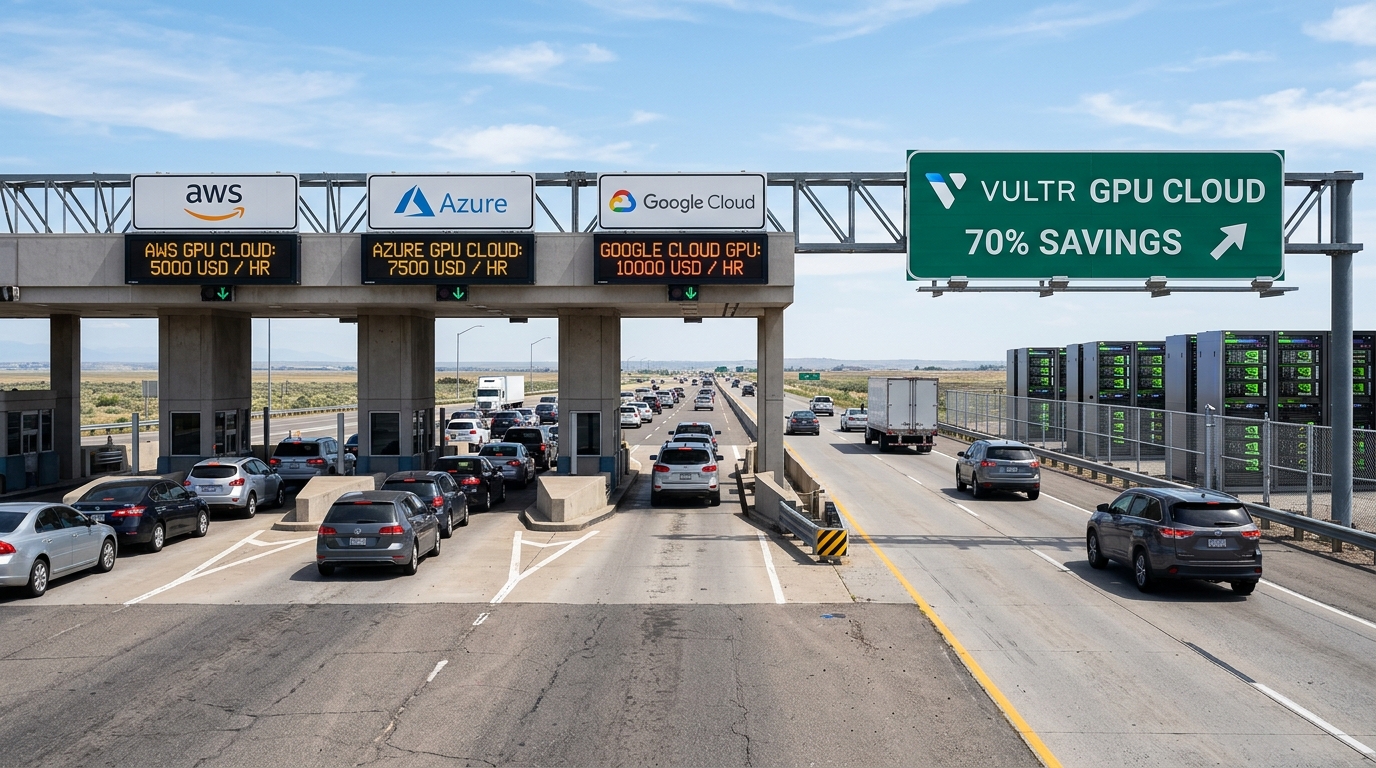
Running AI inference at scale on AWS, Azure, or GCP is brutally expensive. We are talking about GPU instances that cost multiples of what teams budgeted, with long procurement lead times and contracts that quietly lock you into a single ecosystem. For a lot of organizations, the moment they move from "AI experiment" to "AI in production," the economics break.
That is the context behind a partnership announced at KubeCon EU 2026 that I think deserves more attention than it got. SUSE Rancher Prime and SUSE AI are now available on the Vultr Marketplace, and together they offer a genuinely compelling blueprint for running enterprise AI workloads outside the hyperscaler walled gardens.
What Vultr and SUSE Actually Built
Let me break down the components, because the details matter here.
Vultr is an independent cloud provider (valued at $3.5 billion as of late 2024) that operates across 32+ global regions on six continents. They offer bare metal and cloud GPU instances with current-generation hardware: NVIDIA B200s, H100s, and AMD Instinct MI300X accelerators. Think of them as the anti-hyperscaler. Same enterprise-grade GPUs, but with transparent pricing and no ecosystem tax.
SUSE contributes two products through this partnership:
SUSE Rancher Prime for managing Kubernetes clusters across hybrid and multi-cloud environments. This is the orchestration layer that lets you deploy, monitor, and govern containerized workloads from a single control plane.
SUSE AI for running AI inference and training workloads with built-in governance, security, and lifecycle management. It handles model deployment on GPU infrastructure with the guardrails enterprises actually need.
Combined with Vultr's infrastructure, you get a full stack: GPU compute, Kubernetes orchestration, and an AI platform layer, all running on open-source software. No proprietary lock-in at any level.

The GPU Multi-Tenancy Problem (and How K3k Solves It)
One technical detail from the announcement caught my eye. SUSE Rancher Prime now supports Virtual Cluster GPU Multi-Tenancy via K3k. In plain terms: each team or tenant gets a fully isolated Kubernetes control plane while sharing the same underlying GPU hardware.
If you have run GPU workloads in a shared cluster, you know how painful resource contention gets. One team's training job starves another team's inference service. The K3k approach gives every tenant their own virtual cluster with automated quota management, so each team gets a guaranteed share of compute without the overhead of running separate physical clusters.
For organizations running multiple AI projects (which is basically everyone at this point), this is a big deal. It means you can consolidate GPU infrastructure without the governance nightmare.
Why This Matters Beyond the Cost Savings
The cost story is easy to tell. Neocloud providers like Vultr typically offer GPU instances at 60-70% lower cost than the equivalent hyperscaler instance. Some estimates put the savings as high as 50-90% for sustained AI workloads. That is compelling math for any CFO.
But I believe the more important story is about sovereignty and optionality.
Gartner projects that worldwide spending on sovereign cloud IaaS will hit $80 billion in 2026, a 35.6% jump from 2025. They call the trend "geopatriation," and they expect 20% of existing workloads to migrate from global hyperscalers to local or regional providers. Governments and regulated industries are driving this shift because they need to control where their data lives and which jurisdictions govern it.
Vultr's 32-region footprint across six continents, paired with SUSE's open-source Kubernetes stack, directly addresses this. An enterprise in Milan can run AI inference on Vultr's Milan region with full data residency, managed by the same Rancher control plane that governs their clusters in Singapore or Sao Paulo. No data leaves the jurisdiction. No hyperscaler gets to dictate terms.
The Broader Neocloud Trend
Vultr is not alone in this space. The neocloud category, purpose-built cloud providers that focus exclusively on GPU-accelerated AI workloads, is growing fast. CoreWeave went public in early 2025 and reported a contracted revenue backlog of $66.8 billion by the end of that year. NVIDIA invested $2 billion in CoreWeave in January 2026. Lambda, Voltage Park, and Crusoe (many of them pivots from crypto mining) are all competing for the same market.
What sets the Vultr-SUSE approach apart is the Kubernetes-native layer. Most neoclouds sell raw GPU compute. Vultr is selling GPU compute plus a managed, open-source orchestration and AI platform. That is a more complete story for enterprises that need governance, multi-tenancy, and hybrid deployment flexibility, not just cheap GPUs.
The Tradeoffs You Should Know About
I want to be honest about the limitations here, because no stack is perfect.
First, ecosystem maturity. AWS SageMaker, Azure ML, and Google Vertex AI have years of tooling, pre-built integrations, and managed ML pipelines that an open-source stack simply cannot match overnight. If your team depends heavily on proprietary managed services (like SageMaker Endpoints or Vertex AI's AutoML), switching to a Rancher-on-Vultr setup means rebuilding some of those workflows.
Second, scale of the ecosystem. Hyperscalers have massive partner networks, thousands of marketplace integrations, and enterprise support organizations that dwarf what Vultr and SUSE can currently offer. For large enterprises with complex compliance requirements, that gap matters.
Third, the operational burden. Open-source gives you freedom, but it also gives you responsibility. Running Rancher and SUSE AI on Vultr means your team owns more of the stack than they would on a fully managed hyperscaler service. You need people who understand Kubernetes deeply. That is a real constraint for many organizations.
Who Should Pay Attention
In my experience, this kind of stack makes the most sense for:
Mid-to-large enterprises running AI inference at production scale where GPU costs are a top-line budget concern.
Regulated industries (finance, healthcare, government) that need data residency guarantees and sovereignty controls.
Organizations with Kubernetes expertise that want to extend their existing container strategy to AI workloads without adopting a proprietary ML platform.
Multi-cloud teams that already use Rancher and want to add GPU-accelerated AI as another workload type under the same management umbrella.
The Takeaway
The hyperscaler dominance over AI infrastructure is starting to crack. Not because AWS or Azure are doing anything wrong, but because the economics of GPU compute at scale make vendor lock-in increasingly painful. SUSE and Vultr are offering a specific, concrete alternative: open-source Kubernetes orchestration, enterprise AI governance, and current-gen GPUs across 32+ regions at a fraction of the hyperscaler price.
Will every enterprise move their AI workloads to a neocloud tomorrow? No. But the fact that a credible, fully open-source, Kubernetes-native path now exists is a meaningful shift. For the first time, "cloud-neutral AI" is a real option with real products you can deploy today, not just a conference slide.
Source: "SUSE Rancher and Vultr Want to Break AI Infrastructure Free from the Hyperscalers", The New Stack, April 2026. Additional reporting from SDxCentral, IT Brief UK, and Computer Weekly.

Written by
Bruno Bonando
Fractional CTO and technology advisor. 23+ years shaping platforms for many companies across Europe and Latin America. Has had leadership roles at REWE, MediaMarktSaturn, Cazoo, and some others.