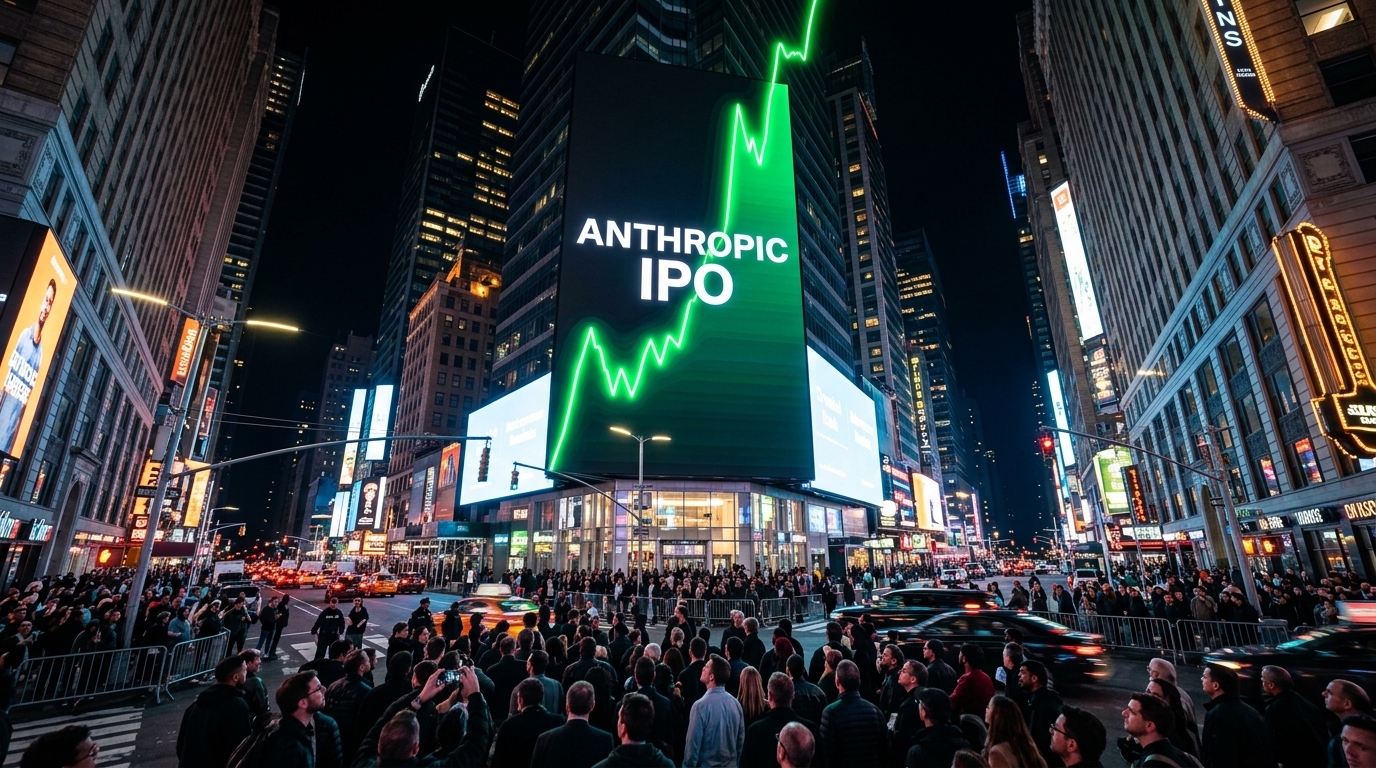
Anthropic is reportedly steering toward an October 2026 IPO at a valuation somewhere between $400 and $500 billion, with recent tender offers pegging it even higher, above $800 billion. Revenue crossed $30 billion ARR in April 2026, triple where it was at the end of 2025. Whatever the final number is, a lot of paper wealth is about to become real money.
Here is the part most people miss. According to Kim's piece, the seven Anthropic co-founders have publicly pledged to donate 80% of their wealth, and she estimates that pledge alone could be worth around $37.8 billion at current valuations. That is roughly ten times everything Coefficient Giving (the organization Open Philanthropy rebranded into in 2025) has ever granted, combined, in its entire history.
And that is the setup for Sophie Kim's argument in a recent EA Forum piece: the money is coming, but the people who know how to deploy it into AI safety don't exist yet.
A bit of context helps here, because the scale of this looks unhinged until you line it up against the rest of the sector. One investor backing both Anthropic and OpenAI recently told the Financial Times that OpenAI's latest round only pencils out if you assume a $1.2 trillion IPO valuation. Against that, Anthropic's $380 billion post-money round and $800 billion tender offers start to look, in the investor's own words, like 'the relative bargain.' I don't think the $1.2T figure is prophecy, but it is the number sophisticated investors are willing to underwrite, and it tells you the Anthropic paper wealth we are talking about is not speculative vapor.
It also helps to remember who is about to get rich. Dario Amodei, Anthropic's CEO, was VP of Research at OpenAI before he left in 2021 with his sister Daniela and a handful of other senior OpenAI researchers to start Anthropic. He has been pretty direct about why: not the Microsoft deal (he has explicitly denied that), but a disagreement over whether AI safety is a foundational design principle or something you bolt on after the fact. Their bet was that you had to build the company around safety from day one. That is the same group now staring down a liquidity event large enough to reshape an entire philanthropic field.
The constraint is people, not dollars
In my experience, whenever a field gets flooded with capital faster than it grows evaluators, the money either sits idle or flows to whatever is easiest to sign a check on. That second outcome is usually worse than the first.
Kim cites numbers that make the scale of the bottleneck very concrete:
Coefficient Giving had just three grant investigators reviewing $140 million in technical AI safety grants in 2025.
Longview Philanthropy had six AI grantmakers.
Globally, the total number of people doing serious AI safety grant evaluation sits between 30 and 60.
Between 30 and 60 humans are directing most of the philanthropic response to what many of them believe is the most consequential technology shift of the century. That is a small office, not a field.
The stress test already happened. When Coefficient Giving tripled its grantmaker headcount, grant volume scaled almost in lockstep, from $40 million in 2024 to $140 million in 2025, and the quality of impact per dollar stayed roughly constant. Translation: they were leaving good grants on the table simply because nobody had time to evaluate them. One grantmaker quoted in the piece said exactly that.

One funder, one worldview, one blind spot
The second problem is concentration. Over 50% of philanthropic AI safety funding flows from Good Ventures via Coefficient Giving. When half the field's money comes from a single source, that source's priorities quietly become the field's priorities, whether or not anyone intends it that way.
Good Ventures has, reasonably, deprioritized entire buckets of work in recent years: Republican-leaning think tanks, digital sentience research, rationalist community organizations, and non-US think tanks. Reasonable or not, when the dominant funder steps away, most of those areas do not get backfilled. They just shrink.
There are also structural limits that are nobody's fault but still shape outcomes:
Private foundations can't legally fund PACs or certain kinds of lobbying.
Large institutional funders tend to avoid politically sensitive work because of reputational risk.
International orgs are cautious about looking like they take American money, which filters out whole geographies.
The kicker: Coefficient Giving itself says that the external funding opportunities it recommends to other donors are typically 2 to 5 times more cost-effective than its own marginal dollar. That is a funder openly saying 'we physically cannot spend our money on the best work we know about.' It is one of the clearest signals I have seen that the field is starved for decorrelated capital, not correlated capital.

Why the IPO is a one-shot window
Ordinarily, new wealth shows up slowly and is mostly run by people who made money in completely different industries. The Anthropic IPO is different in one narrow but important way: the people about to get liquid are the same people who spend their days thinking about AI risk. They are domain-expert, motivated, and about to be very rich, all at once.
But there is a trapdoor. If advisory infrastructure isn't standing and staffed on IPO day, most of that capital will slide into donor-advised funds and sit there. Nationally, over $326 billion is already parked in DAFs, not doing anything. Not because donors are bad people, but because deploying money well is hard, and the default (park it) is easy.
And there is a historical warning label here that Kim does not fully say out loud but commenters on the original post did: FTX Future Fund. A sudden wave of AI safety money appeared, talented people reorganized their careers around it, and then it vanished when the underlying company collapsed. The lesson is not 'don't plan for the wave,' it is 'don't make irreversible career bets on a single funder.' The Manifold market on Anthropic IPO-within-a-year sits near 75%, not 100%.
What being ready actually looks like
Kim breaks readiness into two concrete needs, and I think the framing is right.
Different structural positions. Individual donors can fund things institutional foundations legally or reputationally cannot: 501(c)(4) advocacy, politically sensitive research, work in countries where American-foundation money is radioactive. That is precisely the shape of the gap Coefficient Giving keeps flagging.
Independent grantmakers with different threat models. Someone who genuinely believes the biggest risk is political concentration of AI power will build a very different portfolio than someone who believes it is near-term misuse, or someone focused on long-horizon alignment. Right now the field's largest wallet effectively picks one worldview. It should be picking three.
Kim's call-to-action splits by career stage:
Experienced strategists: direct capital independently, or join an existing funder to shift its agenda from inside.
Earlier-career people: do the upstream work, mapping neglected areas, scouting founders, drafting evaluations for senior reviewers.
Founders: build organizations that address the deprioritized buckets, because the demand side is about to exist.

The takeaway
I keep coming back to this asymmetry: a 12-month sprint to build grantmaking capacity will determine how well a decade-sized pool of capital is spent. If the Anthropic IPO lands on schedule and the advisory layer isn't ready, most of that $37.8 billion will either sit in DAFs or chase the most legible, already-well-funded work. Neither outcome is what the donors who signed the pledge actually want.
The bottleneck is not money. It has not been money for a while. It is the unglamorous work of hiring, training, and trusting more senior evaluators with independent worldviews, before the wave arrives instead of after.
If you are in a position to do grantmaking work, or fund someone else to, this is the window. The IPO will not wait for the infrastructure to catch up.
Written by
Bruno Bonando
Fractional CTO and technology advisor. 23+ years shaping platforms for many companies across Europe and Latin America. Has had leadership roles at REWE, MediaMarktSaturn, Cazoo, and some others.