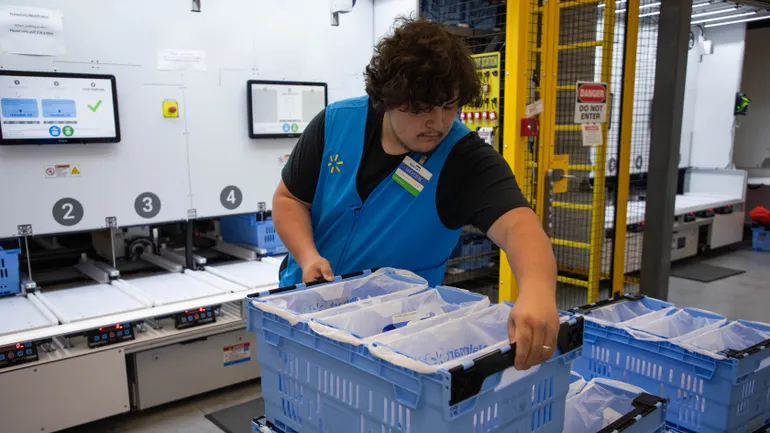
What is happening on the ground
Walmart has started equipping its first store with Symbotic's SymMicro system, an automated fulfillment platform built specifically to handle in-store e-commerce orders. Installation is underway now, with the site expected to be fully operational in roughly six months. Greg Cathey, Walmart's senior vice president of transformation and innovation, and Symbotic CEO Richard Cohen both described the rollout as an extension of a supply chain partnership that predates this specific agreement by nearly a decade.
The system works through autonomous mobile robots, which Symbotic calls SymBots, that retrieve totes from dense in-store storage and deliver them to pick stations where workers fulfill multiple online orders at once. Each station supports 550 picks per hour, a throughput figure meant to compress the time between an online order landing and it being ready for pickup or courier handoff. A second store deployment is already planned to follow the first, and the full commitment runs to roughly 400 locations over multiple years.
The deal that got Walmart here
The path to this rollout is unusual and worth explaining. In 2025, Symbotic acquired Walmart's own Advanced Systems and Robotics business, the internal unit Walmart had built to develop robotic automation for its supply chain, in a deal worth $200 million in cash at closing plus up to $350 million in contingent payments tied to future system orders. As part of the same agreement, Walmart committed roughly $520 million in development funding, with $230 million paid at closing, to fund the very automation Symbotic now installs on Walmart's behalf.
In effect, Walmart built an in-house robotics capability, sold it to a specialized vendor, and is now paying that vendor to deploy the technology back into its stores at scale. Symbotic's leadership put the backlog opportunity from this arrangement at more than $5 billion, against an addressable U.S. market it sizes at over $300 billion. For Symbotic, absorbing Walmart's engineering talent and IP turned a single large customer relationship into a platform business it can eventually sell to other retailers.
Why Walmart chose this structure over building alone
The logic behind selling the robotics unit rather than scaling it internally comes down to a question every large retailer eventually faces: is warehouse and store automation a core competency worth owning end to end, or a capability better run by a specialist who can spread engineering costs across multiple customers? Walmart's answer was the second option, at least for the physical robotics layer, while keeping the commercial relationship close enough that Symbotic's roadmap still bends toward Walmart's specific needs through the size of its purchase commitment.
That is a meaningful signal for any retailer weighing a similar internal automation effort. Building robotics in-house from scratch is a multi-year, capital-intensive undertaking with real execution risk, and Walmart, a company with essentially unlimited capital, still concluded a dedicated vendor could do it better once the technology matured past the earliest R&D stage. Retailers with smaller balance sheets should read that as permission to skip the build-it-yourself phase entirely and go straight to evaluating vendors like Symbotic on their own merits.
The business case for store-level automation
The underlying pressure driving this investment is straightforward. Walmart's store-fulfilled e-commerce deliveries had already surpassed a $2.5 billion monthly run rate, growing nearly 50% year over year, and roughly 90% of the U.S. population lives within 10 miles of a Walmart store. That density is a genuine advantage over pure e-commerce competitors, but only if stores can pick and pack online orders quickly without degrading the in-store shopping experience for walk-in customers navigating the same aisles.
SymMicro is Walmart's answer to that tension: automation dense enough to fit inside an existing store footprint, moving picking activity out of the aisles and into a dedicated automated zone. That reduces foot traffic from e-commerce fulfillment competing with shoppers for space and staff attention, a friction point that has quietly capped how much online growth a store-fulfillment model can absorb before service quality suffers on both sides of the operation.
The risk of committing to 400 stores on one vendor
A 400-store commitment to a single robotics vendor is a significant concentration of operational risk, and it deserves scrutiny even from an admiring distance. If SymMicro underperforms at scale, or if Symbotic hits execution problems as it works through hundreds of installations, Walmart has limited ability to pivot quickly given the depth of the financial and technical entanglement between the two companies. The 2025 deal structure, funding development in exchange for a purchase commitment, also means Walmart's success is now partly tied to Symbotic's ability to execute as a standalone public company.
Walmart appears to have priced that risk in deliberately rather than backing into it. Nearly a decade of prior partnership gave Walmart visibility into Symbotic's execution before this commitment, and starting with one store, then a second, before scaling toward 400 gives both companies room to catch problems early rather than discovering them at scale. Retailers considering a comparable vendor bet should insist on the same staged rollout discipline, since the temptation to announce a large number up front rarely matches the pace at which complex automation actually gets proven out store by store.
What we would tell a CTO about this deal
The transferable lesson here is not the specific vendor or the specific robot. It is the sequencing: prove the technology internally, find the point where a specialist vendor can scale it more efficiently than your own team, and structure the financial relationship so your incentives and the vendor's stay genuinely aligned rather than adversarial. Walmart's willingness to fund Symbotic's development in exchange for guaranteed volume is the kind of deal structure that keeps a vendor focused on your specific operational needs instead of spreading attention thin across customers.
We would also flag the store-level throughput number, 550 picks per hour per station, as the metric worth benchmarking against whatever automation your own team is evaluating. Vendors will pitch impressive-sounding robotics with vague productivity claims. Walmart got a specific, auditable number tied to a real deployment, and any retailer negotiating a similar contract should insist on the same level of specificity before signing a commitment measured in hundreds of stores rather than a handful of pilots.