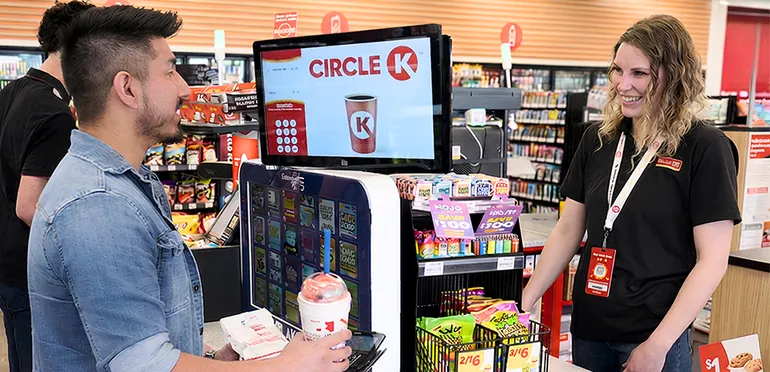
What Circle K relaunched
Alimentation Couche-Tard announced a relaunch of Full Circle Media, Circle K's retail media network, spanning more than 6,600 U.S. convenience store locations. The platform, rebranded earlier this year, now delivers up to 200 million monthly impressions through a mix of physical and digital touchpoints: 13,200 in-store screens under the Lift brand, more than 3,800 fuel pump displays, the Circle K mobile app, and the 14.7 million member Inner Circle loyalty program spanning 5,000 stores across 34 states.
Erica Fortune, Circle K's chief digital officer, framed the opportunity in blunt terms, calling retail media a huge opportunity and stating plainly that Circle K believes it has a right to win in the space. Joell Robinson, the company's director of retail media and a hire from grocery chain Giant Eagle, is leading the buildout, describing the effort as building up capabilities, measurement, and scalability rather than simply adding more screens to more locations.
Why a fuel and convenience chain wants to be a media company
Retail media has become one of the highest-margin revenue lines available to any retailer with enough foot traffic and first-party purchase data to sell against, and Circle K has both in volume that most retailers cannot match: more than 6,600 stores and, according to the company, 2.9 billion annual customer visits. Selling advertising against that traffic converts a cost center, physical retail space and digital screens, into a revenue line with software-level margins, which is precisely why grocery chains and pharmacy retailers built this playbook first.
What makes Circle K's version distinct is the channel mix. Grocery retail media leans heavily on the loyalty app and on-site digital placements tied to a purchase history built around planned shopping trips. Circle K's traffic is largely impulsive and fuel-driven, which shifts the opportunity toward physical touchpoints like fuel pump screens that reach a customer during a captive few minutes they would otherwise spend staring at a pump display with no ads on it at all.
The market Circle K is chasing
Fortune's citation of a $150 billion global retail media market is the number driving this investment, and it explains why a fuel retailer is building measurement infrastructure that looks more like an ad-tech platform than a loyalty program. Brands increasingly allocate marketing budget toward retail media specifically because it sits closer to the purchase decision than traditional advertising and comes with first-party data that is becoming scarcer as privacy regulation tightens across other channels.
That said, the convenience store slice of this market remains genuinely fragmented compared to grocery, where Kroger and Albertsons run mature, multibillion-dollar retail media businesses. Analyst Andrew Lipsman has noted the category still trails far behind Amazon, Walmart, and Kroger in scale and sophistication. Circle K is not the largest player even within its own vertical: 7-Eleven's Gulp Media Network already spans more than 13,000 stores, giving it a meaningful reach advantage before Circle K's relaunch even goes fully live.
The measurement problem retail media has not solved
Every retail media network faces the same credibility gap: brands want proof that an impression on a fuel pump screen or an in-app banner actually drove incremental sales, not just exposure. Circle K's relaunch explicitly emphasizes improved measurement tools as a core feature rather than an afterthought, a response to an industry-wide push, including efforts from the Association of National Advertisers, to standardize how retail media performance gets reported across networks that currently all define success differently.
Getting measurement right matters more for a convenience chain than it does for grocery, because the purchase basket at a Circle K is smaller and more impulsive, making it harder to attribute a specific ad impression to a specific transaction days or weeks later. If Circle K cannot show brands a credible, standardized measurement story, the fuel pump and screen inventory risks becoming a novelty line item in marketing budgets rather than the durable revenue stream Couche-Tard is clearly underwriting with this relaunch.
The build vs partner question for smaller retail chains
Circle K's scale, thousands of stores and a loyalty base in the tens of millions, gives it enough inventory to justify building a retail media operation in-house, complete with a dedicated leadership hire and its own measurement stack. Most retailers considering a similar move do not have that scale, and for them the smarter path is typically partnering with an established retail media platform or joining a cooperative network rather than building bespoke ad infrastructure that will struggle to attract enough brand spend to justify the investment.
The decision point is roughly the same one that shows up across every retail technology build vs buy question: does your first-party data and foot traffic represent enough unique value to brands that they will pay a premium to reach it directly, or would that same audience be reachable more efficiently through an existing network? Circle K's answer, backed by billions of annual visits and a nearly 15 million member loyalty program, is a clear yes. Most retailers should run that same math honestly before committing budget to a proprietary platform.
What we would tell a retail CMO or CTO evaluating this
Treat this relaunch as a reminder to inventory your own physical and digital touchpoints for monetizable ad inventory before assuming you need new infrastructure to compete in retail media. Circle K did not build new stores or new hardware to make this work. It layered a measurement and sales layer onto fuel pumps and loyalty channels that already existed, which is the more common and more achievable version of this opportunity for most retailers than a from-scratch platform build.
We would also flag the leadership hire as instructive. Circle K recruited its retail media director from Giant Eagle, a grocery chain with a more mature retail media operation, rather than promoting from within or hiring a pure ad-tech executive. Bringing in someone who has already solved the measurement and brand-relationship problems in an adjacent category is a faster path to credibility than building that expertise from zero, and it is a hiring pattern worth copying regardless of your category.