A Point Release That Reads Like a Strategy Memo
Microsoft shipped Visual Studio 2026 version 18.7.3 on June 30, 2026, and on paper it is an ordinary monthly servicing update: a few C++ build improvements, some theme tweaks, a pair of crash fixes in the Copilot chat window. Read the release notes more carefully and a different story emerges. The most consequential addition is not a coding capability at all. It is instrumentation: real-time tracking of Copilot usage against the new token-consumption billing model, proactive alerts as you approach your limit, and a customizable warning threshold. Microsoft has, in effect, bolted a fuel gauge onto the IDE.
We read that as a tell. When a vendor invests engineering effort into showing you how fast you are spending, the spending has become the point. This update lands four weeks after GitHub moved every Copilot plan to usage-based billing on June 1, a change that drew immediate backlash when developers reported burning through monthly allowances in hours. Putting a meter inside Visual Studio is the practical answer to that anger, and it quietly confirms that the flat-rate era of AI assistance is over. The features around it are good. The meter is the message.
The Agent Moves From the Margins to the Mainline
The substantive AI work in 18.7.3 pushes Copilot from autocomplete toward something closer to a resident teammate. Long-distance next edit suggestions let Copilot propose changes anywhere in a file rather than only near the cursor, which matters because real refactors are rarely local. Pull request integration brings review, inline comments, thread resolution, and approval directly into the IDE, so developers no longer bounce to the browser to close the loop. Together these are small ergonomic moves that add up to a workflow where the agent participates across the development cycle instead of waiting to be summoned.
The most important governance addition is MCP server trust validation. Visual Studio now detects changes to Model Context Protocol server configurations and assets, then prompts for re-approval before anything runs, using a two-point check on both configuration trust and asset trust. As teams wire agents into external tools through MCP, that supply chain becomes an attack surface. Forcing explicit re-approval when a server definition shifts is the kind of unglamorous control that separates a demo from a production tool, and we expect it to become table stakes across every agent-capable editor within the year.
C++ Modernization Graduates From Preview
The release also marks the general availability of the GitHub Copilot Modernization Agent for C++. The agent analyzes a project, identifies compatibility issues, and upgrades it to use the latest Microsoft C++ build tools, offering both an automated mode and a guided mode for teams that want a human checkpoint at each step. This is paired with MSVC Build Tools v14.51, which brings improved C++23 support, a major overhaul of the long-troubled regex implementation, and Scalable Vector Extension support for ARM64. The combination matters most to enterprises sitting on large, aging native codebases.
Modernization is precisely the kind of work where AI assistance earns its keep. It is tedious, pattern-heavy, and risky to do by hand, yet it rarely gets prioritized because it produces no new features. An agent that can sweep a sprawling C++ solution, flag the breakages, and propose mechanical fixes lowers the activation energy for the upgrades that security and performance both depend on. The general availability label is the signal here: Microsoft is confident enough to take the preview disclaimer off, which suggests the modernization scenarios have held up under real customer codebases rather than curated demos.
The Performance Story Underneath the AI
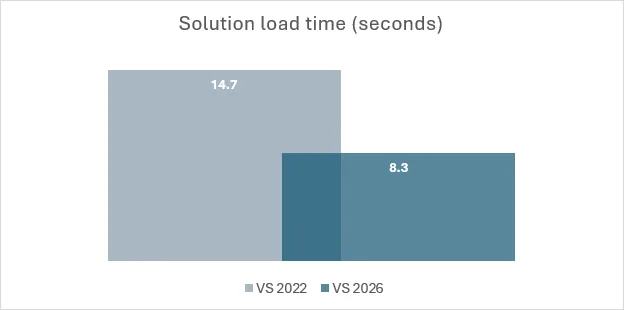
It is easy to forget, amid the agent features, that Visual Studio 2026 was sold first on speed. Microsoft has been blunt about it. The team says it cut UI hangs by more than half, claiming that "those annoying UI freezes have been cut by more than half," and that startup is meaningfully snappier. In the year leading to general availability the team reports fixing over 5,000 reported bugs and implementing 300 feature requests. Early adopters echoed the pitch, with one developer noting a 100-project solution opened far faster than expected.
We think the sequencing is deliberate. Microsoft brands Visual Studio 2026 as "AI-native, making it the world's first Intelligent Developer Environment," but it built the foundations first. An agent that suggests edits across a file, reviews pull requests inline, and rewrites C++ projects is only tolerable if the editor underneath stays responsive. The hard, unfashionable work of cutting hangs and trimming startup time is what makes the AI features usable rather than a source of new friction. The lesson for platform teams is the same one Microsoft is modeling: ship the latency fixes before you ship the intelligence.
What CTOs Should Take From This Release
The strategic takeaway is not which features shipped but what their shape reveals. AI-native tooling is converging on a model where the assistant is ambient, agentic, and metered. The usage tracking in 18.7.3 is an admission that consumption cost is now a first-class operational concern, on par with build time or test flakiness. Engineering leaders who budgeted for AI assistance as a fixed line item will need to treat it as variable spend, with the same forecasting, alerting, and per-team accountability they apply to cloud compute. The gauge in the IDE is a starting point, not a substitute for that governance.
There is also a quieter security message in the MCP trust validation. As organizations connect agents to internal systems through emerging protocols, the configuration of those connections becomes something that must be reviewed, versioned, and re-approved, not set once and forgotten. We would push platform teams to inventory their MCP servers now and decide who owns approval before the agents proliferate. Visual Studio 2026's June update is a modest release on the surface, but it sketches the operating model for AI-assisted engineering: fast, agentic, governed, and billed by the token.