The deadline that arrived without teeth
Today was meant to be the hard date. Under the AI Act as originally drafted, 2 August 2026 was when obligations for standalone high risk systems under Annex III became binding: hiring and recruitment tools, credit scoring, biometric identification, systems used to evaluate students, and the rest of that list. Providers were to complete conformity assessments, register systems in the EU database, and stand up quality management and post market monitoring. Deployers were to implement human oversight, retain automated logs for at least six months, and conduct fundamental rights impact assessments where required. Instead, the date passed with those duties deferred.
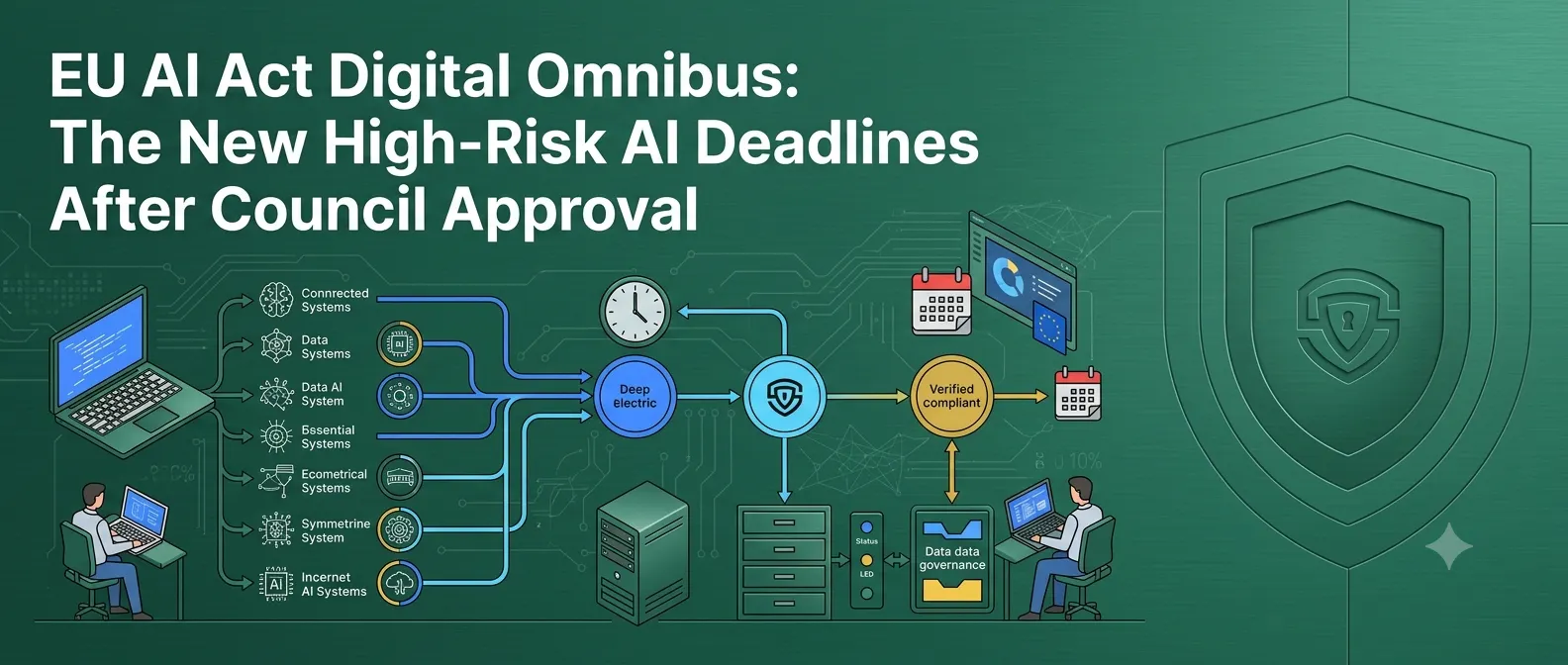
The mechanism was the Digital Omnibus on AI. The European Parliament endorsed it on 16 June 2026 and the Council gave final approval on 29 June, with the act entering into force three days after publication in the official journal. Annex III high risk obligations moved to 2 December 2027, a sixteen month extension. High risk AI embedded in regulated products under Annex I, covering medical devices, machinery, and similar categories, moved from August 2027 to 2 August 2028. Co-rapporteur Arba Kokalari was unambiguous about the intent: "To all the entrepreneurs and engineers out there, we are pressing the pause button on the AI Act and we are reducing red tape."
What is still live today
The reprieve is narrower than the headlines suggest, and reading it as a general suspension of the AI Act would be a costly mistake. Article 50 transparency requirements apply now. That covers disclosure when a person is interacting with a chatbot rather than a human, and labelling of AI generated or manipulated content. For any enterprise running customer service automation, marketing content generation, or synthetic media of any kind in the European market, those duties are current obligations rather than future ones. The prohibited practices list has been enforceable since February 2025 and did not move. Obligations on general purpose AI models have applied since August 2025, and the enforcement machinery around them is now operational.
The penalty structure also survived intact. Breaches of the high risk provisions carry exposure of up to 15 million euros or 3 percent of total worldwide annual turnover, whichever is higher. Nothing in the Omnibus reduced that. What changed is the date on which a subset of obligations becomes testable, and even that change is uneven across annexes. An organisation with a hiring tool, a medical device with an embedded model, and a customer facing chatbot now faces three different compliance clocks running to three different dates. Consolidating those into one programme plan is the first piece of work, and most organisations have not done it.
The readiness gap the extension does not close
The case for delay rested on the argument that industry could not comply in time. The evidence for that claim is genuinely strong, which is also why the extra time is unlikely to be enough. Cloud Security Alliance research found that more than half of organizations lack systematic AI inventories, meaning they cannot enumerate the AI systems they operate, let alone classify them. Separate analysis from appliedAI reviewed 106 enterprise AI systems and found that 40 percent could not be clearly assigned to a risk tier under the Act's own definitions. Compliance cost estimates for large enterprises run in the range of 8 to 15 million dollars for the initial build.
We would draw a specific conclusion from those numbers. The binding constraint is not the conformity assessment paperwork, which is well understood and can be executed by a competent team in a matter of months. The binding constraint is the inventory: knowing which models are running where, who owns them, what data they touch, what decisions they influence, and whether a human meaningfully reviews the output. That work is slow because it is organisational rather than technical. It requires walking into business units that procured a scoring tool through a line of business budget and never told anyone in central IT. Sixteen extra months is roughly the right amount of time for that exercise, and only if it starts now.
The reprieve carries political risk
Treating December 2027 as a settled date assumes the political consensus behind the Omnibus holds, and that assumption deserves scrutiny. The package attracted sustained opposition. Sixty civil society organisations, independent public authorities, and individuals, coordinated in part by European Digital Rights, urged lawmakers to reject changes they characterised as weakening enforcement and legal certainty. The European Center for Not-for-Profit Law described the package as a rollback of AI safeguards before they even apply. A recurring criticism is procedural: because the changes moved through an omnibus process, they were not accompanied by a comprehensive impact assessment, which makes them more vulnerable to legal challenge.
Executive Vice-President Henna Virkkunen framed the balance the Commission was attempting: "Our businesses and citizens want two things from AI rules. They want to be able to innovate and feel safe." That is a reasonable statement of intent and a weak predictor of what happens next. A high profile AI harm inside the Union between now and 2027, particularly one involving employment or credit decisions, would generate immediate pressure to accelerate. Enterprises that paused their programmes on the strength of the extension would then face a compressed timeline with less capacity than they have today. Building to the original standard on the extended timeline is the position that survives both outcomes.
Where the delay genuinely helps
There are real benefits here worth capturing deliberately. The harmonised standards that were supposed to underpin conformity assessment have been late throughout, which left providers guessing at what compliance actually looked like in practice. Sixteen months gives the standardisation bodies room to finish, and gives enterprises the option of building against a published standard rather than an interpretation. Organisations that were preparing to certify against a moving target can now sequence the work properly: inventory first, classification second, controls third, and formal assessment once the standards land.
The extension also relieves pressure on a specific failure mode we have seen repeatedly this year. Teams facing an unmovable August date were beginning to make architecture decisions for compliance reasons that they would not have made otherwise, including pulling models out of the European market, degrading product functionality for EU users, or replacing capable systems with rule based alternatives that are easier to document. Several of those decisions would have been expensive to reverse. The delay buys room to solve the governance problem properly rather than routing around it, provided leadership actually uses the time for that.
How we would spend the sixteen months
Sequence it in four blocks. Spend the rest of 2026 building a credible AI inventory with named system owners, including the tools procured outside central IT and the models embedded in vendor products, because vendor supplied AI is where classification most often fails. Spend the first half of 2027 on classification and on fundamental rights impact assessments for anything touching employment, credit, education, or access to services. Spend the second half of 2027 on controls, logging, and human oversight design. Reserve the final quarter for assessment and documentation, which always takes longer than planned.
One organisational point matters more than the sequencing. This programme needs a single accountable owner with authority across business units, and in most enterprises that person does not currently exist. The work spans legal, data protection, engineering, procurement, and the business units that bought the tools. Distributed ownership produces a partial inventory and a compliance position that looks adequate on a slide and fails on inspection. Name the owner now, while the deadline feels distant and the appointment is a low stakes decision, rather than in late 2027 when it becomes an emergency.