What Actually Changes on August 2
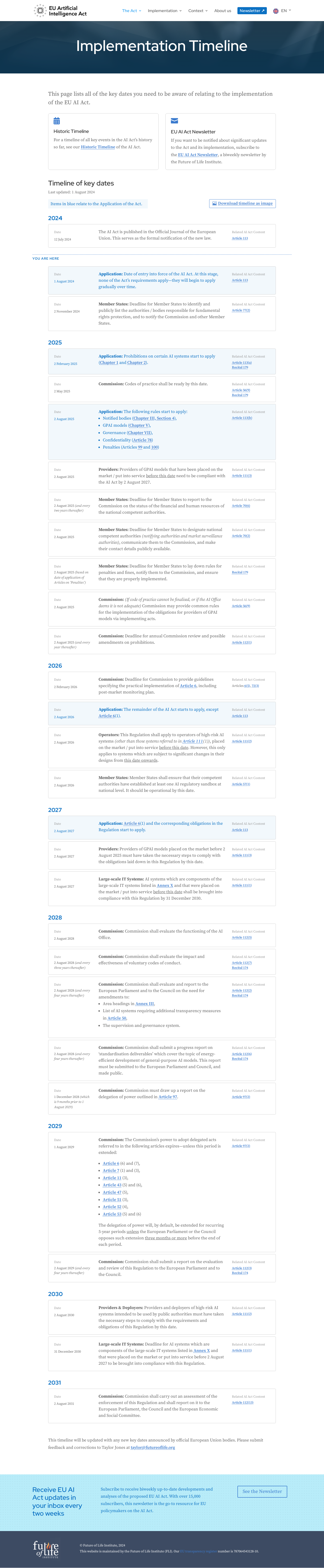
August 2 is the date on which the remainder of the EU AI Act starts to apply, with a narrow carve-out, and the specifics matter more than the headline. Chapter VII on governance becomes applicable, the confidentiality provisions take effect, and the penalty articles activate, which means the regulatory architecture that gives the Act enforcement power switches on. Member States are also required to establish and make operational at least one AI regulatory sandbox at national level, and the provisions covering general-purpose AI and notified bodies come into force. In practical terms, this is the moment the AI Act stops being a framework on paper and becomes a regime with named enforcers and defined consequences.
For enterprise leaders, the significance is that penalties become real. The Act's maximum fines reach 35 million euros or 7 percent of global turnover, a ceiling that sits above GDPR's and that changes how boards should weigh AI compliance risk. Until the penalty provisions applied, the AI Act was a compliance project competing for attention against more immediate pressures. Once regulators can levy turnover-based fines, it becomes a board-level exposure that demands the same seriousness as data-protection or antitrust risk. The organizations that treated August 2 as a distant abstraction are the ones now scrambling to understand which of their systems fall in scope.
The GPAI Obligations Are Live
General-purpose AI model obligations have been building toward this point, and providers of foundation models now face active duties around transparency, copyright-compliance policies, and systemic-risk assessment. The EU has offered the GPAI Code of Practice as a roadmap, giving providers a structured way to demonstrate compliance rather than guessing at what regulators expect. For the companies that build and release frontier models, this is the operational reality of the world's first comprehensive AI law, and it shapes how they document training data, disclose capabilities, and manage the systemic risks their most capable systems can pose. Legacy models placed on the market before the relevant date get until August 2, 2027 to comply.
Most enterprises are not model providers, and that distinction is the single most important thing for a CIO to get right. If your organization uses AI by calling an API to build an application, you are a deployer, and your obligations center on transparency, human oversight, and ensuring that the model provider has completed its own documentation. If you release a model or substantially modify one, you inherit the heavier provider obligations. Many enterprises will discover they have quietly crossed that line by fine-tuning an open-weight model for a specific use, which can pull them into provider territory. Mapping every AI system to the right regulatory role is the foundational exercise, and it is often more nuanced than teams assume.
The Digital Omnibus Complication
The calendar just got messier. Under the Digital Omnibus, a provisional agreement reached in May and still pending formal adoption, the high-risk AI deadline for Annex III systems is deferred from August 2, 2026 to December 2027. That is a substantial reprieve on some of the Act's most demanding obligations, the conformity assessments, registrations, risk-management systems, data-governance requirements, and human-oversight controls that high-risk systems must satisfy. For enterprises building or deploying AI in areas the Act designates as high-risk, this deferral is meaningful breathing room, and it changes the sequencing of compliance work that many teams had planned around the original date.
The complication is that the deferral is provisional, not final, which puts leaders in an awkward planning position. Betting on the December 2027 timeline before the Omnibus is formally adopted carries real risk, because a delay or amendment in the legislative process could snap the original deadline back into force. The prudent posture is to continue high-risk readiness work on the assumption that timelines can shift, while taking advantage of the extra runway to do it properly rather than in a panic. We would caution against reading the deferral as permission to stop, because the direction of travel is unambiguous even if the exact dates keep moving. The obligations are coming, the only question is precisely when.
What Deployers Should Do Now
For the majority of enterprises that consume AI rather than build it, the August 2 milestone is a prompt to get three fundamentals in order. First, maintain an accurate inventory of every AI system in use, including the shadow deployments that departments stood up without central oversight, because you cannot classify what you cannot see. Second, establish the transparency and human-oversight controls the Act expects of deployers, which means documenting where AI informs decisions and ensuring a human can meaningfully review and override them. Third, verify that your model providers have done their compliance homework, because their obligations flow into your risk if they have not.
The organizations that will navigate this well are the ones treating AI governance as an operating discipline rather than a one-time legal exercise. That means a durable inventory that updates as systems change, clear ownership for AI risk that sits with a named executive, and a classification process that assigns each system to its correct regulatory role. The teams still hoping the AI Act will prove toothless are misreading the moment, because turnover-based penalties and an active governance chapter are the opposite of toothless. The deferral of the high-risk deadline is a gift of time, and the smart use of that gift is to build the governance muscle now, before the hardest obligations arrive.
The Strategic Read
Beneath the compliance mechanics sits a strategic reality that will outlast any single deadline. The EU has committed to governing AI comprehensively, with real penalties and a phased set of obligations, and that regime is now the reference point global enterprises must design around whether or not they operate primarily in Europe. Much as GDPR became the de facto global standard for data protection, the AI Act is shaping how multinational companies think about AI governance everywhere, because building two separate compliance regimes is rarely worth the cost. The firms that internalize the Act's principles early will find themselves better positioned as similar rules spread to other jurisdictions.
We would frame the whole exercise as an opportunity as much as a burden. The discipline the AI Act forces, knowing what AI you run, classifying its risk, ensuring human oversight, and documenting your governance, is exactly the discipline that separates organizations deploying AI responsibly at scale from those accumulating unmanaged risk. The companies that build that capability will move faster and more confidently, because they can put AI into production knowing they can defend it to a regulator, a customer, or a board. The August 2 milestone and the shifting deadlines around it are a reminder that AI governance is now a permanent enterprise function, and the sooner leaders treat it that way, the better positioned they will be.