A Deliberate Handover of the Storefront
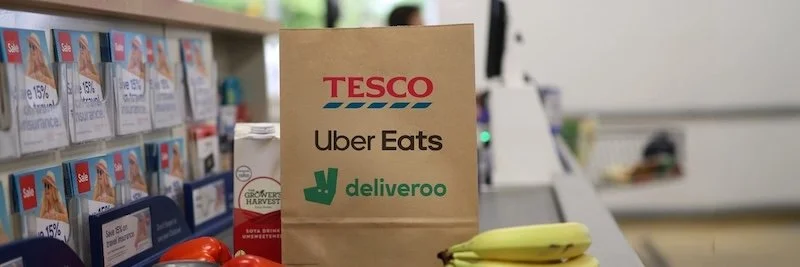
Tesco confirmed on 22 July that it will place thousands of grocery, fresh food and household items on Uber Eats from August, with Deliveroo joining later in the summer. Shoppers will be able to order from Tesco without opening the retailer's own app, and both UberOne and Deliveroo Plus members will see reduced delivery fees. Ashwin Prasad, Tesco UK CEO, said Whoosh has transformed how millions of customers shop with the grocer, offering speed, convenience and value, and framed the aggregator deals as another step in expanding reach. The language matters here. Tesco is keeping its own channel while accepting that meaningful demand now originates inside apps it does not control.
This is a distribution decision before it is a technology decision. Uber Eats reaches more than 90% of the UK, a footprint Tesco cannot replicate through app installs alone, and Saskia De Jongh of Uber Eats called the tie-up a partnership with Britain's biggest supermarket. Rob Harris, VP Merchant and CRO at Deliveroo, said on-demand grocery is becoming an increasingly important part of many customers' lives. For a grocer whose competitive advantage has always been physical density, listing on aggregators converts 1,800 stores into fulfilment nodes for platforms that already own the customer's intent at the moment of hunger or a missed household item.
The Whoosh Numbers That Justify the Move
Tesco is not entering rapid delivery cold. Whoosh delivers in as little as 20 minutes from around 1,800 stores and reaches more than 70% of the UK population, and roughly 1.5 million customers use it today. On-demand sales rose 51% last year, a growth rate that signals a habit forming rather than a novelty fading. When a first-party channel is growing that fast, the strategic question shifts from whether rapid delivery matters to where the ceiling sits. Aggregators answer that by exposing Tesco to demand pools, younger and more impulse-driven, that rarely start a shop inside a supermarket app.
The economics of that incremental demand are the crux. Every order routed through Uber Eats or Deliveroo carries a commission that Tesco keeps entirely when a customer uses Whoosh directly. The retailer is betting that orders it would never have won justify the platform take, and that aggregator baskets skew toward the smaller top-up missions where speed outweighs price sensitivity. For commerce leaders, the lesson is that a healthy owned channel does not remove the case for marketplaces. It strengthens the negotiating position, because Tesco can walk in with a proven fulfilment engine rather than depending on the platforms to teach it rapid grocery.
Protecting Loyalty Economics on Someone Else's App
The most instructive detail is that Clubcard prices and Clubcard points will appear inside the aggregator apps. Loyalty is Tesco's richest data asset, feeding pricing, personalisation and its media business, and most retailers surrender that layer the moment a marketplace intermediates the transaction. By carrying Clubcard onto Uber Eats and Deliveroo, Tesco keeps the shopper tethered to its own identity graph even when the order flows through a third party. That preserves the promotional mechanics that make Clubcard members more valuable and gives Tesco a reason for customers to authenticate rather than shop anonymously.
This is the governance move retail technology leaders should study. The risk of aggregator distribution has always been disintermediation, where the platform learns the customer and the retailer becomes an interchangeable supplier. Tesco is countering that by making its loyalty currency the reason to identify yourself, which keeps first-party data flowing back even from off-app orders. The open question is how much behavioural and basket data Uber and Deliveroo retain, and whether Tesco can reconcile it with Clubcard records. Any grocer weighing a similar deal should treat the data-sharing terms as more consequential than the commission rate.
Buy Distribution, Build Fulfilment
Tesco's structure separates two capabilities that are often conflated. Fulfilment, the picking, staging and 20-minute dispatch from stores, is built and owned through Whoosh. Distribution, the demand surface where the order originates, is now partly bought from Uber and Deliveroo. That split is the correct read of where durable advantage lives. Fulfilment speed from 1,800 locations is expensive to replicate and compounds over time, so it belongs in-house. Demand aggregation is a scale game already won by the platforms, and rebuilding it would waste capital on a race Tesco cannot lead.
For CIOs and digital commerce leaders, this is a template for build-versus-buy decisions under margin pressure. The discipline is to identify which layer of the stack is genuinely defensible and invest there, while renting the layers where incumbents have insurmountable scale. Tesco keeps the physical network and the loyalty graph, the two things rivals struggle to copy, and pays a toll for reach it could not otherwise afford to manufacture. The failure mode is the opposite, building a mediocre in-house marketplace while under-investing in the fulfilment engine that customers actually feel.
What Changes for Suppliers and Retail Media
Extending Clubcard onto aggregators quietly widens Tesco's retail media surface. Clubcard prices are funded in part by supplier investment, and every promoted line that now appears inside Uber Eats and Deliveroo is a new impression against high-intent shoppers who are seconds from checkout. If Tesco can attribute those orders back to Clubcard identities, it can sell media and measurement across a channel it does not own outright. That is a meaningful expansion of inventory at a moment when grocers are racing to grow retail media revenue as a high-margin offset to thin core grocery margins.
Suppliers and CPG brands should read the launch as a signal that shelf placement is fragmenting across surfaces. A product's visibility now depends on how it renders inside a Tesco listing on Uber Eats, not only on Tesco.com or in aisle. Brands will need to manage content, pricing and promotional mechanics across a growing set of third-party storefronts, each with its own ranking logic. The winners will be the ones that treat aggregator listings as first-class merchandising real estate rather than an afterthought fed by an out-of-date product feed.
The Read for Commerce Leaders
We see Tesco's move as a mature acceptance that owning the customer journey end to end is no longer the only way to win grocery. The retailer is strong enough in fulfilment and loyalty to open its catalog to rivals-turned-partners without fearing commoditisation, because it has protected the assets that make it hard to replace. That confidence is what allows a distribution deal to be additive rather than corrosive. Weaker operators who list on aggregators without a defensible fulfilment or data layer risk becoming a logistics backend for someone else's brand.
The practical takeaways are concrete. Grow an owned rapid-delivery channel first so marketplaces become incremental rather than existential. Carry your loyalty currency onto third-party surfaces to keep identity and first-party data intact. Negotiate data-sharing terms as hard as commission rates, because the long-term value of the relationship depends on what you can measure. And treat aggregator listings as media inventory, not just a sales tax. Tesco is showing that the smartest posture toward the platforms is neither dependence nor refusal, but selective, data-protected participation on your own terms.