What Snowflake actually shipped
Snowflake announced Cortex AI Gateway, a centralized control plane for governing AI agents operating across first-party Snowflake tools and third-party platforms connected through the Model Context Protocol. The company says the gateway provides unified governance across more than 100 MCP servers, giving security and data teams a single place to see which agents are running, what they can access, and what actions they have taken. Enhanced AI security capabilities for risk posture assessment and verified agent identity are already generally available, while the gateway itself and most of the new security integrations are moving into private and public preview over the coming months.
The feature list reads like a checklist assembled from every complaint enterprise security teams have made about agentic AI over the past year: end-to-end activity logging, task-scoped access that limits an agent to only what a specific job requires, and centralized spending limits so a runaway agent cannot silently burn through a model budget. None of these are individually novel, but bundling them into one governed layer sitting in front of every agent touching Snowflake data is the part enterprise buyers have been asking vendors to build since agent pilots started multiplying faster than anyone could track them manually.
The identity vendors Snowflake chose to partner with
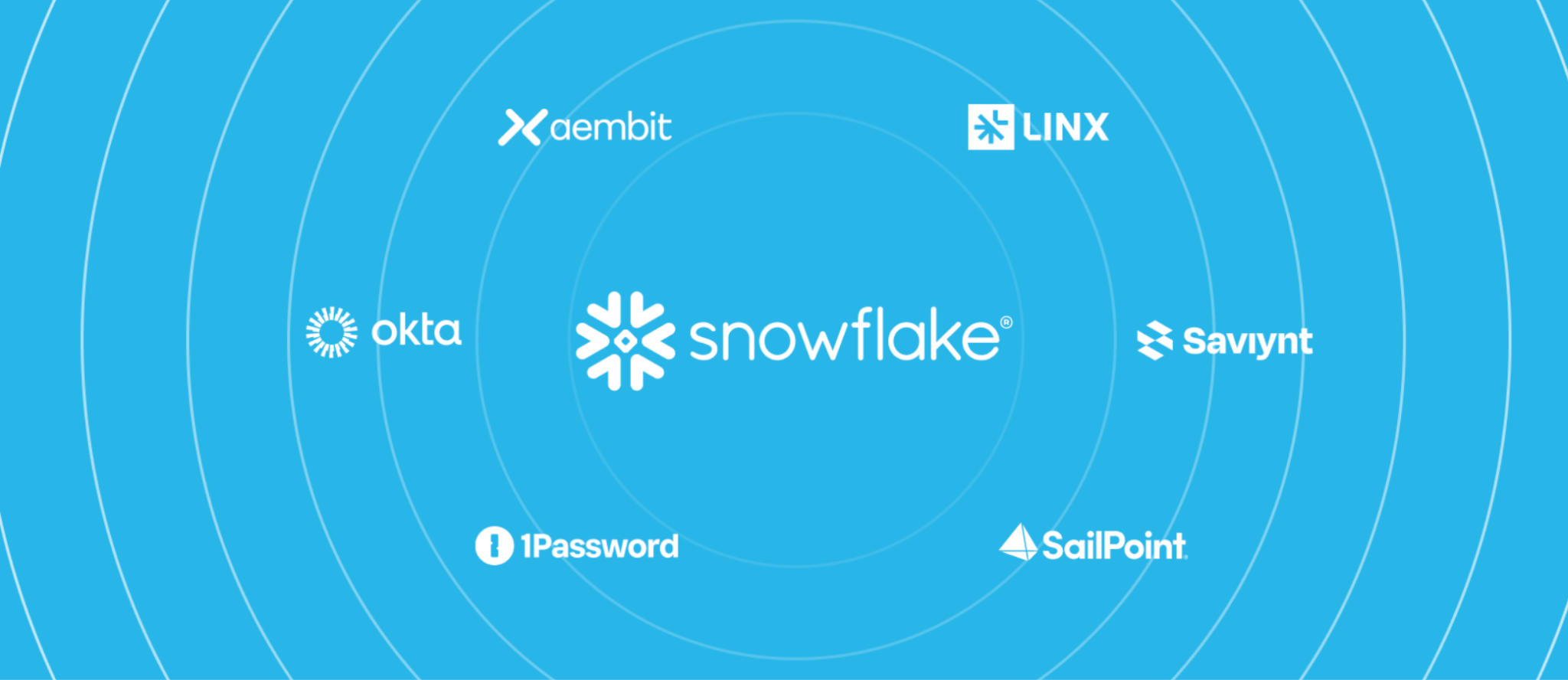
The specific list of security integrations matters as much as the product itself. Okta, SailPoint, and Saviynt cover identity governance and access management for the exact enterprises that have spent the past decade building compliance programs around those tools. 1Password, Aembit, and Linx Security add credential and workload identity management, addressing the harder problem of agents that need to authenticate to downstream systems without a human in the loop. Okta integration specifically is slated for Q4 2026, later than the rest, suggesting the identity handshake between agent frameworks and traditional IAM platforms is still the hardest engineering problem in this stack.
For CTOs at regulated firms, this partner list is a signal about where Snowflake expects the real governance gaps to surface. Agents that call MCP servers under a user's own credentials, effectively impersonating that user across systems, have been the scenario security teams worry about most. Aembit and Linx Security both specialize in workload identity precisely because static API keys and shared service accounts do not hold up once an agent is making autonomous decisions about which tool to call next. Expect this list of integration partners to grow through the rest of 2026 as Snowflake works through the backlog of identity vendors enterprise customers have already standardized on.
Folding FinOps into governance
Snowflake did not stop at access control. Cortex AI Gateway also centralizes cost tracking and attribution across models and teams, and adds intelligent model routing to optimize spend automatically. That is a direct response to the same problem Databricks is solving with Unity AI Gateway: enterprises running agentic workloads across multiple models have lost the ability to see which team, which agent, and which task is driving AI spend, let alone control it. Bundling cost governance with security governance in one product tells buyers Snowflake sees these as the same procurement conversation, not two separate ones.
Meltwater CTO Aditya Jami, an early customer quoted in the announcement, framed the value proposition around production readiness rather than security alone, saying the gateway offers a path to make agents more useful, observable, and production-ready. That framing matters because it positions the gateway as an enabler that gets stalled pilots moving, not just a compliance tax layered on top of AI initiatives that were already working. Vendors that only pitch governance as risk mitigation tend to lose the budget fight to teams asking for new features instead, so Snowflake tying the same product to unblocking production deployment is a sharper sales motion.
Why this validates a bet CTOs already made
Enterprises that consolidated on Snowflake as their primary data platform now get a reason that consolidation was worth defending: governance tooling that spans every connected agent, not just the ones built natively in Snowflake's own tooling. That is a meaningfully different value proposition than raw storage or compute pricing, and it is harder for a challenger to replicate quickly because it depends on deep partnerships with identity vendors that took months to negotiate.
It also raises the bar for what counts as an adequate answer to the agent governance question. Any vendor pitching an agentic AI platform without an equivalent activity log, cost attribution, and scoped access model should now expect that question in every enterprise sales cycle, whether the buyer runs Snowflake or not. Cortex AI Gateway effectively resets the baseline expectation for what enterprise-grade agent infrastructure looks like, and procurement teams at PE-backed firms should start writing that baseline directly into RFPs for any new data or AI platform vendor evaluated this year.
What to actually do with this
CTOs already on Snowflake should request early access to the private preview integrations relevant to their identity stack, particularly SailPoint or Saviynt shops that have been waiting for a governance answer before expanding agent pilots past a handful of use cases. Treat the Q4 2026 Okta timeline as a real constraint if Okta is your primary IdP, not a rounding error, since it will gate how quickly you can extend governance to your broader workforce.
For everyone else, use this launch as leverage in procurement conversations with any data platform vendor. Ask directly what activity logging, cost attribution, and scoped access controls exist today, in general availability, not on a roadmap slide. Snowflake and Databricks have now both shown this is buildable within a single product cycle. Any vendor still answering that question with a promise rather than a shipped feature has fallen behind the market, and that is worth knowing before the next renewal conversation.