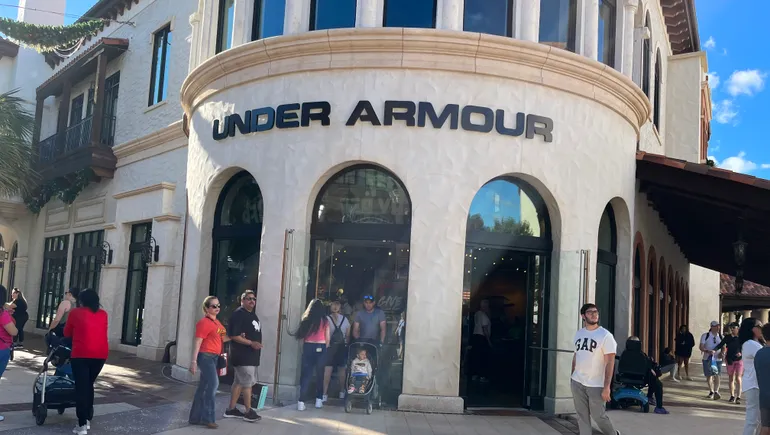
The strategy Under Armour is betting on
Under Armour is pursuing an aggressive shift away from its historical reliance on promotions and discounting. The company already cut its SKU count by 25 percent and now plans another 25 percent reduction over the next 18 months, shrinking its assortment to focus resources on fewer, higher-conviction products. CEO Kevin Plank framed the ambition bluntly, saying consumers are going to choose Under Armour at a premium and that the company intends to sell much more of much less product at a much higher full retail price.
The company is also holding marketing spend to 10 to 11 percent of revenue, at the lower end of its historical range, suggesting Under Armour wants to prove the brand can command full price on fewer, better products rather than buying demand through heavier promotional marketing. It is a coherent strategy on paper: fewer SKUs, tighter inventory, less discounting, and a brand positioned as premium rather than commoditized athletic apparel.
What the quarter actually showed
The results underneath the strategy tell a more complicated story than the confident language in the earnings call. Q1 revenue fell 3 percent year over year to 1.1 billion dollars, with North America sales down a steep 9 percent, the region where the full-price strategy is being tested most directly and where the brand has the longest history of promotional dependence. Wholesale revenue declined 2 percent to 638 million dollars and direct-to-consumer revenue fell 6 percent to 437 million dollars, meaning the softness hit both Under Armour's owned channels and its retail partners simultaneously, leaving no obvious channel where the new strategy is already clearly winning.
Gross margin expanded 590 basis points to 54.1 percent, a number that looks like validation of the full-price strategy at first glance and that Wall Street will be tempted to celebrate uncritically. But the company itself attributes the bulk of that improvement to tariff refunds rather than customers actually paying more without discounts nudging them along. That distinction matters enormously for anyone trying to judge whether this strategy is working on its own merits or whether a one-time financial windfall is currently obscuring the honest answer to that question.
Why fewer SKUs is a technology problem before it is a merchandising one
Cutting SKU count by 50 percent combined, across the two rounds of reductions, does not simply mean designing fewer products and calling it a strategy. It requires much sharper demand forecasting, because a smaller assortment leaves far less room to hide a bad merchandising call with a markdown on an adjacent style nobody was watching closely. When a retailer carries thousands of SKUs, forecasting errors on any single item are absorbed by the broader portfolio without much notice. When the assortment shrinks by half, each remaining SKU carries outsized inventory risk, and the forecasting model needs to be accurate at a granularity most legacy apparel retailers were never architected to support.
This is also where personalization technology becomes load-bearing rather than optional, a capability upgrade many legacy apparel brands have deferred for years. A full-price strategy depends on convincing the right customer that the right product, at full price, is worth buying without a discount nudging the decision along at the last moment before checkout. That requires product recommendation and demand-shaping capability well beyond a generic email marketing calendar segmented by broad customer tiers, closer to what leading direct-to-consumer brands invest in than what a traditional wholesale-driven apparel company typically has in place after decades of leaning on department store partners to do the selling.
The customer conditioning problem money cannot fix quickly
Under Armour's own reporting acknowledges the obstacle directly: customers have been conditioned by years of promotions to expect discounts, and undoing that expectation takes longer than a single strategic pivot. This is where the North America sales decline of 9 percent is the most honest signal in the results. Shoppers accustomed to waiting for a sale are doing exactly that, and a smaller assortment does not automatically change buying behavior built up over years.
Retailers pursuing a similar pivot away from discount dependency should expect a multi-quarter trough before full-price positioning either takes hold or fails, and they need the financial runway plus the technology infrastructure, better forecasting, sharper personalization, tighter inventory visibility, to survive that trough without reverting to the discounting habit under revenue pressure. Under Armour's tariff refund cushion is currently buying it that runway, but that cushion is finite and one-time by nature.
The roadmap lesson for retail leadership
The takeaway for other apparel and specialty retailers is that SKU reduction and full-price positioning can work as a strategy, but success depends entirely on capabilities that are easy to underfund relative to the confidence of the marketing message that usually accompanies the announcement. Demand forecasting precision, inventory allocation systems, and personalization technology sophisticated enough to make full-price feel justified rather than arbitrary to a skeptical, discount-trained customer are the unglamorous line items that actually determine whether the strategy survives contact with a real selling season, not the CEO's confidence on an earnings call.
Boards and CFOs evaluating a similar pivot should scrutinize margin gains the way analysts ought to be scrutinizing Under Armour's 590 basis point expansion right now, separating structural improvement from one-time windfalls like tariff refunds before declaring victory internally. A pricing strategy that only works when subsidized by an external, temporary factor remains a hypothesis rather than a proven playbook, and Under Armour's next two quarters, once the refund cushion fades, will be the real test of whether the underlying demand and forecasting work actually holds up.